
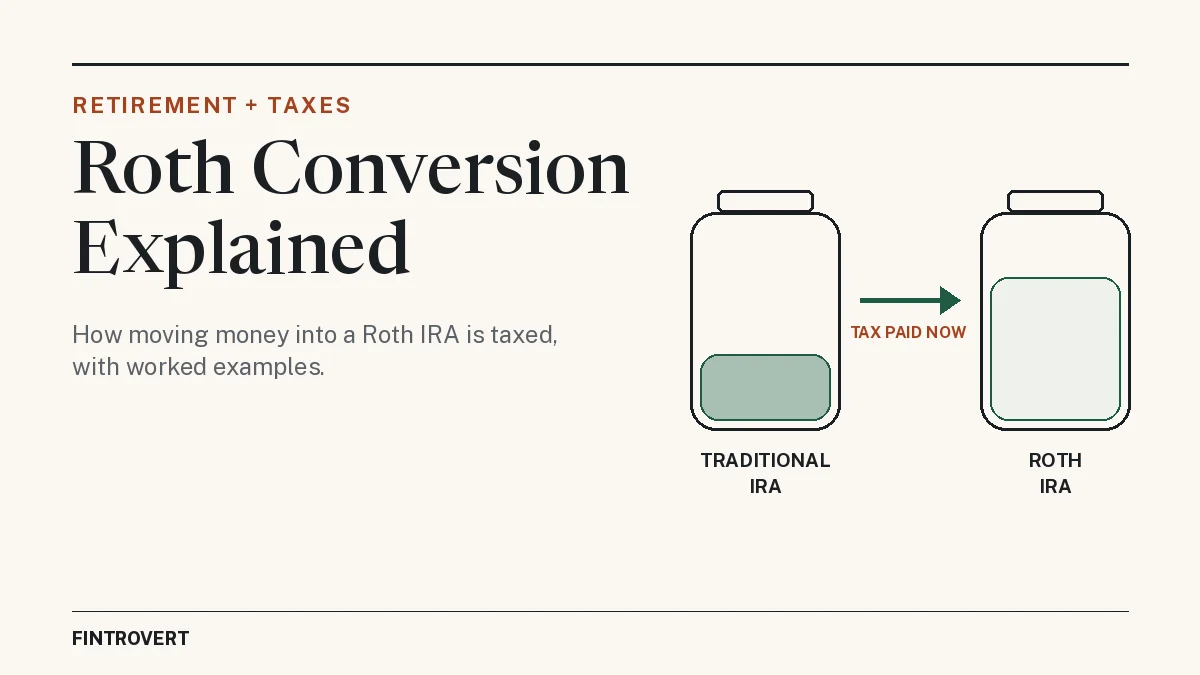

A Roth conversion means moving money from a traditional IRA (or a SEP or SIMPLE IRA) into a Roth IRA. You pay income tax on the converted amount now. In return, qualified withdrawals from the Roth later are tax-free. Whether that trade makes sense depends mostly on your tax bracket today compared with the bracket you expect in retirement.
This guide covers how a Roth conversion works, the IRS rules that trip people up, and three worked examples using the 2026 federal tax brackets.
How a Roth conversion works
The IRS lists three ways to convert a traditional IRA to a Roth IRA:
- Same-trustee transfer. Both accounts are at the same firm, and you ask it to move the money from one to the other.
- Trustee-to-trustee transfer. Your current firm sends the money straight to the firm that holds your Roth IRA.
- 60-day rollover. You take a distribution and deposit it in a Roth IRA within 60 days.
Whichever method you use, any untaxed amount you convert is added to your taxable income for the year. You report the conversion on Form 8606, Nondeductible IRAs. According to IRS Publication 590-A, if the conversion is done properly, the 10% additional tax on early distributions doesn’t apply to the amount converted.
The rules to know before you convert
There’s no income limit on conversions
Before 2010, you couldn’t convert if your modified adjusted gross income was over $100,000. That limit was removed starting in 2010, as the IRS explained in its 2010 fact sheet, and the IRS confirmed in IR-2013-21 that income limits no longer apply to Roth IRA conversions. Roth IRA contributions still have income limits, but conversions don’t.
You can’t undo a conversion
People used to be able to “recharacterize” a conversion, reversing it if the market dropped or the tax bill turned out bigger than expected. The Tax Cuts and Jobs Act ended that. The IRS says a conversion made on or after January 1, 2018, can’t be recharacterized. Once you convert, the tax is owed, so run the numbers first.
The pro-rata rule
If you’ve ever made nondeductible (after-tax) contributions to a traditional IRA, you can’t choose to convert only those after-tax dollars. Publication 590-B says that until all of your basis has been distributed, each distribution is partly nontaxable and partly taxable, and the calculation counts all of your traditional, SEP and SIMPLE IRAs together. Form 8606 is where you work out the split. Example 3 below shows how it plays out.
The two 5-year rules
Publication 590-B describes two separate clocks, and they’re easy to mix up.
- The conversion clock. Each conversion has its own 5-year period, starting January 1 of the year you convert. If you withdraw converted money that was taxable before that period ends, and you’re under 59½ with no exception, you may owe the 10% additional tax on that amount.
- The qualified distribution clock. For earnings to come out tax-free, the withdrawal must come after the 5-year period that begins with the first tax year you contributed to any Roth IRA, and you must also be 59½ or older, disabled, a beneficiary after the owner’s death, or using up to the first-time homebuyer limit.
The IRS gives this example: a conversion made on February 25, 2025, starts its 5-year period on January 1, 2025.
Roth conversion tax examples (2026 brackets)
These examples use the 2026 federal income tax brackets from IRS Revenue Procedure 2025-32. All figures are taxable income, meaning after the standard deduction ($16,100 single, $32,200 married filing jointly for 2026). They show federal income tax only. State tax and other income-based effects aren’t included.
| Rate | Single (2026 brackets) | Married filing jointly (2026 brackets) |
|---|---|---|
| 10% | $0 to $12,400 | $0 to $24,800 |
| 12% | Over $12,400 | Over $24,800 |
| 22% | Over $50,400 | Over $100,800 |
| 24% | Over $105,700 | Over $211,400 |
| 32% | Over $201,775 | Over $403,550 |
| 35% | Over $256,225 | Over $512,450 |
| 37% | Over $640,600 | Over $768,700 |
Example 1: Single filer, conversion stays in one bracket
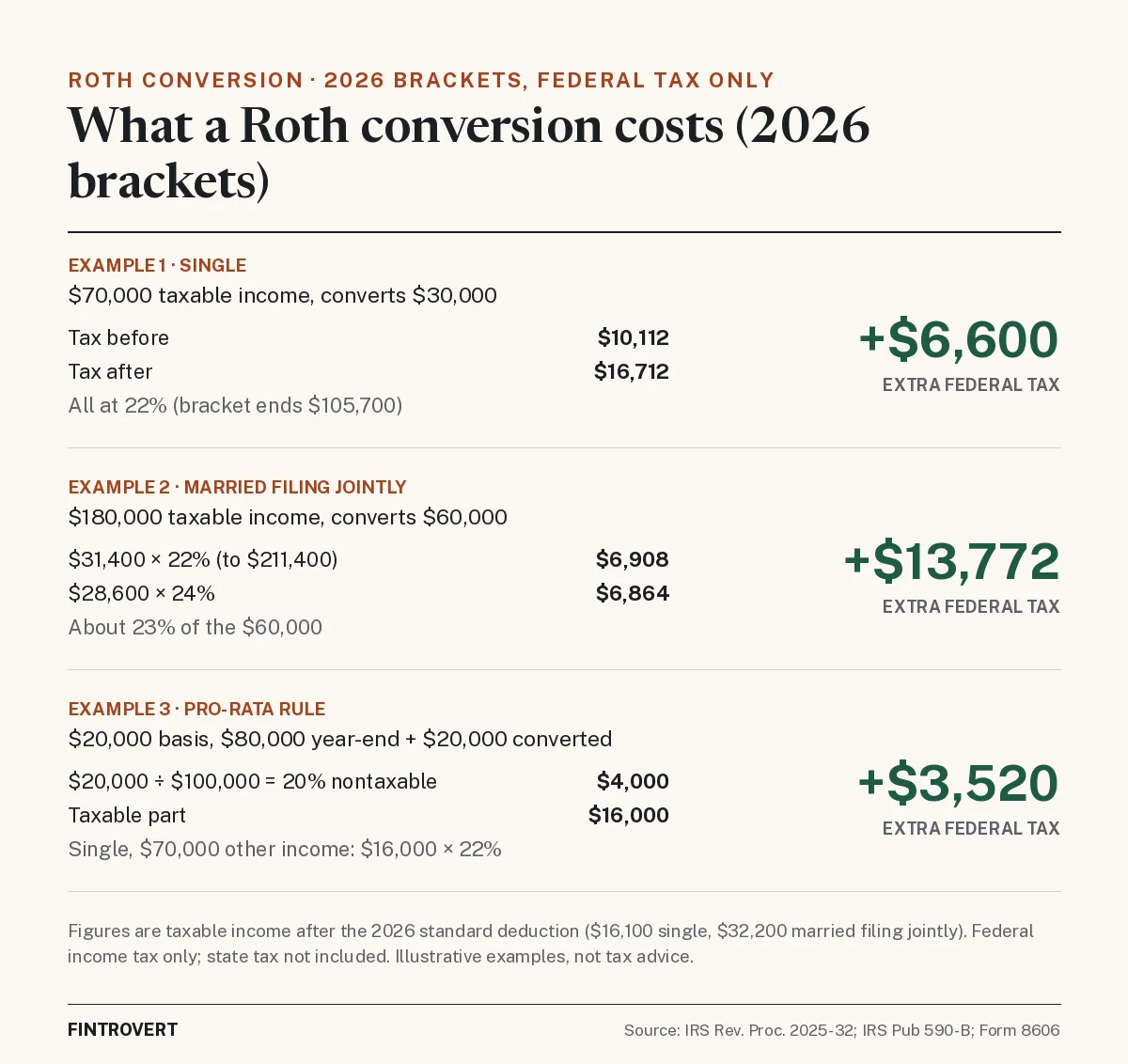
Maria is single with $70,000 of taxable income. She converts $30,000 of pre-tax traditional IRA money, which brings her taxable income to $100,000.
- Tax without the conversion: $12,400 × 10% = $1,240, plus $38,000 × 12% = $4,560, plus $19,600 × 22% = $4,312. Total: $10,112.
- Tax with the conversion: $1,240 + $4,560 + ($49,600 × 22% = $10,912). Total: $16,712.
- Extra tax from the conversion: $16,712 − $10,112 = $6,600, which is 22% of $30,000.
Her taxable income stays under the $105,700 top of the 22% bracket, so every converted dollar is taxed at 22%.
Example 2: Married couple, conversion crosses into 24%
James and Priya file jointly with $180,000 of taxable income. They convert $60,000, bringing them to $240,000.
- The first $31,400 fills the rest of the 22% bracket (up to $211,400): $31,400 × 22% = $6,908.
- The remaining $28,600 is taxed at 24%: $28,600 × 24% = $6,864.
- Extra tax from the conversion: $6,908 + $6,864 = $13,772, about 23% of the $60,000.
If they wanted to keep the whole conversion at 22%, they could convert $31,400 this year and more in later years. Many people spread conversions out like this to “fill up” a bracket each year.
Example 3: The pro-rata rule with after-tax money
Dan has $20,000 of nondeductible contributions (basis) across his traditional IRAs. He converts $20,000 during 2026 and takes no other withdrawals that year. At year end, his remaining traditional IRAs are worth $80,000.
- Total for the calculation: $80,000 year-end value + $20,000 converted = $100,000.
- Nontaxable share: $20,000 basis ÷ $100,000 = 20%.
- Nontaxable part of the conversion: $20,000 × 20% = $4,000. Taxable part: $16,000.
- If Dan is single with $70,000 of other taxable income, the $16,000 stays in the 22% bracket (2026 brackets): $16,000 × 22% = $3,520 extra tax.
Even though Dan converted exactly the amount of his after-tax contributions, most of the conversion is still taxable, because the IRS looks at all his traditional IRA money together. Form 8606 walks through this calculation: the December 31 value of all your traditional IRAs, plus any distributions and the amount converted, makes up the total that your basis is divided by.
How to do a Roth conversion, step by step
- Add up your traditional IRA money. List every traditional, SEP and SIMPLE IRA you own and any after-tax basis from past Forms 8606. You need both numbers for the pro-rata calculation.
- Estimate your taxable income for the year. Start with your expected income, subtract the standard deduction or your itemized deductions, and see where you land in the 2026 brackets.
- Pick a conversion amount. Work out how much room is left in your current bracket. Converting up to the top of that bracket keeps the whole amount at one rate, as in Example 1.
- Plan how you’ll pay the tax. Paying from savings outside the IRA keeps more money in the Roth. Any amount you take out and don’t move into the Roth isn’t part of the conversion, so it’s taxed as a regular IRA distribution.
- Ask your IRA provider to move the money. A same-trustee or trustee-to-trustee transfer avoids the 60-day deadline that comes with a rollover.
- Note the year. Write down the conversion year so you know when its 5-year period ends.
- File Form 8606. Report the conversion with your tax return for that year. Your provider will send a Form 1099-R showing the distribution.
Since the conversion adds to income in the year it happens, you may need to raise your withholding or make estimated tax payments so you aren’t short at filing time. The IRS explains the options in its guidance on estimated tax.
When a Roth conversion may make sense
A conversion tends to work best when your tax rate now is lower than the rate you expect to pay on withdrawals later. Common situations include a low-income year, such as a gap between jobs or the early years of retirement before other income starts. It also helps to have cash outside the IRA to pay the tax, so the full amount keeps growing in the Roth. If you’re comparing the two account types for new savings, try our Roth vs. traditional IRA calculator.
Keep in mind that the converted amount raises your income for the whole year, which can affect other income-based items on your return. Because a conversion can’t be undone, it’s worth running the numbers with a tax professional for larger amounts.
For more, see our Retirement and Taxes guides.
FAQ
Is there an income limit for a Roth conversion?
No. The IRS removed the income limit on conversions starting in 2010. Income limits still apply to direct Roth IRA contributions.
Can I reverse a Roth conversion?
No. Conversions made on or after January 1, 2018, can’t be recharacterized.
Which form do I use to report a conversion?
Form 8606, Nondeductible IRAs, filed with your tax return for the year you convert.
Will I pay the 10% early withdrawal tax on a conversion?
Not on a properly done conversion. But withdrawing taxable converted money within its 5-year period before age 59½ can trigger the 10% additional tax unless an exception applies.
This article is general information, not tax advice. Written by the Fintrovert Team.
Sources: IRS Publication 590-A; IRS Publication 590-B; IRS Form 8606; IRS Retirement Plans FAQs Regarding IRAs; IRS IR-2025-103 (Rev. Proc. 2025-32); IRS FS-2011-01; IRS IR-2013-21.