
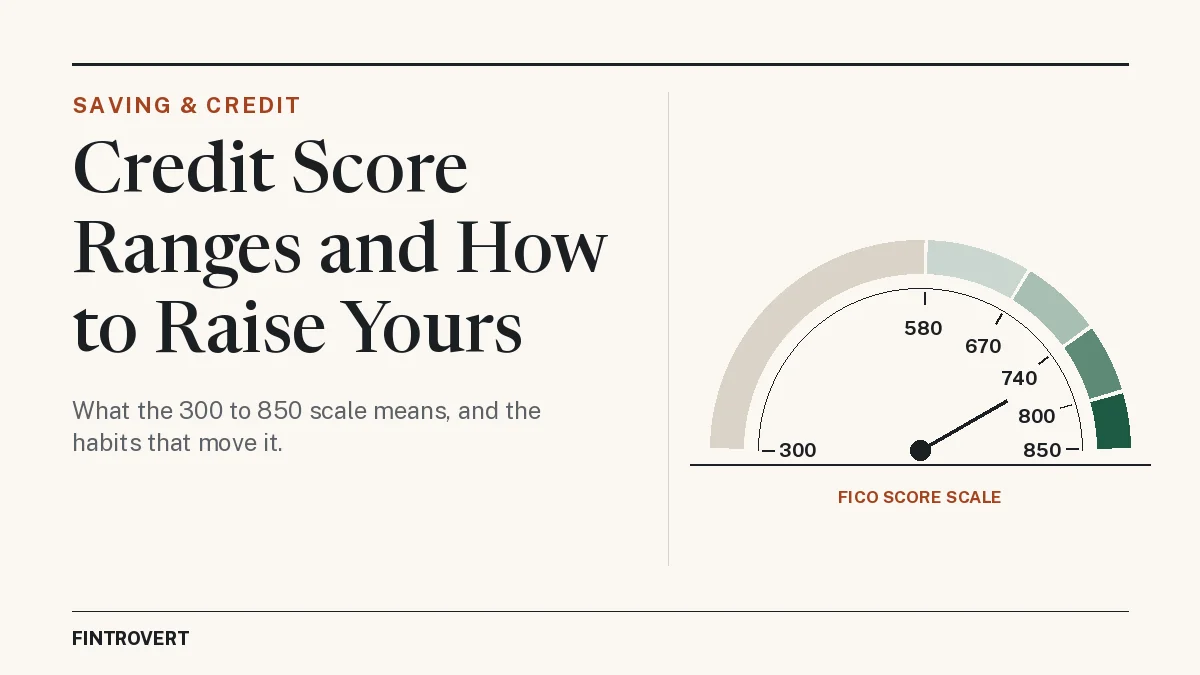

A credit score is a three-digit number, but it can change what you pay for a mortgage, a car loan, or a credit card. The good news is that the things that move your score are well documented, and most of them are within your control. This guide walks through the score ranges the two main models use, what goes into the number, and how to raise your credit score in practical steps.
What a credit score is
A credit score is a summary of the information in your credit reports, the files kept by the three nationwide credit bureaus: Equifax, Experian, and TransUnion. Lenders use it to judge how likely you are to repay what you borrow. According to myFICO, most credit scores run from 300 to 850, and a higher score means lower risk to a lender.
You don’t have just one score. There are different scoring companies, different versions of each model, and a separate score for each bureau’s report. Not every lender reports to all three bureaus, and they don’t all report on the same day, so your numbers can differ a bit from one report to the next. That’s normal.
Credit score ranges
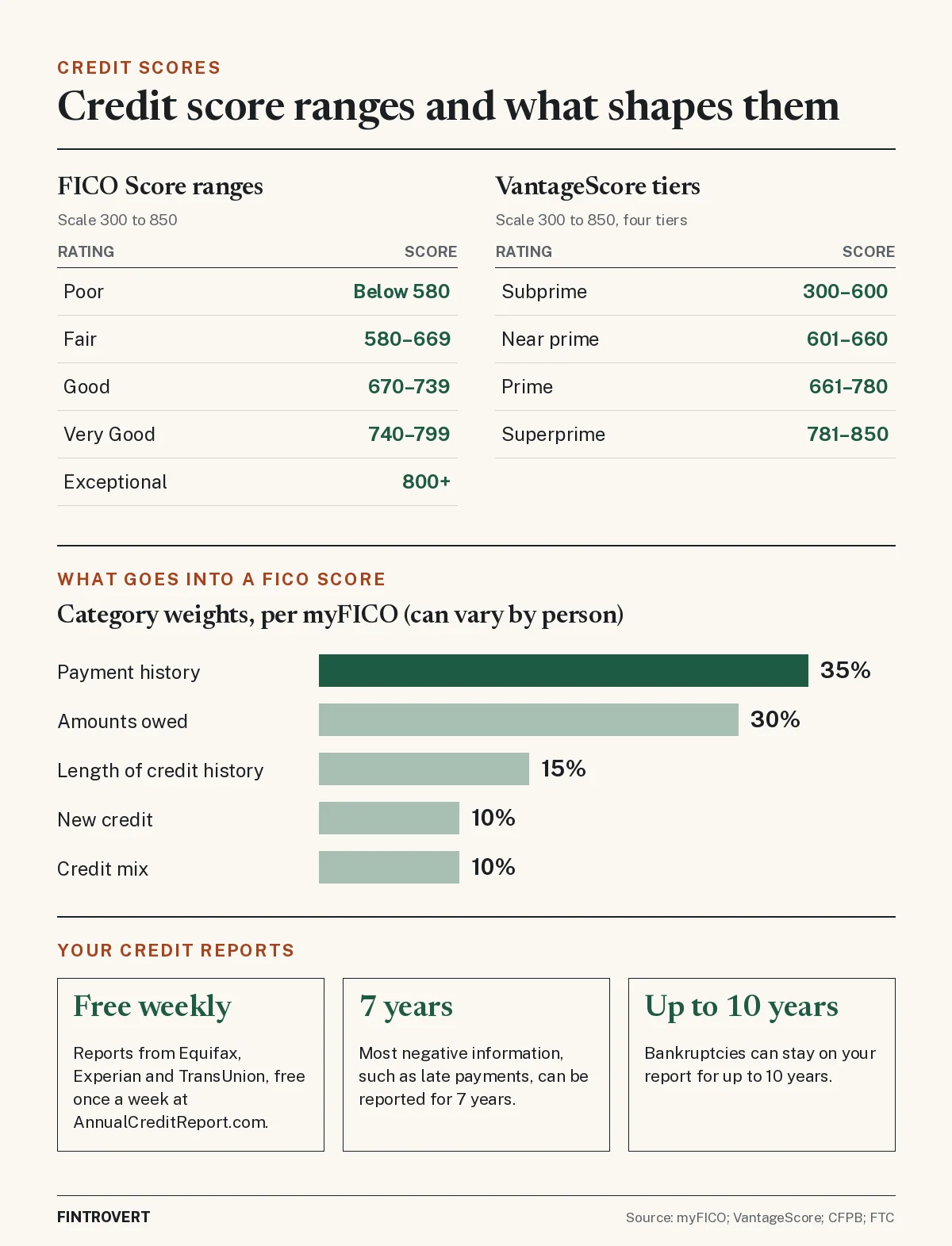
FICO Score ranges
FICO says its scores are used by 90% of top lenders. Here is how FICO describes its ranges:
| FICO rating | Score range |
|---|---|
| Poor | Below 580 |
| Fair | 580 to 669 |
| Good | 670 to 739 |
| Very Good | 740 to 799 |
| Exceptional | 800 and up |
FICO also notes there is no single minimum score that every lender requires. Each lender sets its own cutoffs and also looks at things like income and existing debt.
VantageScore ranges
VantageScore, the other major scoring company, also uses a 300 to 850 scale for its current models. VantageScore groups its scores into four tiers:
| VantageScore tier | Score range |
|---|---|
| Subprime | 300 to 600 |
| Near prime | 601 to 660 |
| Prime | 661 to 780 |
| Superprime | 781 to 850 |
The cutoffs don’t line up exactly with FICO’s, so a 665 could be “Fair” on one model and “Prime” on the other. When you see a score in an app or on a statement, check which model it comes from before you compare it with another number.
What goes into your score
FICO publishes the general weight of each category in its scores. Per myFICO, they break down like this:
- Payment history, 35%: whether you’ve paid past accounts on time.
- Amounts owed, 30%: how much you owe in total and how much of your available credit you’re using.
- Length of credit history, 15%: the age of your oldest and newest accounts and the average age of all of them.
- New credit, 10%: recently opened accounts and recent applications.
- Credit mix, 10%: the kinds of credit you have, such as cards, installment loans, and mortgages.
FICO points out that these weights can vary from person to person, depending on what’s in your report. It also lists what is not part of the score: your income, job, age, where you live, and your race, religion, sex, or marital status. A lender may still ask about income when you apply, but the score itself only looks at your credit report.
VantageScore weighs things differently. For VantageScore 4.0, the company lists payment history at 41%, depth of credit at 20%, credit utilization at 20%, recent credit at 11%, balances at 6%, and available credit at 2%. The wording is different, but the message is the same across both models: paying on time and keeping balances low matter most.
How to raise your credit score
There are no shortcuts here, but there is a clear order of priorities. Start with the habits that carry the most weight.
1. Check your credit reports for free
Your score is only as accurate as the reports behind it. You can get your reports from all three bureaus for free once a week at AnnualCreditReport.com, the only site authorized by federal law for this. Checking your own report does not affect your score. You can request all three at once or space them out.
Look for accounts you don’t recognize, late payments you’re sure you made on time, wrong balances, and duplicate entries. An unfamiliar account can be a sign of identity theft, and the FTC suggests reporting that at IdentityTheft.gov.
2. Dispute errors
If something is wrong, you have the right to dispute it, and it costs nothing. The FTC recommends contacting both the credit bureau and the business that reported the information. Explain in writing what is wrong, include copies (not originals) of documents that back you up, and keep records of everything you send. The bureau generally has 30 days to investigate, and it must give you the results in writing.
3. Pay every bill on time
Payment history is the single biggest piece of a FICO Score at 35%. Setting up automatic payments for at least the minimum due is one of the simplest ways to protect it. FICO notes that one or two late payments aren’t an automatic disaster if the rest of your history is good, but a steady record of on-time payments is what builds a strong score.
4. Use less of your available credit
Your credit utilization ratio is the share of your credit card limits you’re using. If you have $10,000 in total limits and carry $4,000 in balances, your ratio is 40%. FICO says using a high percentage of your available credit can hurt your score and using a low percentage can help. VantageScore suggests keeping it under 30% if possible.
Paying balances down is the most direct fix. If you’re working through several balances, our debt payoff calculator can help you plan an order and a timeline.
5. Be choosy about new applications
Each application for credit usually adds a hard inquiry to your report. FICO counts only inquiries from the last 12 months, though they stay on your report for two years. Opening several accounts in a short time can look risky, especially if your history is short. If you’re shopping for a single loan, VantageScore treats hard inquiries within a 14-day window as one inquiry, so it helps to do your rate shopping in a short stretch.
6. Let your accounts age
Length of history is 15% of a FICO Score, and it looks at the age of your oldest account and the average age of all of them. There is no quick way to speed this up. Keeping older accounts in good standing and avoiding a burst of new ones lets your average age grow over time.
7. Skip paid “credit repair”
The CFPB warns against paying upfront fees to companies that promise to “fix” your credit. No one can legally remove accurate negative information from your report. If your report has errors, you can dispute them yourself for free.
How long negative items stay on your report
Under federal law, accurate negative information doesn’t stay forever. According to the CFPB and the FTC:
- Most negative information, such as late payments, can be reported for 7 years.
- Bankruptcies can stay on your report for up to 10 years.
- Lawsuits and judgments can be reported for 7 years or until the statute of limitations runs out, whichever is longer.
The CFPB adds that these limits don’t apply when a report is pulled for a job paying more than $75,000 a year, or for more than $150,000 of credit or life insurance. Positive information, like a long record of on-time payments, can stay on your report longer, even after an account is closed.
As an old late payment ages, it tends to matter less. VantageScore notes that late payments stay on your report for seven years but their effect fades over time. So even if you have a rough patch behind you, the steps above still pay off.
Frequently asked questions
What is a good credit score?
On the FICO scale, a good score is 670 to 739. Very Good is 740 to 799, and Exceptional is 800 and up. On VantageScore, the Prime tier runs from 661 to 780.
Does checking my own credit hurt my score?
No. Checking your own reports, including through AnnualCreditReport.com, does not affect your credit scores.
How often can I get my credit reports for free?
Once a week from each of the three nationwide bureaus at AnnualCreditReport.com, with no credit card or subscription needed.
Does my income affect my credit score?
Not your FICO Score. FICO says salary, occupation, and employer aren’t part of the calculation, though lenders may consider income separately when you apply.
The bottom line
If you want to know how to raise your credit score, the answer comes down to a few steady habits: check your reports, fix real errors, pay on time, keep balances low, and apply for new credit only when you need it. Scores respond to your track record, so the sooner you start, the sooner the results show up. For more on borrowing and saving, visit our Saving & Credit hub.
Sources: myFICO, What is a credit score?; myFICO, What’s in your credit score?; VantageScore, The Complete Guide to Your VantageScore 4.0 Credit Score; AnnualCreditReport.com; FTC, Disputing Errors on Your Credit Reports; CFPB, How long does information stay on my credit report? This article is for general education and isn’t individual financial advice. By Fintrovert Team.