
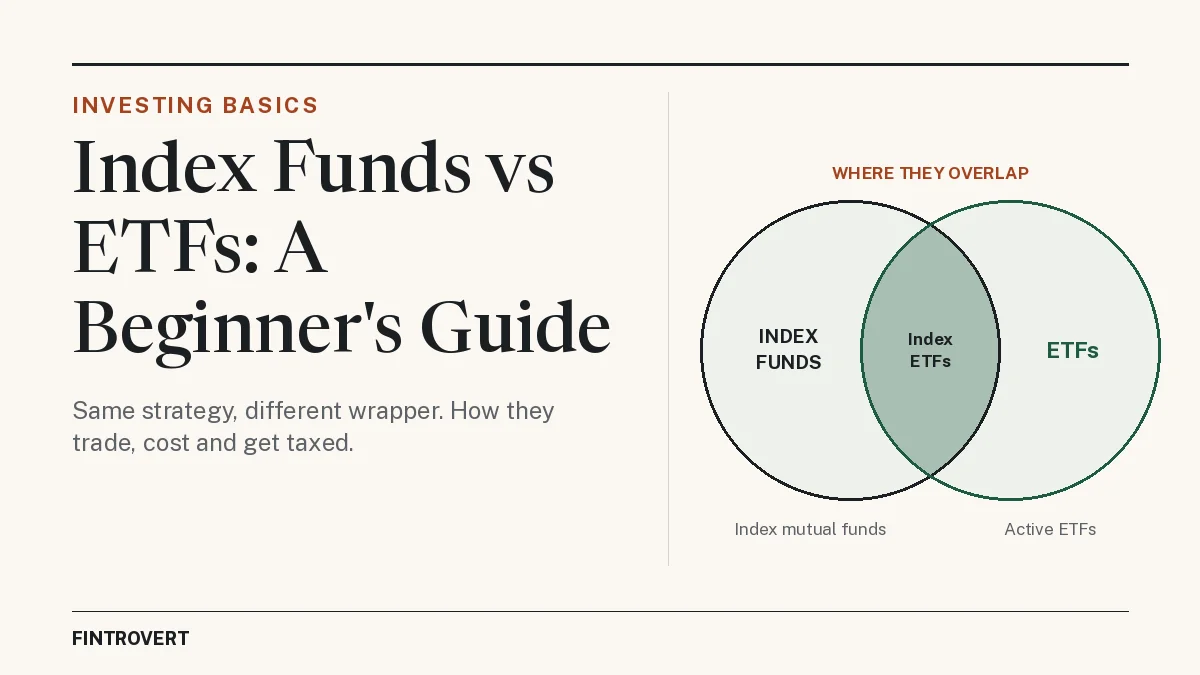

If you’re starting to invest, you’ll run into the question of index funds vs ETFs almost right away. The two get mentioned in the same breath so often that they can sound like rival products. They aren’t, exactly. An index fund describes a strategy, and an ETF describes a way a fund is built and traded. Plenty of funds are both. This guide sorts out what each term means, where the real differences show up, and what to look at before you buy either one.
What an index fund is
An index fund is a fund that tries to match the return of a market index, such as a broad U.S. stock index or a bond index, rather than trying to beat it. According to Investor.gov, the SEC’s site for individual investors, an index fund can be a mutual fund, an exchange-traded fund (ETF), or a unit investment trust. It follows a passive strategy, usually by holding the securities in the index or a representative sample of them.
The SEC notes that passive management usually means less trading inside the fund. That tends to bring lower transaction costs, smaller realized capital gains, and lower fees and expenses than actively managed funds, where a manager picks investments in hopes of doing better than the market.
What an ETF is
An ETF is a pooled fund whose shares trade on a stock exchange, much like shares of a company. The SEC’s investor bulletin on ETFs explains that ETFs are registered investment companies, usually managed by an SEC-registered investment adviser, and that each share represents a proportionate slice of the fund’s portfolio.
ETFs can be index-based or actively managed. An index ETF tries to track an index. An active ETF lets the manager buy and sell without sticking to one. So "ETF" tells you how the fund trades, not what it holds or how it invests.
Index funds vs ETFs: why they overlap
Here’s the part that clears up most of the confusion. When people compare index funds vs ETFs, they’re usually comparing two specific things: an index mutual fund and an index ETF. Both can track the very same index. The differences come from the wrapper, not the strategy.
A quick way to picture it: the strategy is either passive (index) or active, and the structure is either a mutual fund or an ETF. You can find all four combinations. The SEC’s bulletin comparing mutual funds and ETFs also warns that you can’t always tell which kind of fund you’re looking at from the name. Some ETFs don’t use "ETF" in their names, and some exchange-traded products that use it aren’t registered funds at all. The prospectus is where to check.
Where index mutual funds and index ETFs are alike
Per the SEC, the two structures share a lot:
- SEC registration. Both file registration statements with the SEC and provide a prospectus, which you can get free from the fund or the SEC’s EDGAR database.
- Pooled money. Your shares represent a proportional piece of the fund’s holdings, along with its gains and losses.
- Diversification. Both can spread your money across many companies, which can lower the damage if one company fails. Some funds are much narrower than others, though, and some ETFs track a single stock.
- Liquidity. You can sell shares of either easily, just through different routes.
- Ongoing costs. Both charge fees and expenses whether the fund goes up or down.
The real differences
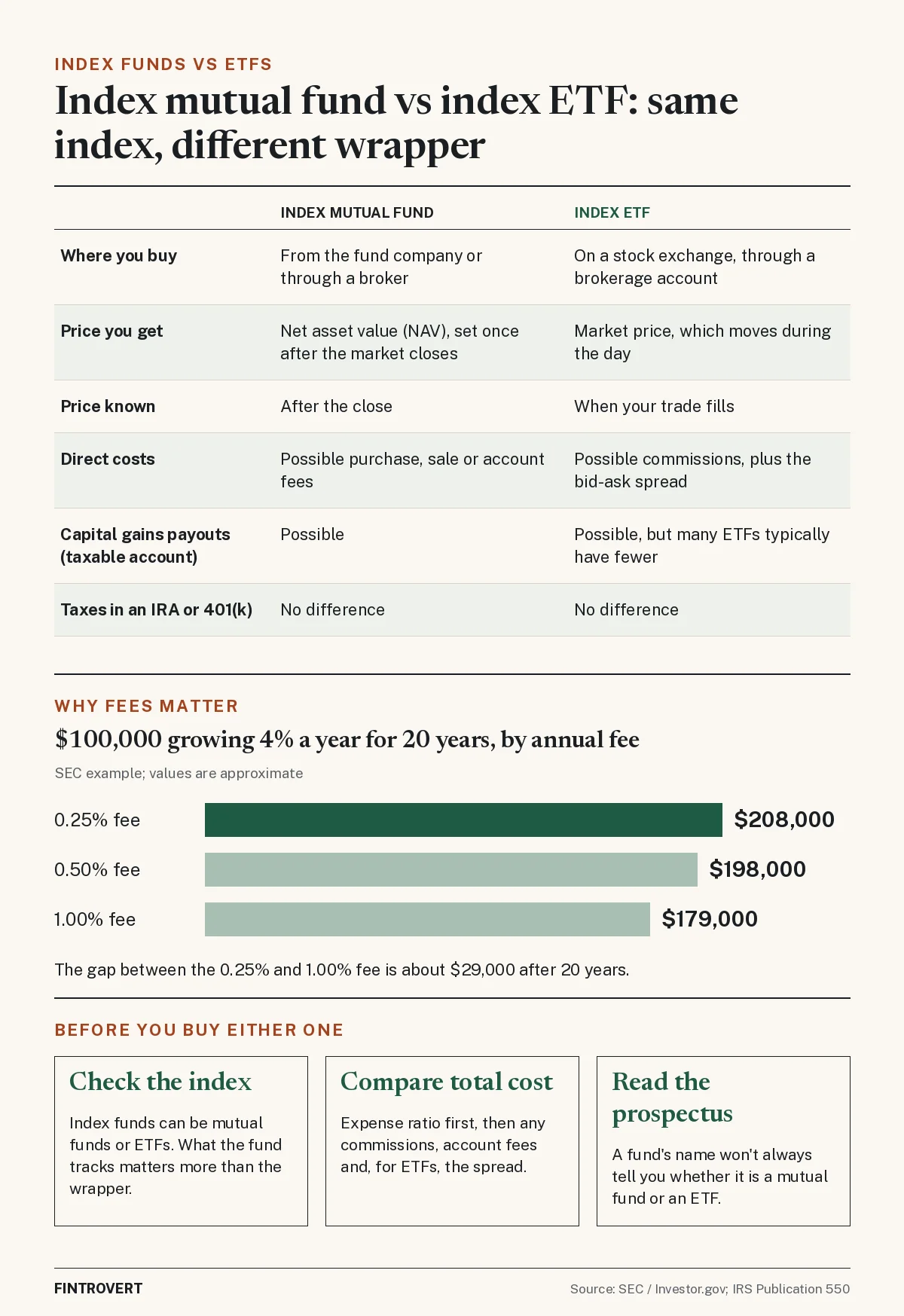
Most of what separates the two shows up when you buy, sell, or pay taxes. This table pulls the main points from the SEC’s comparison:
| Index mutual fund | Index ETF | |
|---|---|---|
| Where you buy | From the fund company directly or through a broker | On a stock exchange, through a brokerage account |
| Price you get | Net asset value (NAV), set once at the end of the business day | Market price, which moves during the trading day |
| When the price is known | After the market closes | When your trade fills |
| Typical direct costs | Possible purchase, sale, exchange, or account fees, depending on the fund | Possible broker commissions, plus the bid-ask spread |
| Capital gains distributions in a taxable account | Possible | Possible, but many ETFs typically have fewer |
| Taxes inside an IRA or 401(k) | No difference | No difference |
1. How you buy and sell
With a mutual fund, you buy shares from the fund itself or through an intermediary like a broker, and you sell them back to the fund. With an ETF, retail investors can only buy and sell in market transactions on an exchange, so the SEC says you need a brokerage account to buy, sell, and hold ETF shares. If your money is already in a brokerage account, that’s not much of a hurdle. If you’d rather open an account with a fund company and buy its funds directly, the mutual fund route can be simpler.
2. How they’re priced
A mutual fund prices its shares once each business day. Investor.gov explains that mutual funds generally calculate their net asset value, or NAV, after the major U.S. exchanges close, and you buy or sell at the next NAV calculated after you place your order. You can put in an order at 11 a.m., but you won’t know your exact price until the end of the day.
ETFs also calculate a NAV every business day, but you trade at the market price. That price moves during the day and can sit a little above the NAV (a premium) or below it (a discount). The SEC says an ETF’s market price generally stays close to its end-of-day NAV, but may vary significantly. If you buy at a premium or sell at a discount, your result can differ slightly from the fund’s reported performance.
For long-term investors adding money every month, intraday trading usually doesn’t matter much. It matters more to people who want to control exactly what price they pay, and it can be a temptation to trade more often than a long-term plan calls for.
3. Costs: expense ratios, commissions, and spreads
Both kinds of funds take an annual operating expense out of fund assets, shown in the prospectus as the expense ratio. The SEC’s ETF bulletin says ETFs have tended to be less expensive to operate than mutual funds that invest in a similar way, often passing those savings on as lower total fees. That’s a tendency, not a rule, so compare the actual numbers for the funds you’re considering.
ETFs come with a cost that mutual funds don’t: the bid-ask spread. The bid is the highest price a buyer will pay right now, and the ask is the lowest price a seller will accept. The SEC’s example uses an ETF quoted at $59.50/$60.00. Buy 200 shares at $60 and sell them right away at $59.50, and you’d lose $100 to the spread. ETFs with more trading volume typically have tighter spreads, and funds post their median bid-ask spread on their websites. You may also owe a broker commission on each ETF trade, depending on your broker.
Small differences in annual fees add up over time. In the SEC’s fees and expenses bulletin, a $100,000 investment growing 4% a year for 20 years ends up at about $208,000 with a 0.25% annual fee, about $198,000 with a 0.50% fee, and about $179,000 with a 1.00% fee. That’s roughly $29,000 lost to the higher fee. To see how growth compounds over different timelines, try our compound interest calculator.
4. Taxes in a regular brokerage account
This is the difference people mention most. When a fund sells holdings at a gain, it may pass those gains to shareholders as capital gains distributions, and you owe tax on them in a taxable account even if you didn’t sell any shares. The IRS says in Publication 550 that capital gain distributions from mutual funds are reported as long-term capital gains, regardless of how long you’ve owned the fund.
ETFs can pay capital gains distributions too. But the SEC notes that because many ETFs buy and sell portfolio securities through in-kind exchanges instead of for cash, they typically have fewer capital gains distributions, and thus lower taxes, than mutual funds. Index mutual funds already tend to trade less than active ones, so the gap between a given index mutual fund and a similar index ETF depends on the specific funds.
When you sell shares of either, the usual capital gains rules apply. Per IRS Topic 409, gains on assets held more than one year are generally long-term, and those held one year or less are short-term and taxed as ordinary income. If you want to estimate the tax on a sale, our capital gains tax calculator can help.
Inside a tax-advantaged account such as an IRA or 401(k), the SEC says there’s no tax difference between an ETF and a mutual fund. If you’re still deciding which kind of IRA to use, see our Roth vs. traditional IRA calculator.
5. Minimums and small amounts
The SEC says some mutual funds set relatively low minimums to buy in, and ETF shares can often be bought for relatively low dollar amounts. Some mutual funds require a larger first investment, so check the prospectus. With ETFs, the share price sets the minimum unless your broker offers fractional shares. FINRA notes that some brokers let you buy fractions of ETF shares by dollar amount, while others limit it or don’t offer it at all. FINRA also points out that fractional shares currently can’t be transferred to another brokerage firm, so you may have to sell them first if you move your account.
Which one fits a beginner?
Neither structure is better for everyone. Since an index mutual fund and an index ETF can track the same index, what you own can be nearly identical. These questions usually point the way:
- Where is your account? A workplace 401(k) offers a set menu of investment options chosen by the plan, so your choice may be made for you. In a brokerage account, you can usually buy both.
- Do you want to invest a set dollar amount? Mutual fund orders can be placed in dollars. With ETFs, buying an exact dollar amount depends on whether your broker offers fractional shares.
- Is the account taxable? In a regular brokerage account, an ETF’s typical tax efficiency can be a point in its favor. In an IRA or 401(k), it doesn’t matter.
- What are the total costs? Compare expense ratios first, then any commissions, account fees, or transaction fees, plus the spread for ETFs.
- Will intraday trading tempt you? If seeing prices move all day makes you want to act, the once-a-day pricing of a mutual fund can work as a speed bump.
Whichever you choose, the index matters more than the wrapper. A fund tracking the whole U.S. stock market behaves very differently from one tracking a single industry or a bond index. Read the fund’s investment objective and holdings before you buy.
ETFs to be careful with
Not every ETF is a plain index fund. The SEC has a separate investor bulletin on leveraged and inverse ETFs, which aim for a multiple of an index’s daily return or the opposite of it. Most reset daily, so over weeks or months their results can differ significantly from what the name suggests, and losses can be sudden. They’re built for short-term trading, not buy-and-hold investing. The SEC also notes that some ETFs track just one stock, which gives up the diversification most beginners are after.
Frequently asked questions
Is an ETF an index fund?
Sometimes. Many ETFs track an index, which makes them index funds. Others are actively managed. Check the fund’s investment strategy in its prospectus.
Are index funds or ETFs better for beginners?
Either can work. An index mutual fund and an index ETF tracking the same index will hold much the same investments. The better choice usually comes down to your account type, total costs, whether you want automatic purchases, and taxes if the account is taxable.
Why do ETFs often owe less tax than mutual funds?
Many ETFs move securities in and out through in-kind exchanges rather than selling them for cash, so they typically realize and distribute fewer capital gains. This only matters in a taxable account.
Do I need a brokerage account to buy an ETF?
Yes. Retail investors buy and sell ETF shares on an exchange, so you need a brokerage account. Mutual funds can be bought directly from the fund company or through a broker.
Can I lose money in an index fund or ETF?
Yes. Both rise and fall with the investments they hold. Matching an index means you get its losses as well as its gains.
The bottom line
The index funds vs ETFs question is really about structure. If you want broad, low-cost market exposure, you can get it either way. Index mutual funds price once a day and can be bought straight from a fund company. Index ETFs trade all day through a brokerage account and are often more tax efficient in a taxable account. Compare total costs, check what index the fund tracks, and pick the format that fits how you’ll actually invest. For more on building a long-term plan, visit our Investing hub, and if you’re investing for retirement, read our guide to Roth conversions.
Sources: Investor.gov, Index Fund; SEC Investor Bulletin, Characteristics of Mutual Funds and Exchange-Traded Funds (ETFs); SEC Updated Investor Bulletin, Exchange-Traded Funds (ETFs); Investor.gov, Net Asset Value; SEC Investor Bulletin, How Fees and Expenses Affect Your Investment Portfolio; SEC Updated Investor Bulletin, Leveraged and Inverse ETFs; FINRA, Investing in Fractional Shares; IRS Publication 550; IRS Topic No. 409, Capital Gains and Losses. This article is for general education and isn’t individual investment or tax advice. It doesn’t recommend any specific fund. By Fintrovert Team.