

A high yield savings account is a plain savings account that pays more interest than the typical one. There’s no trick to it. You deposit money, the bank or credit union pays you interest, and you can take the money out when you need it. The main difference is the rate, and that difference can add up over a few years.
This guide covers how these accounts work, how they’re protected, what the interest means at tax time, and what to check before you open one. We don’t list any bank’s current rate here, because rates change often and we’d rather point you to sources you can check yourself.
What is a high yield savings account?
Legally, it’s just a savings account. “High yield” is a marketing term, not a regulatory category. Banks use it for savings accounts that pay well above the national average. Many are offered by online banks, which have lower branch costs, but some traditional banks and credit unions offer them too.
For a sense of what “average” means, the FDIC publishes a national rate for savings accounts every month. In its update dated October 19, 2026, the national savings rate was 0.38% (based on the $2,500 product tier), according to the FDIC’s National Rates and Rate Caps page. An account advertised as high yield is usually paying a good deal more than that figure.
How a high yield savings account works
You deposit money
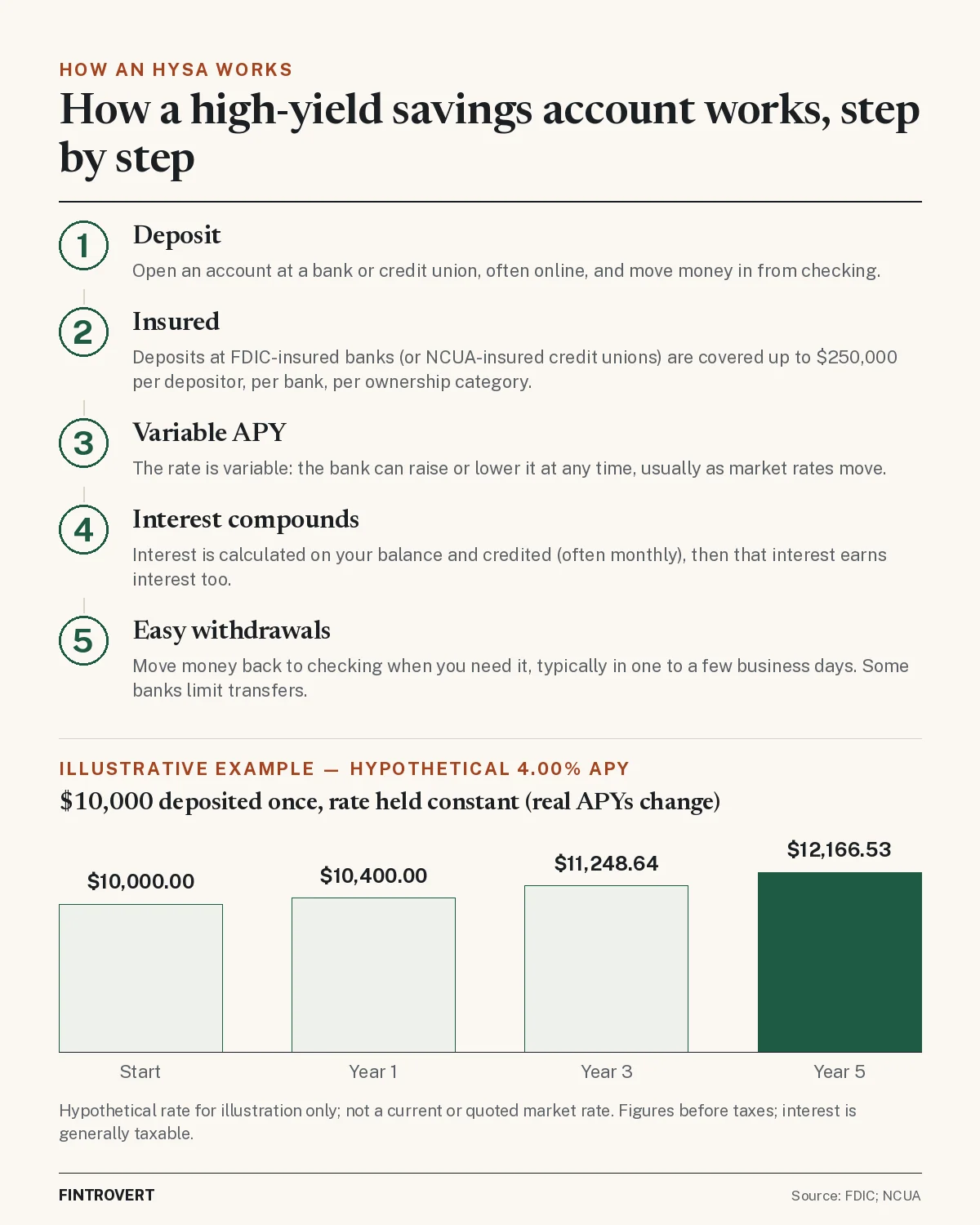
You open the account, often online, and link it to your checking account. Then you move money in, either as a one-time transfer or on a schedule. Some people set up a recurring transfer on payday so saving happens without much thought.
The rate is variable
Most savings accounts pay a variable rate. Under the CFPB’s Truth in Savings rules (Regulation DD), a variable-rate account is one where the interest rate can change after you open it. In practice, savings rates tend to rise and fall along with broader interest rates. The rate you see on the day you sign up is not a promise for the future.
Interest compounds
Banks advertise savings rates as an annual percentage yield, or APY. Regulation DD defines APY as a rate that reflects the total interest paid on an account over a 365-day period, based on both the interest rate and how often interest compounds. That’s why APY is the number to compare. Once interest is credited to your balance, that interest starts earning interest too.
Here’s an illustrative example using a hypothetical 4.00% APY. This is not a current or quoted market rate. If you deposited $10,000 once and the rate never changed, you’d have about $10,400 after one year, $11,248.64 after three years and $12,166.53 after five years, before taxes. Real APYs move, so treat this as a picture of how compounding works, not a forecast.
If you want to try your own numbers, our compound interest calculator lets you change the deposit, rate and time frame.
You withdraw when you need it
When you need the money, you transfer it back to checking. Transfers between banks usually aren’t instant and often take a business day or more, so it’s worth checking your bank’s stated timing before you rely on the account for a bill that’s due tomorrow.
Is there still a six-withdrawal limit?
Not under federal rules. For years, the Federal Reserve’s Regulation D limited “convenient” transfers and withdrawals from savings accounts to six per month. On April 24, 2020, the Federal Reserve Board announced an interim final rule that deleted that six-per-month limit from the savings deposit definition and let banks allow unlimited convenient transfers.
The catch is that banks were allowed to drop the limit, not required to. Some still cap the number of transfers or charge a fee for going over. Read the account agreement or fee schedule so you know where your bank stands.
Is your money safe?
FDIC insurance at banks
At an FDIC-insured bank, savings accounts are covered by deposit insurance. According to the FDIC, coverage is $250,000 per depositor, per FDIC-insured bank, for each account ownership category. Ownership categories include single accounts, joint accounts, certain retirement accounts such as IRAs, and trust accounts, among others.
That means a single account and a joint account at the same bank are insured separately. But two single accounts at the same bank, such as your checking and your savings, are added together and share one $250,000 limit. The FDIC also notes that insurance covers deposits only, not stocks, bonds, Treasury securities or crypto, even if you bought them through an insured bank. You can confirm a bank is insured with the FDIC’s BankFind tool.
NCUA insurance at credit unions
Credit unions call savings accounts “share accounts,” and federally insured credit unions are covered by the National Credit Union Share Insurance Fund. According to the NCUA’s MyCreditUnion.gov, each member has at least $250,000 in coverage for share accounts at a federally insured credit union, and the fund is backed by the full faith and credit of the United States government. Some state-chartered credit unions use private insurance instead, which does not carry that federal backing, so check before you join.
Watch out for non-bank apps
Some savings products are offered by financial apps that partner with banks rather than being banks themselves. The FDIC states that its insurance does not cover the default or bankruptcy of a non-FDIC-insured company. If you use an app, find out which insured bank actually holds your money.
How interest is taxed
Interest from a savings account is taxable income. The IRS says in Topic No. 403 that most interest credited to an account you can withdraw from without penalty is taxable in the year it becomes available to you. That’s true for credit union “dividends” on share accounts as well, which the IRS treats as interest.
If you earn $10 or more in interest from one institution, it should send you a Form 1099-INT, per the IRS. Earned less than that? You still have to report it. The IRS is clear that all taxable interest must go on your return, even if no form arrives.
If your savings interest is large, the IRS also notes you may need to make estimated tax payments so you don’t owe a lump sum in April.
What to check before you open one
- Insurance. Confirm the bank is FDIC-insured or the credit union is federally insured by the NCUA.
- The APY and any conditions. Some accounts pay the top rate only on certain balances or if you meet requirements like a monthly deposit. Regulation DD calls accounts with different rates for different balances tiered-rate accounts.
- Fees and minimums. A monthly fee can cancel out much of the interest on a smaller balance.
- Transfer rules. Look for any limit on monthly withdrawals and how long transfers to your checking account take.
- Bonuses. A sign-up bonus is nice, but it’s a one-time payment. The ongoing rate matters more over time.
When a high yield savings account makes sense
These accounts are a good home for money you want to keep safe and reachable: an emergency fund, a house down payment you plan to use in a year or two, or savings for a big trip. Not sure how much to keep on hand for emergencies? Our emergency fund calculator can help you land on a target.
They’re less suited to long-term goals like retirement. A savings rate can fall at any time, and over decades, cash has historically struggled to keep pace with investments. If you know you won’t touch the money for a set period, a certificate of deposit might lock in a rate instead, though you’d usually pay a penalty to withdraw early.
For more on building savings and managing credit, browse our Saving & Credit hub.
FAQ
Can I lose money in a high yield savings account?
Not from market swings, since it’s a deposit account and not an investment. Your balance is protected up to the FDIC or NCUA limits at an insured institution. Fees and inflation can still eat into what your money is worth over time.
Can the bank lower my rate?
Yes. Most savings accounts are variable-rate accounts, so the rate can go down as well as up after you open the account.
Do I pay tax on the interest?
Yes. Savings interest is taxable income. You should get a Form 1099-INT if you earned $10 or more at one institution, but you have to report all of it either way.
What if I have more than $250,000 to save?
You can spread money across different insured banks, or use different ownership categories at the same bank, such as a single account and a joint account. The FDIC’s Electronic Deposit Insurance Estimator (EDIE) can show how much of your money is covered.
Sources: FDIC, Understanding Deposit Insurance; FDIC, National Rates and Rate Caps (October 19, 2026); NCUA, Share Insurance; Federal Reserve Board press release, April 24, 2020; CFPB, Regulation DD § 1030.2; IRS Topic No. 403; IRS, About Form 1099-INT. This article is general information, not personal financial advice. By Fintrovert Team.