

A 529 plan is one of the most useful ways to save for a child’s education in the US. Your money can grow without federal tax, and withdrawals stay tax-free when they pay for qualified education costs. Recent law changes also made these accounts more flexible, especially for K-12 families. This guide covers how a 529 plan works, what counts as a qualified expense, what happens if you take money out for something else, the gift tax rules, the newer 529 to Roth IRA rollover and how a 529 affects financial aid.
What is a 529 plan?
A 529 plan gets its name from Section 529 of the Internal Revenue Code. The IRS calls it a qualified tuition program. It’s set up by a state, a state agency or an educational institution, and it lets you save for a beneficiary’s education costs with tax advantages.
According to the SEC’s Investor.gov, there are two types:
- Education savings plans. You open an investment account, usually choosing from a menu of mutual fund style portfolios. The account value goes up or down with the markets.
- Prepaid tuition plans. You pay today for future tuition at participating colleges, often at today’s prices. These are offered by some states and some colleges, and they usually come with more restrictions.
Most people who say “529 plan” mean the education savings type, so that’s the focus here.
How the tax benefits work
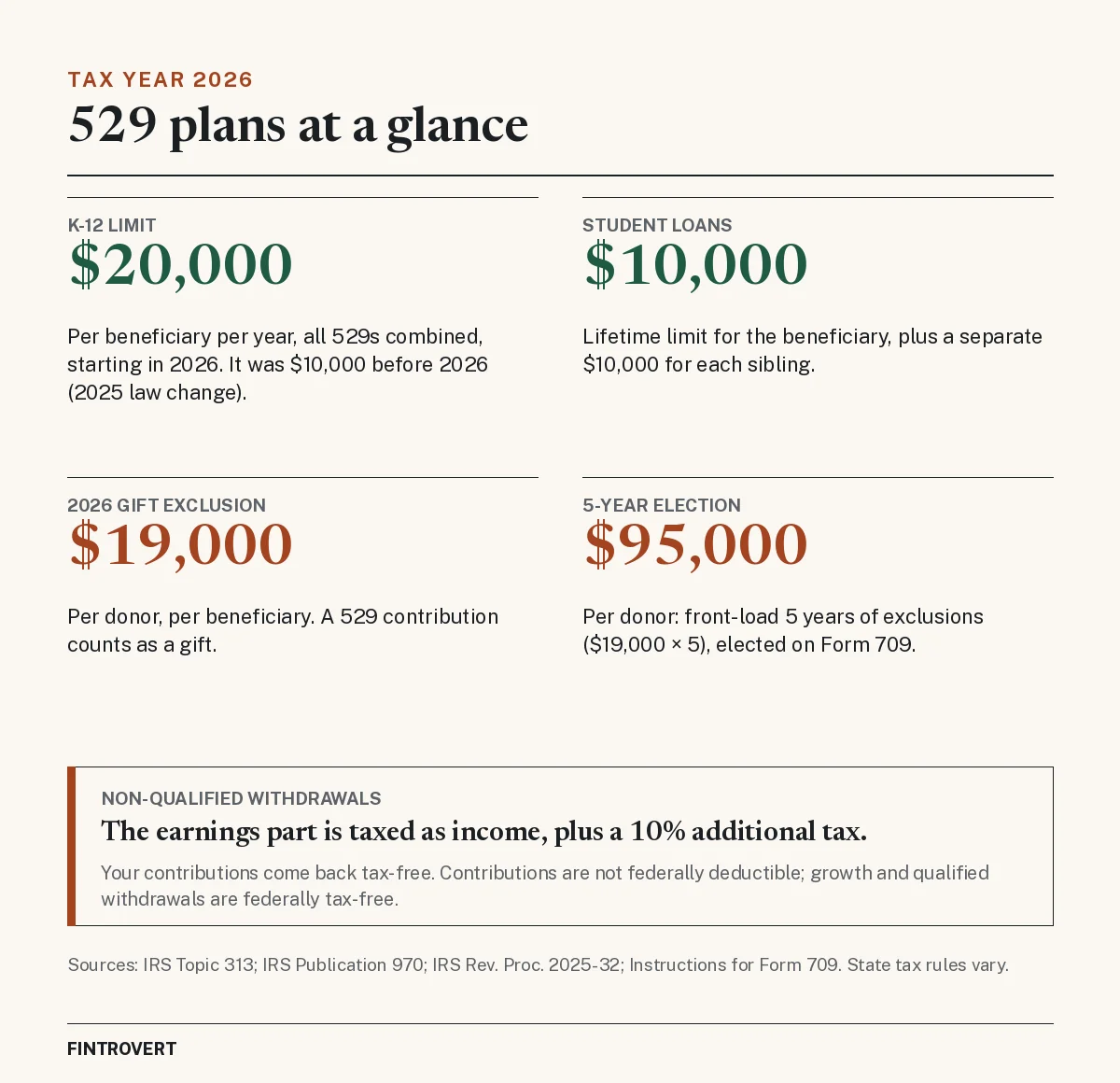
Contributions to a 529 plan are not deductible on your federal return. The benefit comes later. Per IRS Topic 313 and IRS Publication 970, earnings grow without federal tax, and withdrawals are tax-free as long as they don’t exceed the beneficiary’s qualified education expenses for the year.
In practice, that means the longer the money stays invested, the more of your balance can come from earnings you never pay federal tax on, provided you use them for school.
What counts as a qualified expense
The list has grown in the last few years. Based on IRS Topic 313 and Publication 970, qualified expenses include:
- College and other postsecondary school costs. Tuition, fees, books, supplies and equipment required for enrollment at an eligible school. That generally means any college, university, vocational school or other postsecondary school that can take part in federal student aid programs run by the Department of Education.
- Room and board for students enrolled at least half-time, within limits set by the school’s cost of attendance.
- Computers, software and internet access used mainly by the beneficiary while enrolled.
- Registered apprenticeship costs. Fees, books, supplies and equipment for an apprenticeship program registered and certified with the Department of Labor.
- Student loan payments. Up to $10,000 in total (a lifetime amount) toward principal or interest on qualified student loans of the beneficiary, plus a separate $10,000 for each of the beneficiary’s siblings.
- Postsecondary credential costs. Tuition, fees, books and testing or continuing education fees for recognized credential programs, such as certain professional licenses and certifications.
- K-12 costs, covered in the next section.
The K-12 limit is now $20,000 a year
The One Big Beautiful Bill Act, signed July 4, 2025, made two changes for elementary and secondary school (kindergarten through grade 12). According to IRS Topic 313:
- Higher limit. Starting in 2026, you can withdraw up to $20,000 per year per beneficiary for K-12 expenses, counting all of that beneficiary’s 529 accounts together. Before 2026 the limit was $10,000, and it only covered tuition.
- More kinds of expenses. K-12 qualified expenses now also include curriculum and curricular materials, books and other instructional materials, online educational materials, tutoring or classes outside the home (if the tutor isn’t related to the student and is a licensed teacher, has taught at an eligible school or is a subject matter expert), fees for standardized achievement tests, AP exams and college admission exams, dual enrollment fees and educational therapies for students with disabilities provided by a licensed or accredited provider.
Public, private and religious schools all count. One caution: whether your state treats these K-12 withdrawals as qualified for state tax purposes is up to your state, so check your plan’s rules before you use the money this way.
What if you take money out for something else?
If you withdraw more than your qualified expenses, only the earnings part of that excess is taxable. Your original contributions come back to you tax-free because you already paid tax on that money. Per Publication 970, the taxable earnings are:
- included in your income and taxed at your regular federal income tax rate, and
- generally hit with a 10% additional tax on top of that.
The 10% additional tax doesn’t apply in some cases, including withdrawals made after the beneficiary dies or becomes disabled, and withdrawals up to the amount of a tax-free scholarship, veterans’ educational assistance or employer-provided educational assistance the student received. Regular income tax on the earnings still applies in those cases.
If the beneficiary doesn’t need the money, you also have options short of withdrawing it. You can change the beneficiary to another eligible family member without tax, or move money to another 529 plan, as Publication 970 explains.
How much can you contribute?
There’s no federal annual contribution limit specific to 529 plans. Each plan sets its own total cap, which, per IRS Topic 313, can’t be more than what’s needed to cover the beneficiary’s qualified expenses. Check your plan for its exact maximum.
Gift tax rules matter more for most savers. A 529 contribution counts as a gift to the beneficiary. Under IRS Rev. Proc. 2025-32, the annual gift tax exclusion for 2026 is $19,000 per recipient. You can give up to that much to any one person in 2026 without filing a gift tax return.
The 5-year election for big contributions
529 plans have a special rule that lets you front-load a contribution. If you put in more than the annual exclusion for one beneficiary, you can elect to treat up to five years’ worth of exclusions as if the gift were spread evenly over five years. The election is made on Form 709, as described in the IRS Form 709 instructions.
With the 2026 exclusion of $19,000, that means one person can contribute up to $95,000 ($19,000 x 5) for a beneficiary in 2026 and treat it as $19,000 a year for 2026 through 2030. A married couple where each spouse makes the election could put in up to $190,000 for the same child. Two things to keep in mind:
- You still need to file Form 709 to make the election, even if no tax is owed.
- If you give that same person other gifts during the five years, they count against the same exclusion, so the election uses up your annual room for that beneficiary.
Rolling a 529 into a Roth IRA
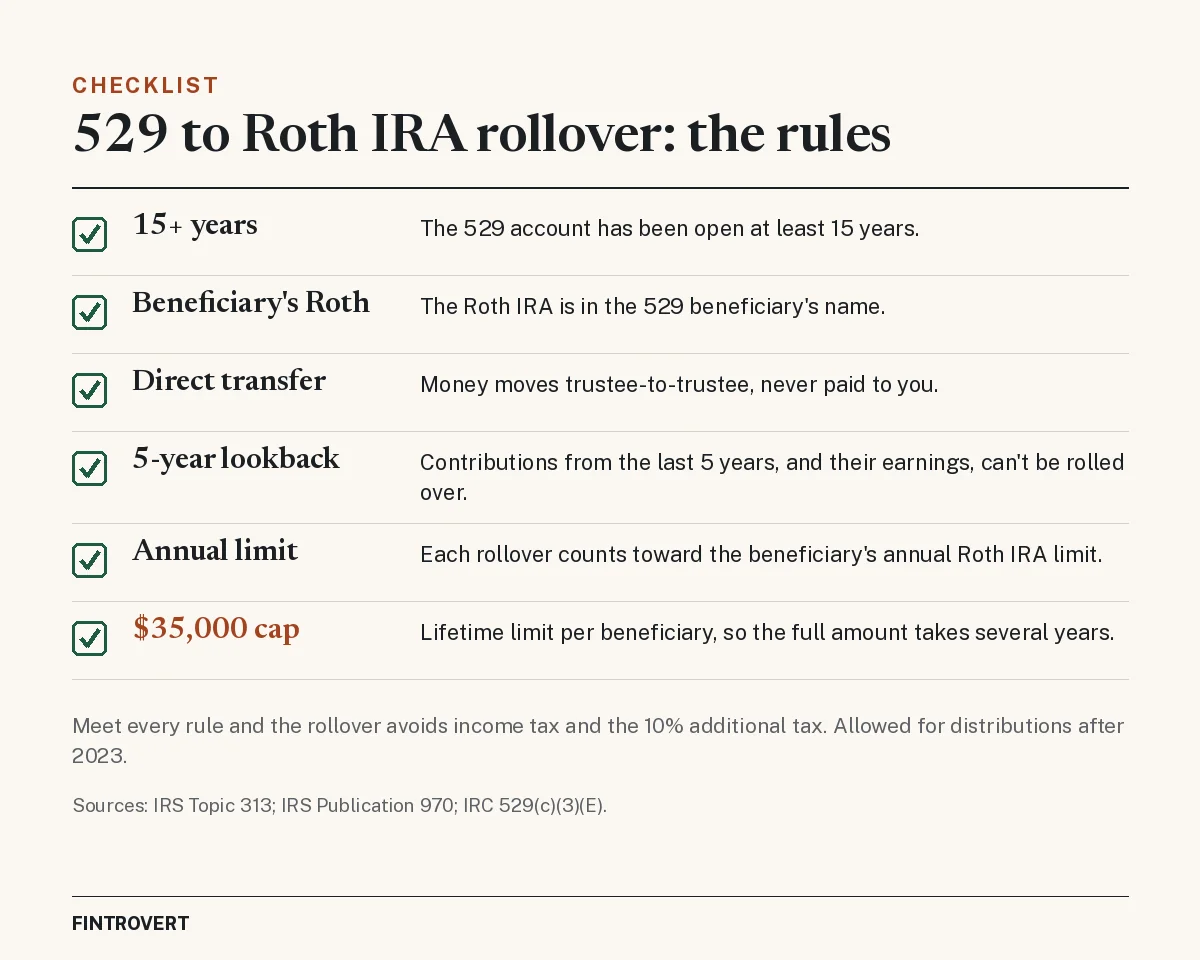
Since 2024, leftover 529 money can move into a Roth IRA for the beneficiary without income tax or the 10% additional tax, if it meets the rules in IRS Topic 313 and Publication 970:
- The 529 account must have been open for at least 15 years.
- The Roth IRA must belong to the 529 beneficiary.
- The money must move by a direct trustee-to-trustee transfer.
- You can’t roll over contributions made in the last 5 years, or the earnings on them.
- Each year’s rollover counts toward the beneficiary’s annual Roth IRA contribution limit, together with any other Roth IRA contributions they make that year.
- There’s a $35,000 lifetime limit per beneficiary.
Because of the annual limit, moving the full $35,000 takes several years. This rule makes it less risky to save in a 529 for a young child, since money that isn’t needed for school can give them a head start on retirement. If you’re weighing a Roth against a traditional IRA, our Roth vs traditional IRA calculator can help, and our guide to Roth conversions covers another way money moves into a Roth.
State tax breaks vary
Federal rules are the same everywhere, but state rules are not. As Investor.gov notes, some states offer extra benefits, such as a state income tax deduction for contributions or matching grants, and these can come with restrictions. Some states give the break only for their own plan, and others don’t have a state income tax at all. Check what your state offers before you pick a plan.
How a 529 affects financial aid
On the FAFSA, a 529 owned by a parent is reported as a parent asset when the student has to report parent information, according to the 2026-27 FAFSA form from the Department of Education. If the student doesn’t have to report parent information, it’s reported as the student’s asset. Parents don’t report 529 accounts they hold for their other children.
Investor.gov points out that money in a 529 will generally affect need-based aid eligibility, and that colleges treat these assets differently for their own aid. It also reminds families that, for many, the larger part of an aid package may be loans. So the effect is real, but saving usually still leaves you better off than borrowing. You can read more on StudentAid.gov.
How to get started
- Look at your state’s plan first and see whether it offers a state tax break for contributions.
- Compare fees and investment options. Investor.gov suggests checking each plan’s offering circular for fees and expenses, since they reduce your returns over time.
- Pick an investment option. Many plans offer age-based portfolios that get more conservative as the beneficiary nears school age.
- Set up automatic contributions, even small ones. Relatives can often contribute too.
- Keep receipts for every expense you pay with 529 money, so you can match withdrawals to qualified costs in the same year.
If you’re building other savings goals at the same time, our guides to sinking funds and high-yield savings accounts can help with money you’ll need sooner. For longer-term investing outside a 529, see index funds vs ETFs.
The bottom line
A 529 plan gives you tax-free growth and tax-free withdrawals for a wide range of education costs, now including up to $20,000 a year for K-12. Watch out for non-qualified withdrawals, which bring income tax plus a 10% additional tax on the earnings. Use the 2026 gift exclusion of $19,000, or the 5-year election, to plan larger gifts, and remember the Roth IRA rollover if money is left over. For more ways to save, visit our Saving & Credit hub.
Written by the Fintrovert Team. Last updated November 5, 2026. For more tax topics, visit our Taxes hub. This article is for general educational purposes and isn’t personalized tax or financial advice. Figures reflect IRS guidance for the 2026 tax year. State rules differ, so check your plan’s offering circular.