

If you have cash you want to keep safe but would like it to earn something, you have probably heard people talk about Treasury bills. T-bills, notes and bonds are all ways to lend money to the US government, and they work in slightly different ways. The big differences come down to how long your money is tied up and how you get paid. This guide walks through each one in plain English, how to buy them, what the minimums are and how they’re taxed.
What are Treasury securities?
Treasury securities are debt issued by the US Department of the Treasury to help pay for the federal government’s operations. When you buy one, you are lending the government money, and it promises to pay you back with interest. According to TreasuryDirect, all of these securities are backed by the full faith and credit of the United States government. The SEC’s Investor.gov notes that this is why they are considered one of the safest investments.
Bills, notes and bonds are called “marketable” securities. That means you can hold one until it matures or sell it to someone else before then. They are not the same thing as US savings bonds like I bonds or EE bonds, which are registered to you and can’t be sold to another person.
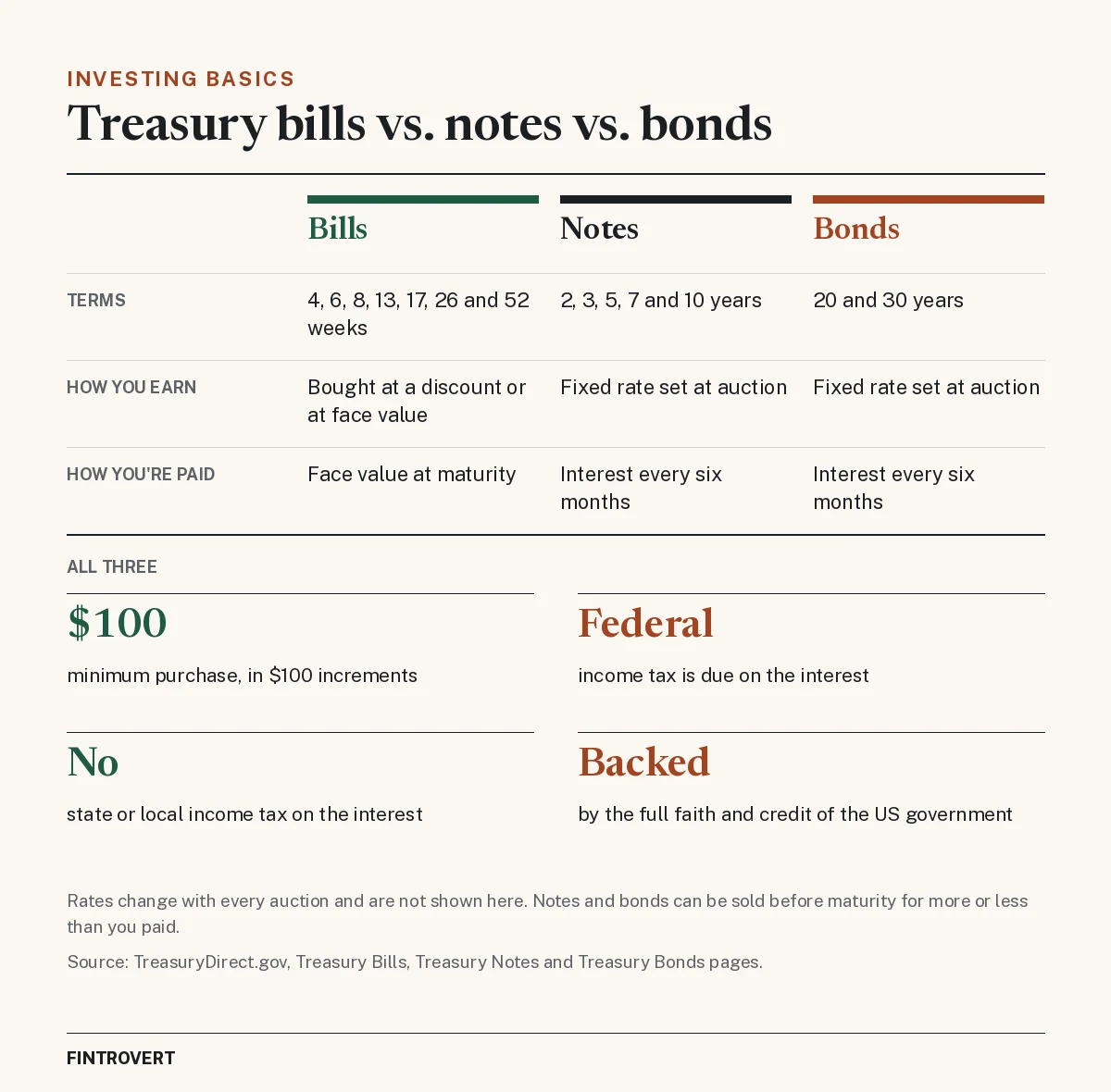
Treasury bills, notes and bonds at a glance
| Treasury bills | Treasury notes | Treasury bonds | |
|---|---|---|---|
| Terms | 4, 6, 8, 13, 17, 26 and 52 weeks | 2, 3, 5, 7 and 10 years | 20 and 30 years |
| How you earn | Bought at a discount or at face value, paid face value at maturity | Fixed interest every six months | Fixed interest every six months |
| Minimum | $100 | $100 | $100 |
| Increments | $100 | $100 | $100 |
| Federal income tax | Yes | Yes | Yes |
| State and local income tax | No | No | No |
Treasury bills: short term, sold at a discount
Treasury bills are the short-term option. TreasuryDirect sells them in terms of 4, 6, 8, 13, 17, 26 and 52 weeks. The shorter bills are auctioned every week, and 52-week bills are auctioned every four weeks.
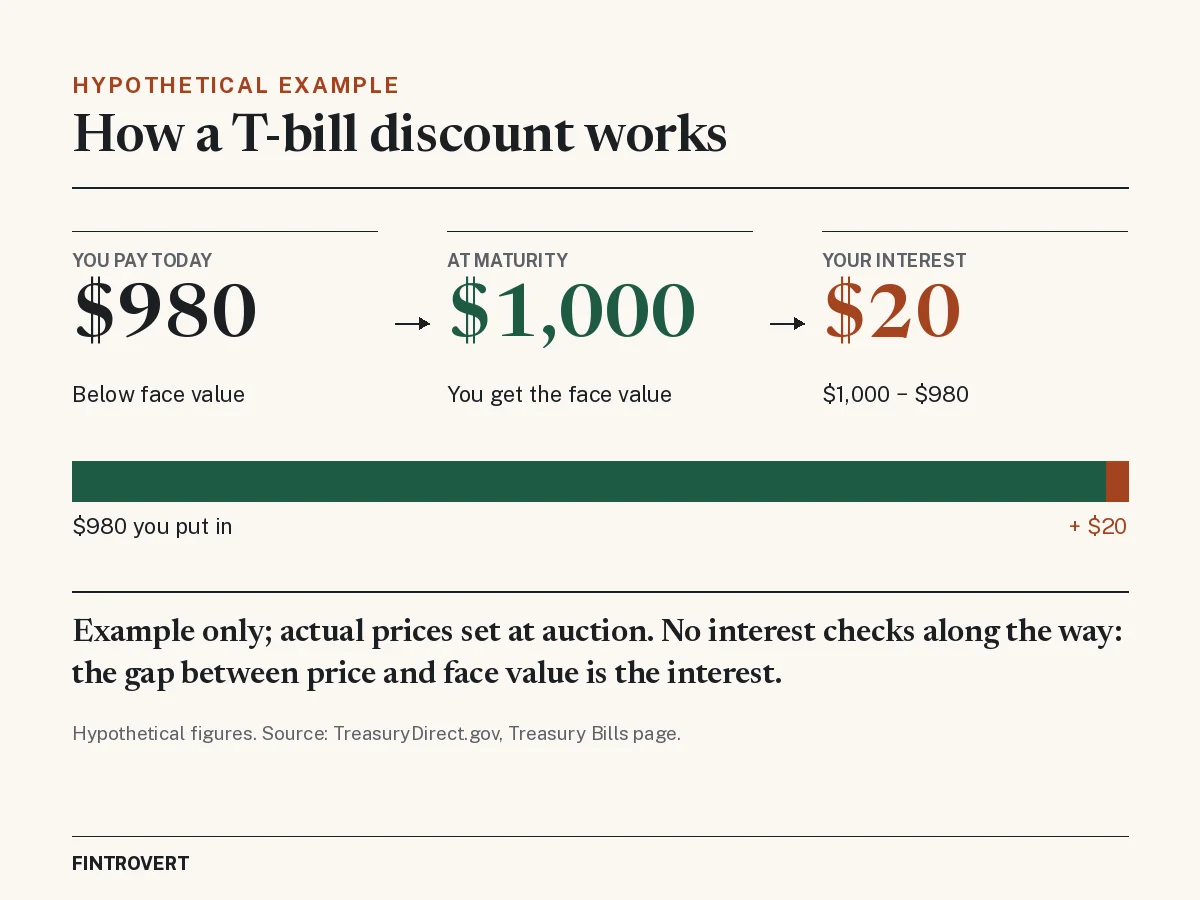
T-bills don’t send you interest checks along the way. Instead, you buy a bill for less than its face value (or sometimes at face value), and when it matures you get the full face value back. Your “interest” is the difference between the two. Here is a made-up example to show how it works: if you pay $980 for a bill with a $1,000 face value, you get $1,000 at maturity, and the $20 difference is your interest. The actual price is set at auction, so it changes from one auction to the next.
Because they mature in a year or less, T-bills can be a fit for money you’ll need soon, such as savings for a known expense. If you are setting money aside for a bill that comes due on a set date, our guide to sinking funds explains how to plan for it.
Treasury notes: the middle ground
Treasury notes come in terms of 2, 3, 5, 7 or 10 years. They pay a fixed rate of interest every six months until they mature, and then you get your principal back. The rate is set at auction and doesn’t change over the life of the note. TreasuryDirect says it is never less than 0.125%.
Treasury bonds: the long haul
Treasury bonds are the longest option, with terms of 20 or 30 years. Like notes, they pay a fixed rate of interest every six months, and the rate is set at auction and stays the same until the bond matures.
A longer term means your money is committed for a long time. You can sell a note or bond before it matures, but the price you get depends on the market at that point, so you could get more or less than you paid. If you plan to hold until maturity, you get the face value back.
How to buy Treasuries: TreasuryDirect or a broker
New bills, notes and bonds are sold at auction. According to TreasuryDirect, you have two ways to buy:
- TreasuryDirect. This is the government’s own website for buying straight from the Treasury. You open an account, choose the security and amount, and money is taken from your linked bank account. You can only place non-competitive bids here, which means you accept the rate set at auction and are guaranteed to get the amount you asked for. TreasuryDirect charges no fees to open an account or buy securities. One catch: you must hold a new security for at least 45 calendar days before you can transfer or sell it.
- A bank, broker or dealer. You can place non-competitive or competitive bids at auction, and you can also buy and sell existing Treasuries on the secondary market. A broker may charge fees for its services, so check before you buy.
Most individual investors bid non-competitively, according to TreasuryDirect. Either way, the minimum purchase is $100, in $100 increments, and the most you can buy with a non-competitive bid is $10 million per auction.
How Treasuries are taxed
Interest from Treasury bills, notes and bonds is subject to federal income tax, but it is exempt from state and local income taxes. That’s spelled out on each TreasuryDirect product page and in IRS Publication 550, which covers investment income. The state tax break can matter if you live in a state with a high income tax, because interest from a bank savings account or CD is usually taxed by your state too.
About rates and yields
Treasury rates change with every auction, so we don’t list them here. For current numbers, check TreasuryDirect’s auction announcements and results or Treasury.gov’s daily Treasury bill rates. It’s worth comparing those against what you could get from a high-yield savings account, keeping in mind the state tax difference and that a savings account lets you pull money out any time.
Which one fits you?
- Need the money within a year? T-bills match short timelines and pay you at maturity.
- Want steady income for a few years? Notes pay interest twice a year for 2 to 10 years.
- Investing for decades? Bonds lock in a fixed rate for 20 or 30 years, but your money is tied up longer and the price can move a lot if you sell early.
- Still building your safety net? Keep your emergency fund somewhere you can reach right away before buying longer-term securities.
The bottom line
Treasury bills, notes and bonds are all loans to the US government, backed by its full faith and credit. Bills are short and sold at a discount, notes and bonds pay interest every six months over longer terms, and all three start at $100 and skip state and local income tax. You can buy them straight from TreasuryDirect with no fees or through a broker. If you would rather lock in a bank rate, a CD ladder works in a similar way with insured deposits. If you want stock market exposure too, see our guide to index funds vs ETFs, or visit our Investing hub for more.
This article is for general educational purposes and isn’t personalized financial advice.