
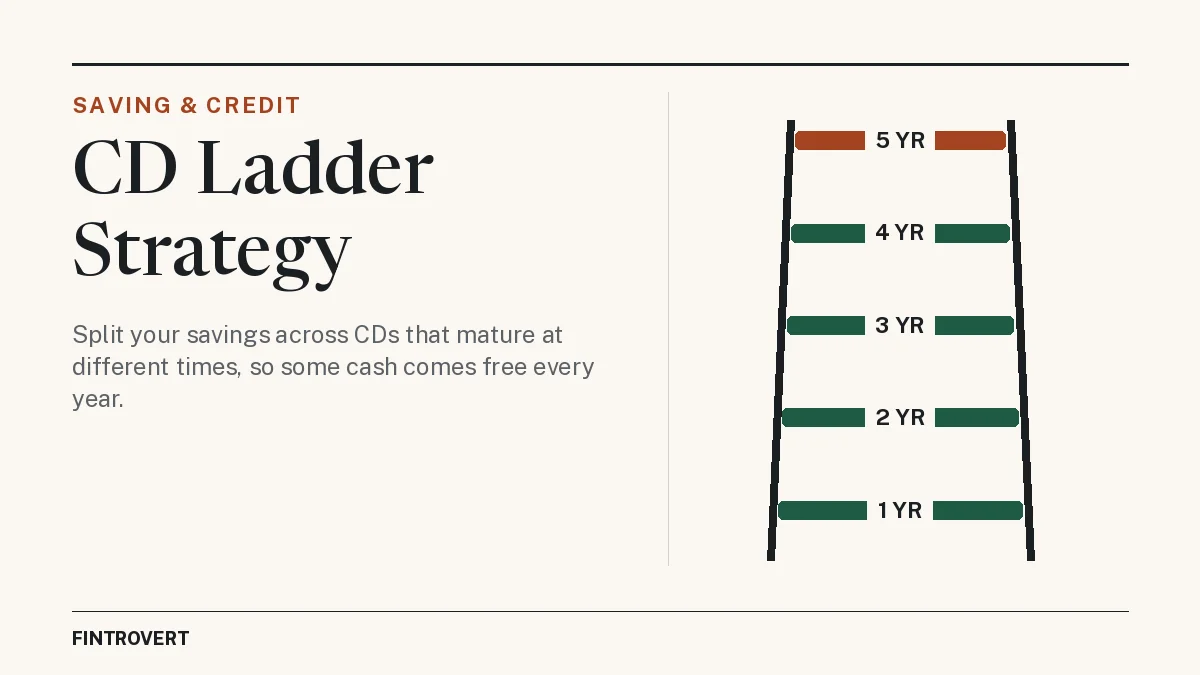

A certificate of deposit pays a fixed rate if you leave your money alone for a set time. The catch is that the money is locked up, and if rates rise later you’re stuck with the old one. A CD ladder is a simple way to get around both problems. Instead of putting all your cash into one CD, you split it across several CDs that mature at different times. Some money comes free every year, and the rest keeps earning. This guide explains how a CD ladder works, what early withdrawal penalties and brokered CDs mean for you, and how to build one step by step.
What is a CD, in plain terms?
The SEC’s Investor.gov describes a CD as a savings account that holds a fixed amount of money for a fixed period of time, such as six months, one year or five years. In exchange, the bank pays interest. When the CD matures, you get back what you put in plus the interest it earned.
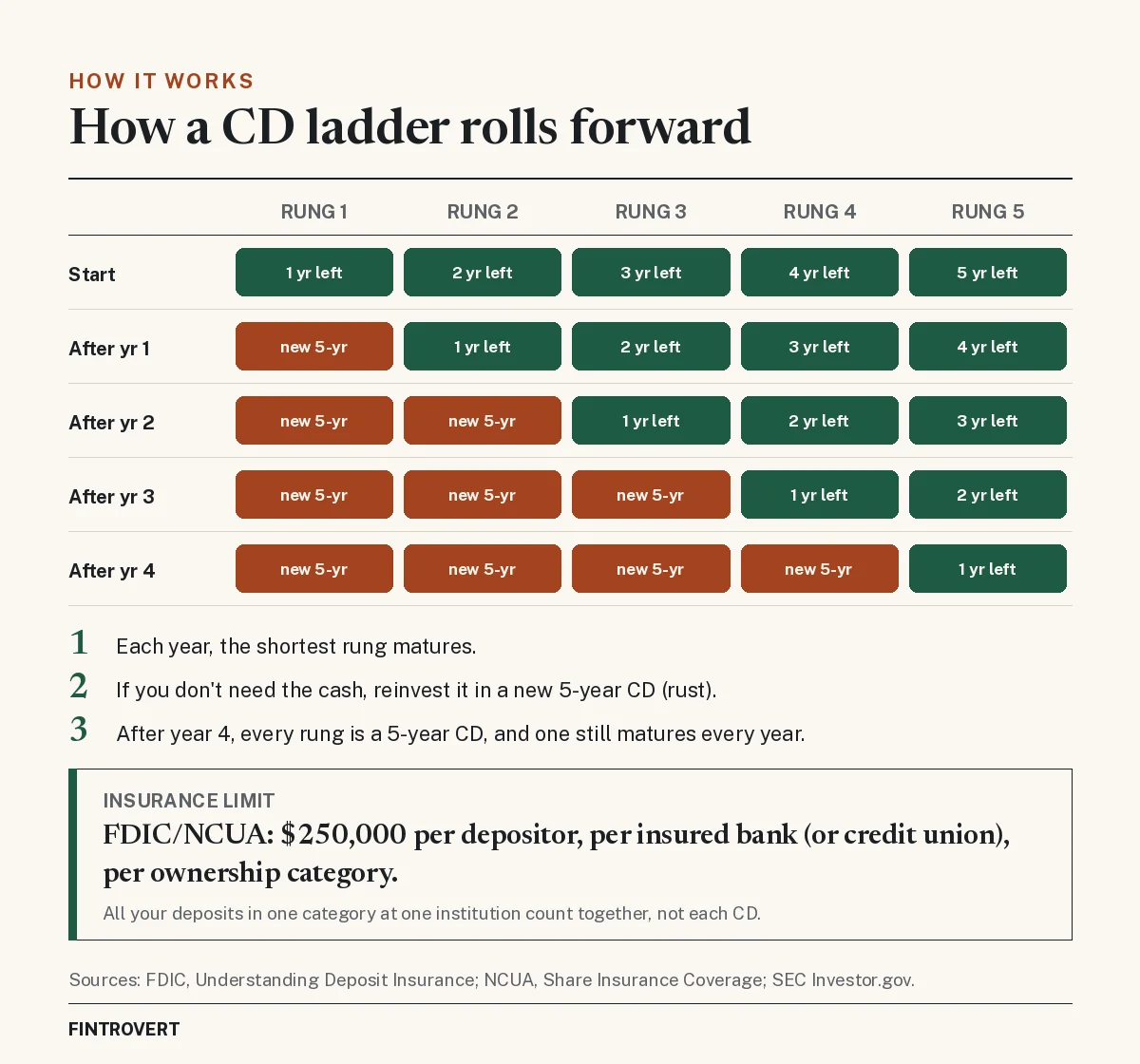
CDs at banks are covered by FDIC insurance, and share certificates at credit unions are covered by NCUA share insurance. The FDIC covers $250,000 per depositor, per insured bank, for each account ownership category. The NCUA provides the same $250,000 coverage per member, per insured credit union, per ownership category. That limit applies to all your deposits in the same category at the same institution added together, not to each CD separately. So if a ladder would push you past $250,000 at one bank, spread it across more than one.
How a CD ladder works
Say you have $10,000 you won’t need for a while. Rather than buy one 5-year CD, you split it into five $2,000 CDs with terms of 1, 2, 3, 4 and 5 years. Each of those is a “rung.”
After year one, the 1-year CD matures. If you don’t need the cash, you put it into a new 5-year CD. A year later the next one matures, and you do the same thing. After four years of this, every rung is a 5-year CD, but one of them still matures every year. You get the higher rates that longer CDs often pay, and you still have money freeing up every 12 months.
Here’s how the starting ladder could look. These rates are made-up examples, not current offers. Real rates change often, so check what banks and credit unions are paying when you shop.
| Rung | Amount | Example APY | Value at maturity | Interest earned |
|---|---|---|---|---|
| 1-year CD | $2,000 | 4.00% | $2,080.00 | $80.00 |
| 2-year CD | $2,000 | 4.10% | $2,167.36 | $167.36 |
| 3-year CD | $2,000 | 4.20% | $2,262.73 | $262.73 |
| 4-year CD | $2,000 | 4.30% | $2,366.83 | $366.83 |
| 5-year CD | $2,000 | 4.40% | $2,480.46 | $480.46 |
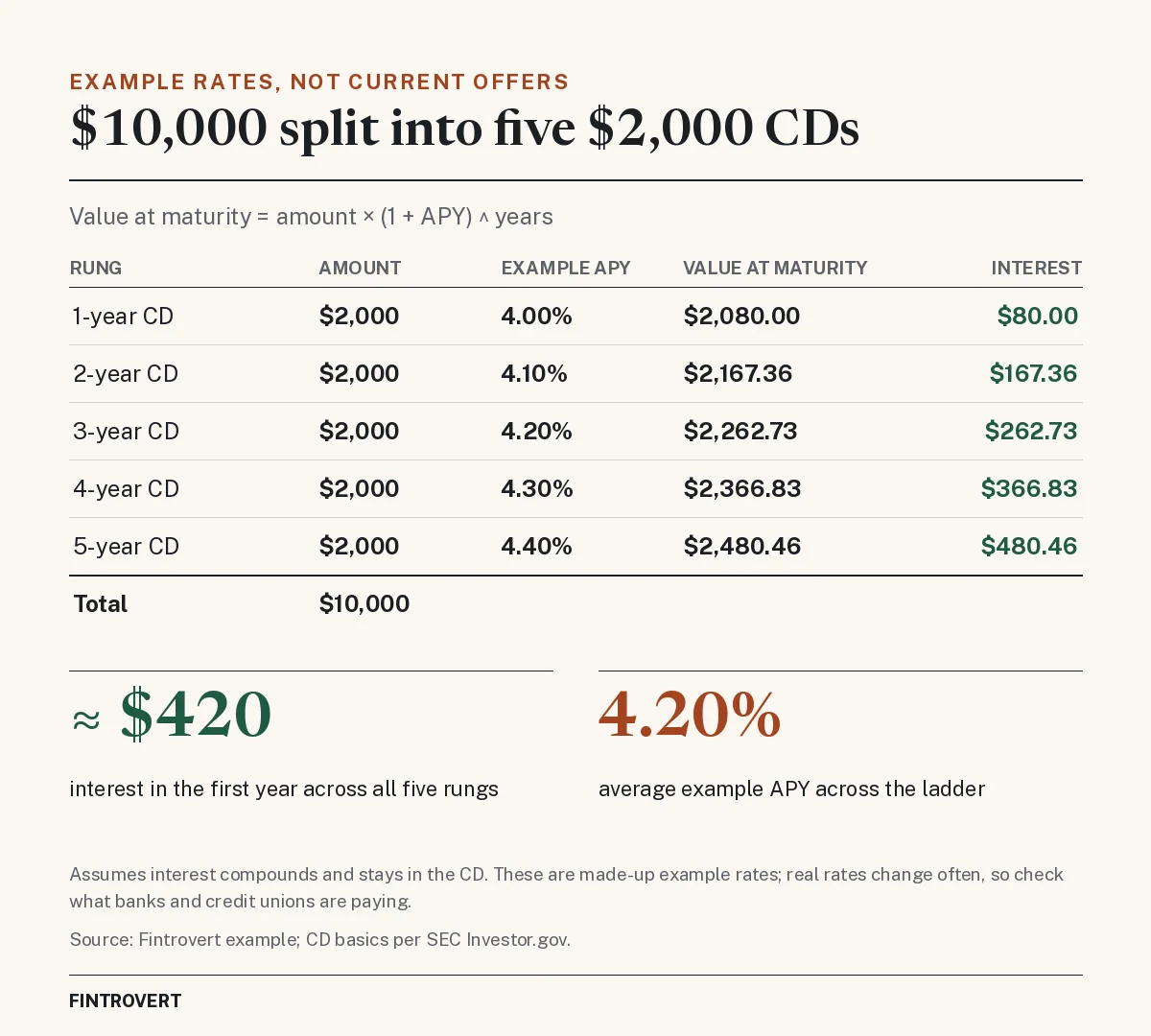
In the first year, this ladder earns about $420 in total, an average of 4.20% across the five rungs. Each time a rung rolls into a new 5-year CD at the example 4.40% rate, that $2,000 would grow to about $2,480.46 by the time it matures.
Why people use a CD ladder
- Regular access to cash. A rung matures on a schedule, so you’re never more than a year (or whatever spacing you pick) away from some penalty-free money.
- Less guessing about rates. If rates go up, your next maturing rung can be reinvested at the higher rate. If rates go down, the rest of your ladder is still locked in at the older, higher rates.
- Predictable, insured savings. Within the FDIC and NCUA limits, your principal is protected, which makes a ladder a good fit for money you want safe but not sitting idle.
A ladder isn’t a replacement for an emergency fund. Money you might need on short notice belongs somewhere you can reach any day, like a high-yield savings account. Our emergency fund calculator can help you figure out how much to keep there first. A ladder works better for the next layer of savings, or for known future costs you’re saving for in sinking funds.
Early withdrawal penalties
The trade-off for a fixed rate is that taking money out before maturity usually costs you. Under the CFPB’s Truth in Savings rule (Regulation DD), a CD that lets you withdraw in the first six days must charge at least seven days’ interest on the amount withdrawn. Past that minimum, each bank sets its own penalty, and it’s often a set number of days or months of interest. Investor.gov notes that your CD disclosure should clearly state any early withdrawal penalty, so read it before you buy.
Here’s an example. Suppose a bank’s penalty is 90 days of simple interest, and you break the 1-year, $2,000 CD from the table at 4.00%. The penalty would be $2,000 times 4.00% times 90 divided by 365, or about $19.73. That’s an example, not a standard. Some banks charge much more on longer CDs, so the ladder’s built-in access is what keeps you from paying this in the first place.
Also watch for automatic renewal. The FDIC suggests finding out whether a CD renews on its own at maturity and at what rate. Renewing CDs may give you a short grace period after maturity to withdraw without a penalty. Put each maturity date on your calendar so you can decide what to do with that rung.
Brokered CDs: what’s different
You can also buy CDs through a brokerage account. These are called brokered CDs. Investor.gov explains that deposit brokers can sometimes negotiate a higher rate by bringing a bank a large amount of deposits, then offer those CDs to their customers. They can make a ladder easier to build in one place, but the SEC’s guide to high-yield CDs flags a few things to check:
- Getting out early can cost principal. The SEC warns that if you need your money back early from a brokered CD, you may lose some of your principal.
- Call features. Some CDs are callable, which means the issuing bank can end the CD early, often when rates fall. Only the bank has that right, not you. You get your deposit and accrued interest back, but you’d have to reinvest at the lower rate.
- Know the issuing bank. Insurance is based on the bank that holds your money. If you already have deposits there, a brokered CD could push you over the $250,000 limit.
- Check the broker. Deposit brokers aren’t licensed or approved by any state or federal agency, so look up their history using the SEC’s and FINRA’s databases before you buy.
How to build a CD ladder, step by step
- Set aside your emergency fund first. Only ladder money you don’t expect to need before each rung matures.
- Decide how much to ladder. Pick a total you’re comfortable locking up, like the $10,000 in our example.
- Choose the length and spacing. A five-year ladder with one rung a year is common. If you want access more often, use shorter terms, like 3, 6, 9 and 12 months.
- Split the money evenly. Divide the total by the number of rungs. $10,000 divided by 5 rungs is $2,000 each.
- Shop for rates and terms. Compare banks and credit unions, and confirm each one is FDIC or NCUA insured. Read the early withdrawal penalty, renewal rules and any call feature.
- Open the CDs. Buy one CD for each term. Watch the $250,000 limit at any single institution.
- Track maturity dates. Add each date to your calendar, with a reminder a week or two ahead.
- Roll each rung forward. When a CD matures, either use the money or reinvest it in a new CD at the longest term in your ladder.
CD ladders and Treasuries
Some savers build the same kind of ladder with U.S. Treasury bills, notes and bonds instead of CDs. Treasuries aren’t covered by FDIC insurance, since they’re backed by the U.S. government rather than a bank, and they work a little differently. Our guide to Treasury bills, notes and bonds walks through how they compare.
The bottom line
A CD ladder spreads your savings across CDs that mature at different times, so you can earn fixed, insured interest without locking all your money up at once. Keep your emergency fund separate, read each CD’s penalty and renewal terms, stay within the $250,000 insurance limit at each institution, and roll each rung forward as it matures. For more ways to save and manage credit, visit our Saving & Credit hub.
Written by the Fintrovert Team. This article is for general educational purposes and isn’t personalized financial advice. Example rates are hypothetical and are not current offers.