
Use this RMD calculator to figure the required minimum distribution you need to take from a traditional IRA or other retirement account this year. Enter your account balance from the end of last year and your birth year. You will see your RMD start age, the IRS distribution period for your age, the amount to withdraw and the deadline.
Figure your required minimum distribution
How this RMD calculator works
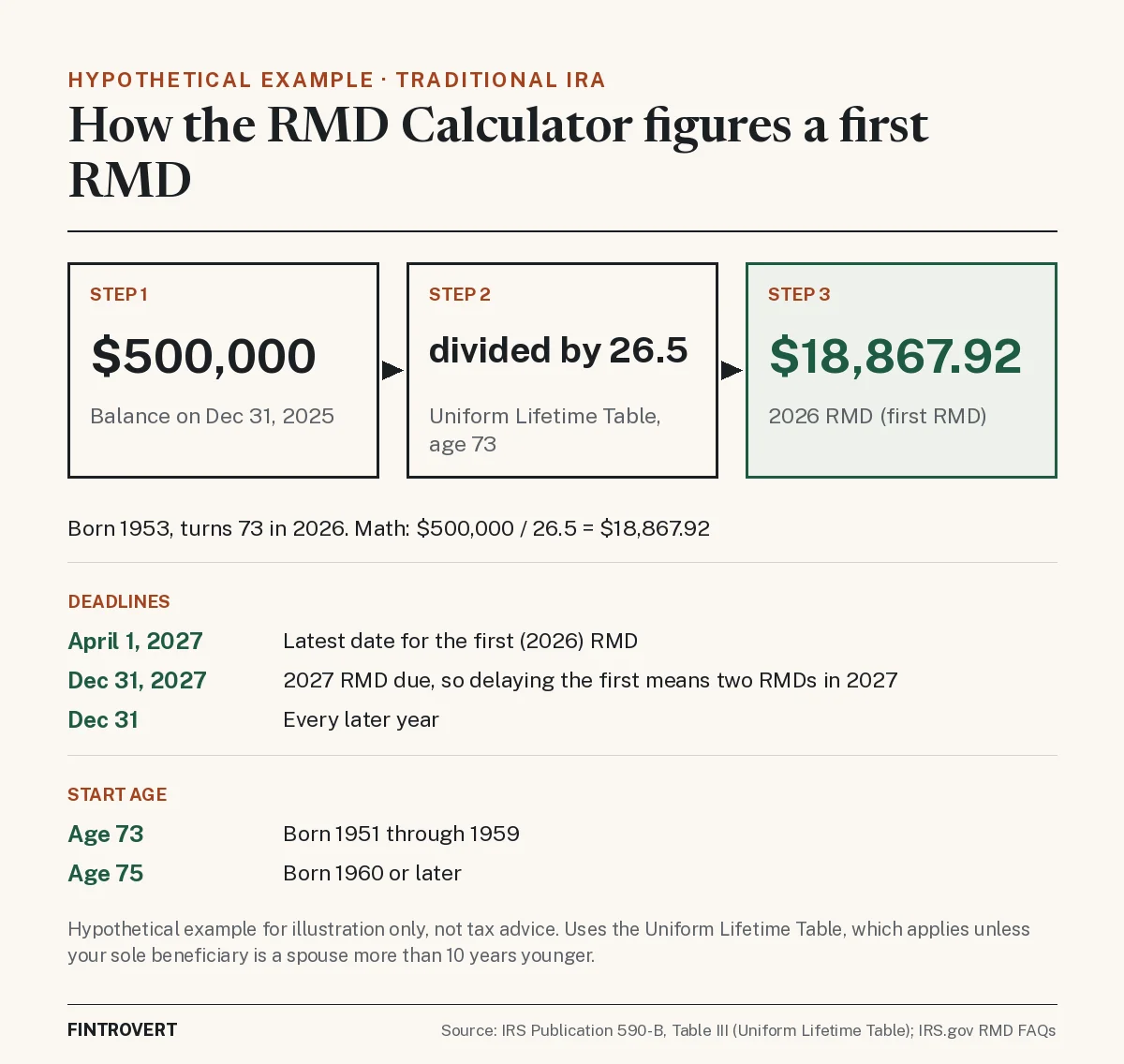
The IRS formula is simple. You take your account balance as of December 31 of last year and divide it by the distribution period listed next to your age in the Uniform Lifetime Table. That table is Table III in Appendix B of IRS Publication 590-B, and this calculator uses every age on it, from 72 through 120 and over. Your age is the age you reach on your birthday during the year you are figuring the RMD for.
Your start age depends on when you were born. Under the SECURE 2.0 Act, it is 73 if you were born from 1951 through 1959 and 75 if you were born in 1960 or later. The birth-date breakdown comes from the final IRS regulations published in the Federal Register in July 2024.
A worked example
Say you were born in 1953 and turn 73 in 2026. Your traditional IRA was worth $500,000 on December 31, 2025. The distribution period for age 73 is 26.5, so your 2026 RMD is $500,000 divided by 26.5, or $18,867.92. Because this is your first RMD, you have until April 1, 2027 to take it. Your 2027 RMD is still due by December 31, 2027, so waiting means two withdrawals in the same tax year.
Deadlines and penalties
Your first RMD is due by April 1 of the year after you reach your start age. Every RMD after that is due by December 31. If you miss one or take too little, the IRS says you may owe a 25% excise tax on the amount you did not withdraw. That drops to 10% if you fix the shortfall within two years. You report it on Form 5329.
Roth IRAs and other exceptions
If you own a Roth IRA, you do not have to take RMDs from it during your lifetime. The same goes for designated Roth accounts in a 401(k) or 403(b). Beneficiaries who inherit a Roth account do have RMD rules, as the IRS RMD FAQs explain. This calculator is for account owners, not inherited accounts. If your spouse is your sole beneficiary and is more than 10 years younger than you, check the box above and use the Joint Life and Last Survivor table in Publication 590-B instead.
Want the full rules in plain English? Read our guide to required minimum distributions. If you are still saving, try the retirement calculator or the 401(k) calculator. A Roth conversion is one way some people lower future RMDs, since Roth IRAs have no RMDs for the owner. You will find more tools on our calculators page and more guides in Retirement.
RMD calculator FAQ
Does this work for my 401(k)?
The math is the same for most workplace plans. One difference: if you are still working and do not own 5% or more of the company, your plan may let you wait until April 1 of the year after you retire. IRAs do not get that delay.
I have more than one IRA. What do I enter?
Figure the RMD for each traditional IRA separately. According to Publication 590-B, you can add them together and take the total from any one or more of your IRAs. Workplace plan RMDs generally have to come from each plan.
Can I take more than the RMD?
Yes. The RMD is only the minimum. Withdrawals from traditional accounts are generally taxed as ordinary income, and taking extra this year does not lower next year's RMD.
Disclaimer: This calculator gives an educational estimate only. It isn't tax or financial advice. Check your figures with your account custodian or a tax professional.
By Fintrovert Team