

Medicare enrollment is easy to get wrong because Parts A, B and D have different sign-up windows, and income-related surcharges (IRMAA) are separate from the base premiums. Miss the right window and you can face months without coverage, a lasting late penalty, or a tax hit on a Health Savings Account (HSA).
We cover the 7-month Initial Enrollment Period, automatic versus manual sign-up, the work-based Special Enrollment Period (and why COBRA and retiree coverage do not extend it), Part D creditable coverage and the 63-day gap, late penalties, IRMAA’s two-year income lookback and Form SSA-44, and the Part A retroactivity trap for HSA contributions. For claiming Social Security itself, see when to claim Social Security. For HSA basics, see FSA vs HSA.
Parts A, B and D in plain English
- Part A (Hospital Insurance): inpatient hospital care and related services. Most people who paid Medicare taxes long enough get premium-free Part A.
- Part B (Medical Insurance): doctors, outpatient care and many other medical services. Most people pay a monthly Part B premium.
- Part D (drug coverage): prescription drugs through a Medicare drug plan or a Medicare Advantage plan that includes drugs. Plan premiums vary; you choose a plan.
After you have Part A and Part B, you choose how to get your coverage. Original Medicare is Part A and Part B through the federal program. You can add a separate Part D drug plan, and many people also buy a Medigap (Medicare Supplement) policy. A Medicare Advantage plan (Part C) is a private plan that bundles Part A and Part B, and often Part D. Per Medicare.gov’s joining-a-plan page, you need both Part A and Part B to join a Medicare Advantage plan, and either Part A or Part B to join a stand-alone drug plan. This article focuses on when to enroll in A, B and D, not on picking a specific Advantage or Medigap product.
Your first window: the 7-month Initial Enrollment Period
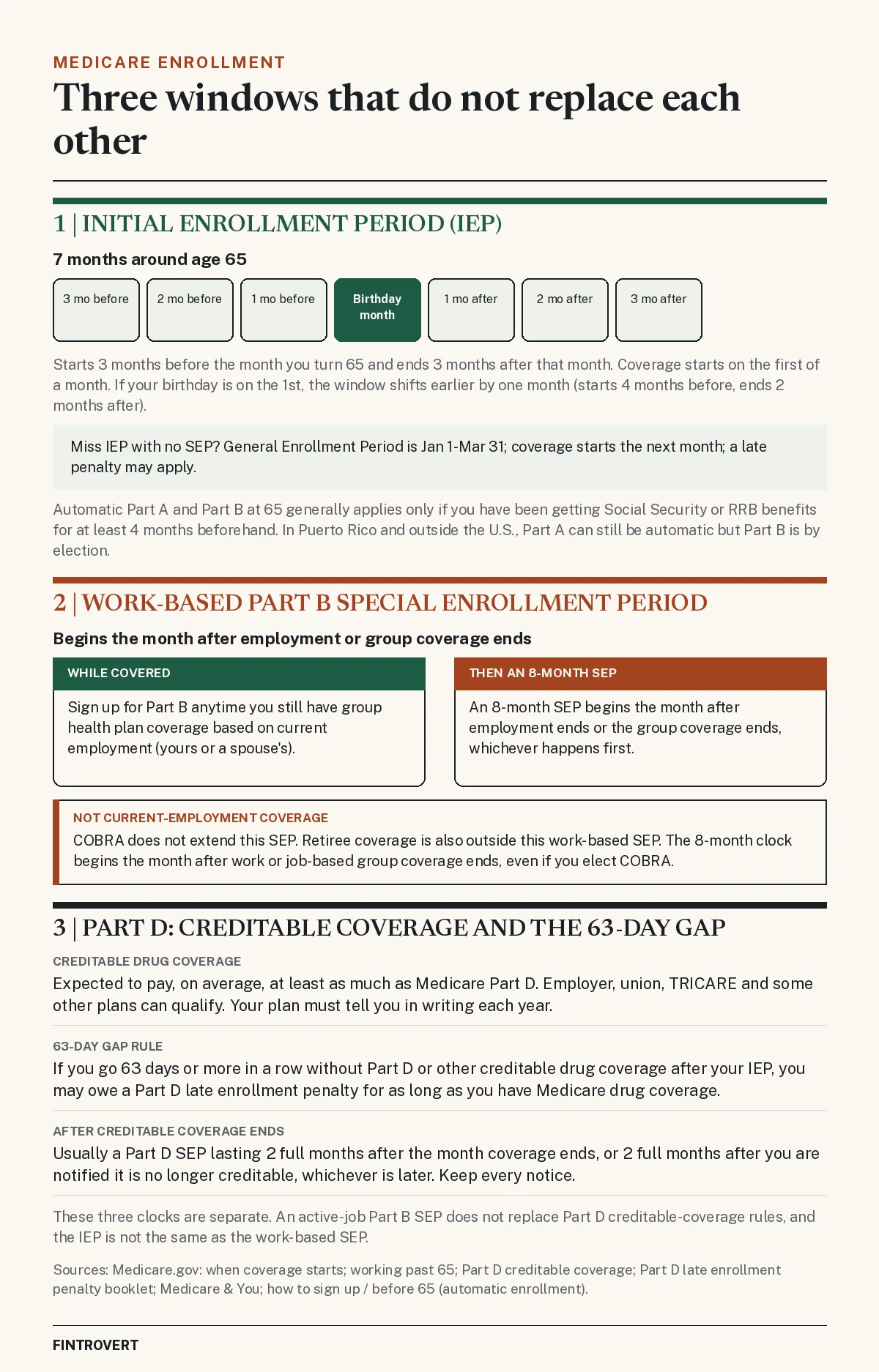
For most people, the first chance to sign up is the Initial Enrollment Period (IEP). Per Medicare.gov, it lasts 7 months: it starts 3 months before the month you turn 65 and ends 3 months after the month you turn 65.
The Medicare & You handbook notes a birthday-on-the-first wrinkle: if your birthday is on the first day of the month, the 7-month period starts 4 months before the month you turn 65 and ends 2 months after that month. Coverage always starts on the first of a month. For Part B (and premium Part A), signing up before your birthday month generally starts coverage in your birthday month; signing up in your birthday month or the 3 months after generally starts coverage the next month. Premium-free Part A for people who qualify typically starts the month you turn 65 (or the prior month if your birthday is on the first).
If you miss the IEP and do not qualify for a Special Enrollment Period, you may have to wait for the General Enrollment Period (January 1 through March 31 each year), with coverage starting the month after you sign up, and you may owe a late enrollment penalty.
Automatic enrollment vs. signing up yourself
Per Medicare.gov’s sign-up guide, the getting benefits before 65 path, and the Enrolling in Medicare Part A and Part B booklet:
- Automatic (typical U.S. case): If you have been getting Social Security or Railroad Retirement Board benefits for at least 4 months before you turn 65, Medicare generally enrolls you in Part A and Part B starting the month you turn 65 (or the prior month if your birthday is on the first). Your welcome package with the Medicare card usually arrives about 3 months before coverage starts. If you do not want Part B, follow the card instructions and return it before coverage starts; otherwise you keep Part B and premiums are typically withheld from your benefit.
- Puerto Rico and living outside the U.S.: If you get Social Security or RRB benefits, you generally still get Part A automatically, but Part B is not automatic. You must elect Part B (for Puerto Rico, Social Security’s Medicare in Puerto Rico publication and Medicare.gov say to contact Social Security / use Form CMS-40B). Missing that election can mean a delay and a Part B late enrollment penalty.
- Disability paths: After 24 months of Social Security disability benefits (or certain RRB disability benefits), Part A and Part B usually start automatically. If you have ALS, Part A and Part B generally start the month those disability benefits begin.
- Manual: If you are near 65 and are not getting Social Security or RRB benefits at least 4 months beforehand, you need to sign up yourself. Apply at SSA.gov/medicare/sign-up. You can sign up for premium-free Part A anytime after you first qualify; Part B (and premium Part A) can only be added during defined enrollment periods.
Still working: the Part B Special Enrollment Period
If you or your spouse has group health plan coverage based on current employment, you may delay Part B without a late enrollment penalty. Per Medicare.gov’s working-past-65 page and the coverage-start page:
- You can sign up for Part B anytime you are still covered by that job-based group plan based on current employment.
- After that coverage based on current employment ends, you also have an 8-month Special Enrollment Period. Per the Medicare & You handbook and Medicare.gov, that 8-month period begins the month after the employment ends or the group health plan coverage ends, whichever happens first.
- Ask the employer whether you need Part A and Part B at 65 for the plan to pay correctly. Some job-based plans expect you to have Medicare.
Premium-free Part A can often be taken at 65 even if you delay Part B. That choice interacts with HSAs (covered below), so do not treat Part A as “free and harmless” without checking your HSA.
COBRA and retiree coverage are not the same as active employer coverage
- COBRA is not coverage based on current employment. Medicare.gov states that COBRA does not extend your limited time to sign up for Medicare. The 8-month Part B SEP still begins the month after employment or job-based group coverage ends (whichever is first), even if you elect COBRA. Waiting until COBRA ends can leave you outside the SEP, facing the General Enrollment Period and a possible Part B late penalty.
- Retiree coverage is also not current-employment coverage for this SEP. Medicare.gov notes that retiree coverage may not pay fully if you lack both Part A and Part B, and that ending retiree coverage is listed among situations that do not create the work-based SEP. Ask your benefits administrator how the retiree plan coordinates with Medicare before you delay Part B.
The Medicare & You handbook also lists VA coverage and individual health insurance as outside the “active employer or union coverage” category for delaying Part B under this rule.
Part D: creditable coverage and the 63-day gap
Part D has its own clock. Per Medicare.gov’s creditable coverage page and the Part D Late Enrollment Penalty booklet:
- Creditable prescription drug coverage is coverage expected to pay, on average, at least as much as Medicare drug coverage. Employer, union, TRICARE, and some other plans can be creditable. Your plan must tell you in writing each year.
- If you go 63 days or more in a row without Part D or other creditable drug coverage after your Initial Enrollment Period, you may owe a Part D late enrollment penalty for as long as you have Medicare drug coverage.
- If you keep creditable coverage, you can usually wait to join a Medicare drug plan. When that coverage ends or is no longer creditable, Medicare.gov’s Special Enrollment Periods page describes a chance to join lasting 2 full months after the month you lose creditable coverage, or 2 full months after you are notified that coverage is no longer creditable, whichever is later.
Keep every creditable-coverage notice. When you later join a Medicare drug plan, the plan may ask whether you had prior creditable coverage. Medicare.gov and the Part D late enrollment penalty booklet say you should complete and return that form by the plan’s deadline so the plan knows about coverage it may not already see in its records.
Late enrollment penalties (separate from IRMAA)
Late enrollment penalties are added to premiums when you delay signing up without a qualifying exception. They are not the same as IRMAA. Per Medicare.gov’s avoid-penalties page:
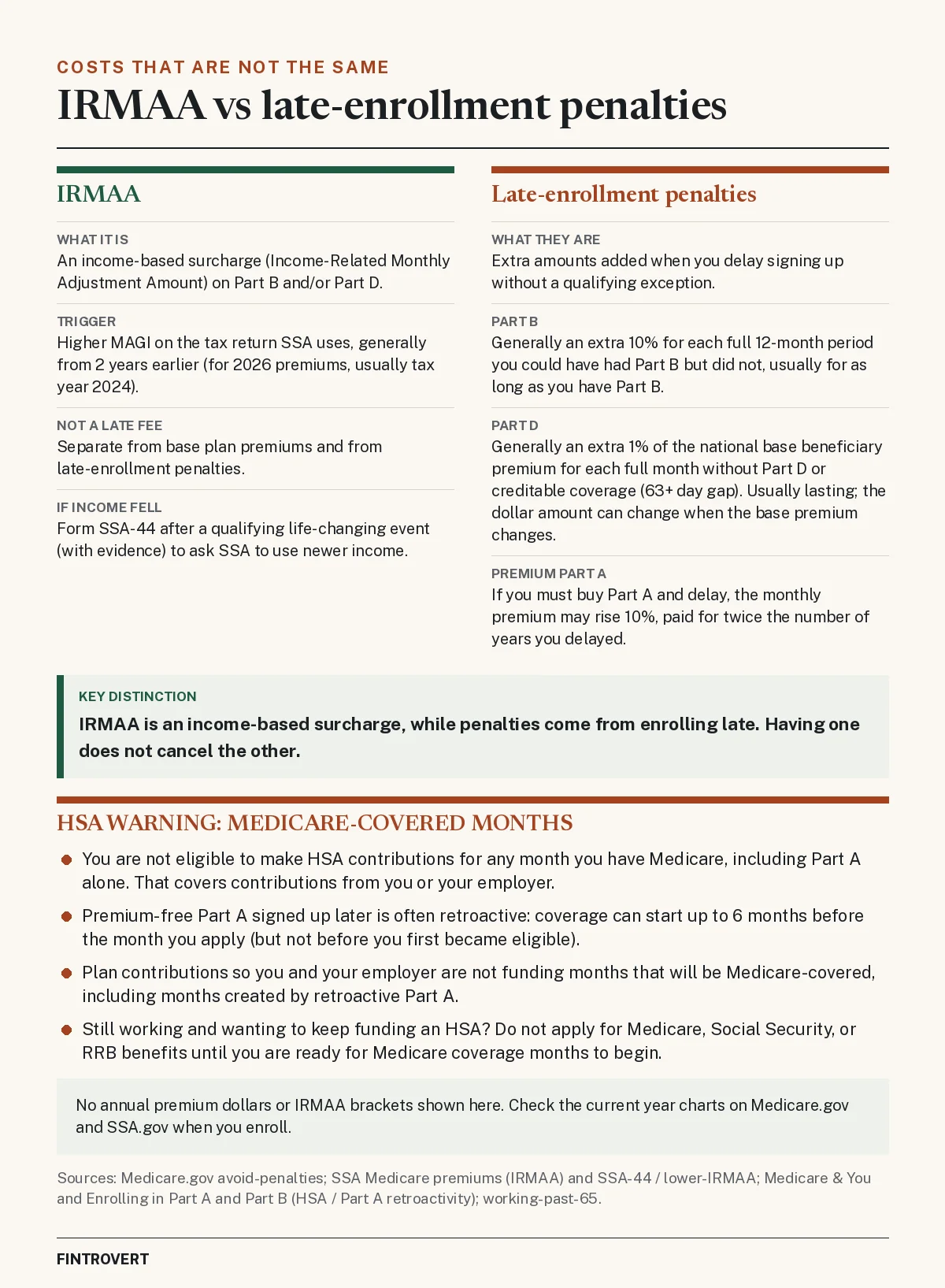
- Part B: generally an extra 10% for each full 12-month period you could have had Part B but did not, usually for as long as you have Part B.
- Part D: generally an extra 1% of the national base beneficiary premium for each full month without Part D or creditable coverage (63+ day gap rule), usually for as long as you have drug coverage. The base premium used in the formula can change each year, so the dollar penalty can change even if your uncovered months stay the same.
- Premium Part A: if you must buy Part A and delay, the monthly premium may rise 10%, and you may pay that higher amount for twice the number of years you delayed.
Medicare.gov posts yearly dollar examples for these formulas (such as the Part B standard premium and the Part D national base beneficiary premium used in penalty math). Check the current figures on Medicare.gov when you enroll.
IRMAA: the income surcharge on Part B and Part D
IRMAA stands for Income-Related Monthly Adjustment Amount. It is an extra amount higher-income enrollees pay on top of the standard Part B premium and on top of a Part D plan premium. It is not a late penalty, and it is not the plan’s base premium.
Per Social Security’s Medicare premiums page:
- SSA uses the most recent federal tax return information the IRS provides, generally your modified adjusted gross income (MAGI) from 2 years earlier. For 2026 premiums, SSA generally looks at tax year 2024 returns filed in 2025.
- If your MAGI is above the published thresholds for your filing status, you pay IRMAA for Part B, Part D, or both, depending on which coverage you have.
- Part B IRMAA and Part D IRMAA are separate add-ons. Having one does not replace the other.
- SSA sends a notice if IRMAA applies. Part D IRMAA is often withheld from your Social Security check even if you pay your drug-plan premium another way.
Thresholds and dollar add-ons change. Use the current chart on SSA.gov or Medicare.gov rather than memorizing an older year’s brackets.
Form SSA-44: asking to lower IRMAA after a life event
Because IRMAA uses older tax data, a drop in income may not show up for two years. If a qualifying life-changing event reduced your household income, you can ask SSA to use more recent information. Per SSA.gov/medicare/lower-irmaa and Form SSA-44, the listed events include marriage, divorce or annulment, death of a spouse, work stoppage or work reduction, loss of income-producing property, loss of pension income (a scheduled cessation, termination, or reorganization of an employer’s pension plan), and an employer settlement payment related to employer bankruptcy or reorganization.
SSA’s lower-IRMAA page explains how to request a reduction, including completing Form SSA-44 and providing evidence of the event and the lower income. If an amended tax return changes the MAGI SSA used, SSA’s Medicare premiums page says to contact Social Security with the amended return and IRS acknowledgment. Disagreeing with SSA’s IRMAA decision is an appeal; asking for a new determination after a listed life-changing event is a separate request described on those SSA pages.
HSA caution: Part A can start months before you apply
Per the Medicare & You handbook and the Enrolling in Medicare Part A and Part B booklet, you are not eligible to make HSA contributions after you have Medicare. That includes months of Medicare coverage that start because of Part A, and it covers contributions from you or your employer. Think in months: for any month you have Medicare, you are not eligible for HSA contributions for that month.
Premium-free Part A signed up later is often retroactive: coverage can start up to 6 months before the month you apply (but not before you first became eligible). Contributions made for those retroactive Medicare months can create a tax problem. Medicare.gov’s working-past-65 page says you and your employer should stop contributing to the HSA 6 months before you retire or apply for Social Security or RRB benefits when that retroactive window would otherwise overlap.
Practical timing from Medicare & You:
- If you sign up during your IEP (or within 2 months after it ends), make your last HSA contribution the month before you turn 65 (2 months before if your birthday is on the first, because coverage can start a month earlier).
- If you wait 6 or more months after turning 65 to apply, stop contributions 6 months before the month you apply, so contribution months do not overlap retroactive Part A months.
- If you are still working and want to keep funding an HSA with a high-deductible plan based on current employment, do not apply for Medicare, Social Security, or RRB benefits until you are ready for Medicare coverage months to begin. Applying for Social Security can start Medicare and end HSA eligibility for those months.
You can still use money already in the HSA for qualified medical expenses after Medicare starts. For yearly contribution-limit context, see 2027 HSA contribution limits and FSA vs HSA.
Quick checklist
- Mark your 7-month Initial Enrollment Period around your 65th birthday (adjust if your birthday is on the first).
- If you have been on Social Security or RRB for at least 4 months before 65, watch for your Medicare card and decide about Part B before coverage starts (in Puerto Rico or abroad, Part B usually still needs a separate election).
- If you still have group coverage from current work, confirm with the employer whether you need Part A, Part B, or both at 65, and calendar the 8-month SEP that begins the month after work or that coverage ends (whichever is first).
- Do not assume COBRA or retiree coverage buys you more time for Part B.
- Ask whether your drug coverage is creditable; keep the annual notice; avoid a 63-day gap.
- Treat IRMAA as a separate income add-on with a two-year lookback; use Form SSA-44 after a qualifying life event if income fell.
- Plan HSA contributions so you and your employer are not funding months that will be Medicare-covered, including months created by retroactive Part A.
FAQ
Is IRMAA the same as a late enrollment penalty? No. Late penalties come from delayed enrollment without a qualifying exception. IRMAA is an income-based add-on to Part B and/or Part D premiums based on MAGI from an earlier tax year.
Does COBRA give me a Part B Special Enrollment Period when it ends? No. Medicare.gov says COBRA is not current employer coverage for that SEP. The 8-month clock is tied to when employment or job-based group coverage ends, even if you elect COBRA.
Can I keep contributing to my HSA after I take only Part A? Not for Medicare-covered months. Medicare materials say you are not eligible to make HSA contributions after you have Medicare, including Part A alone, and that includes employer contributions. Because Part A can be retroactive, avoid contributions for those coverage months.
For more retirement context, see our Retirement hub, when to claim Social Security, and the retirement calculator.
This article is general information, not financial, tax, legal or insurance advice. Medicare and Social Security rules depend on your exact dates, coverage and tax history. Check current guidance at Medicare.gov and SSA.gov, or talk with a qualified professional or your State Health Insurance Assistance Program (SHIP), before you enroll.
By Fintrovert Team