

Deciding when to start Social Security is one of the biggest money choices most people make in retirement, and you usually only get to make it once. You can start as early as 62 or wait as late as 70, and the monthly check can differ by more than 75% depending on when you claim. There’s no single right answer for when to claim Social Security, but there is a clear way to think it through. This guide walks through the rules, a worked example with real dollar figures, and the personal factors that should drive your decision.
Your claiming window: age 62 to 70
You can start retirement benefits as early as age 62, but you get your full benefit only at your full retirement age (FRA). Per SSA’s early retirement page, FRA is 67 for anyone born in 1960 or later, and between 66 and 67 for people born from 1955 through 1959. If you wait past FRA, your benefit keeps growing until age 70.
Your full benefit at FRA is called your primary insurance amount, or PIA. Everything else, the early reduction, the delay bonus and even what a spouse can get, is figured as a percentage of that number. Our companion guide on how Social Security benefits are calculated explains how your PIA is worked out from your earnings record.
What you give up by claiming early
Claim before FRA and your benefit is reduced for every month you start early. According to SSA’s benefit reduction table, the cut is 5/9 of 1% per month for the first 36 months and 5/12 of 1% for each month beyond that. For someone with an FRA of 67, starting at 62 means 60 months early:
- 36 months x 5/9 of 1% = 20%
- 24 months x 5/12 of 1% = 10%
- Total reduction: 30%, so you get 70% of your PIA
That reduction is permanent. It doesn’t go away when you reach FRA, although cost-of-living adjustments still apply to whatever amount you receive.
What you gain by waiting past full retirement age
For anyone born in 1943 or later, SSA’s delayed retirement credits page shows that each year you delay past FRA adds 8% to your benefit (2/3 of 1% per month). The credits stop at age 70, so there’s no benefit to waiting longer than that. With an FRA of 67, waiting to 70 adds 36 months of credits, a 24% increase.
One timing detail: if you start before 70, some of the credits you earned in the year you claim aren’t added until the following January. SSA’s page explains how that works.
Worked example: a $2,000 PIA at 62, 67 and 70
Say your PIA is $2,000 a month and your FRA is 67. Ignoring cost-of-living adjustments to keep the math simple, here’s what each choice pays:
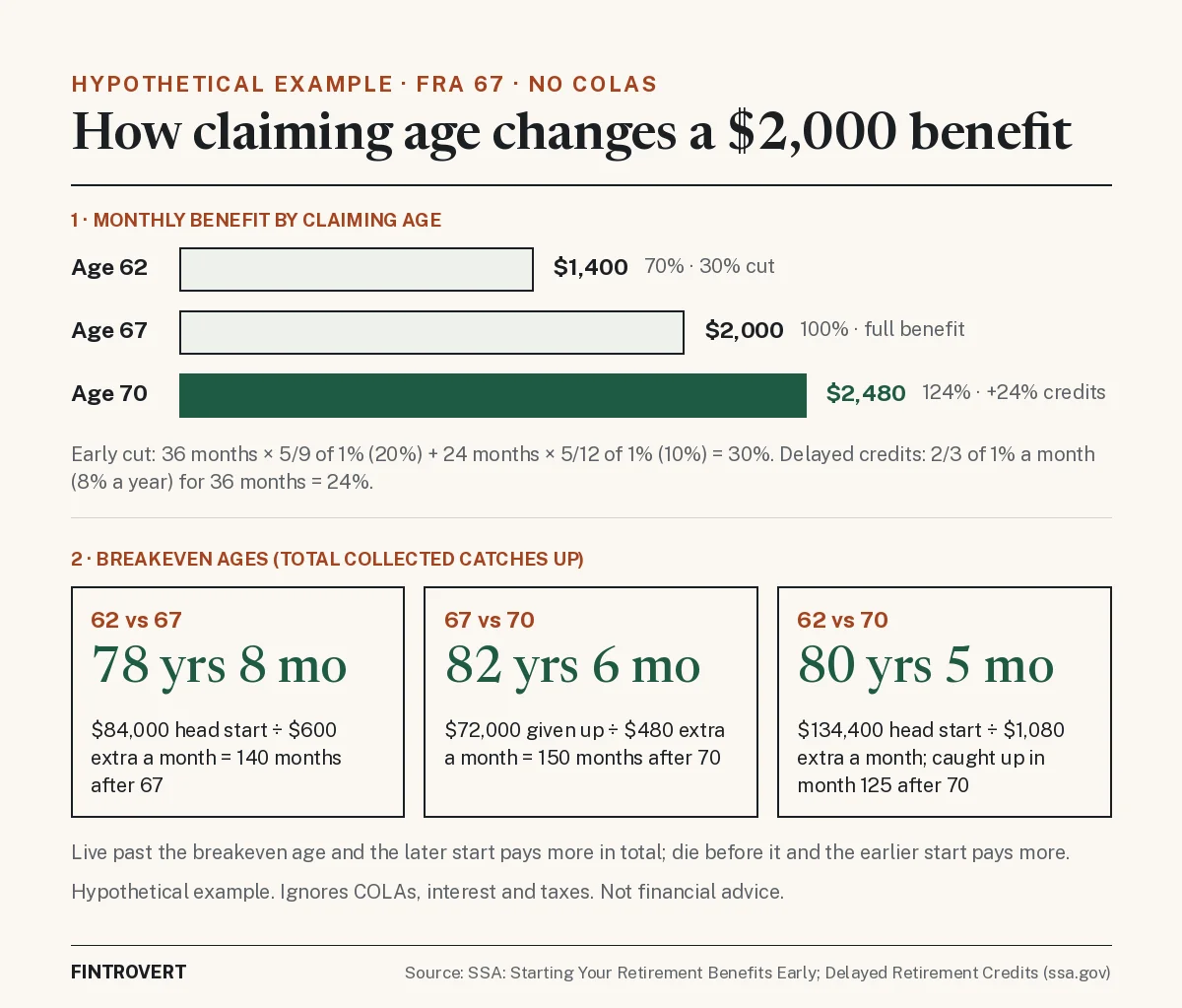
- Claim at 62: $2,000 x 70% = $1,400 a month ($16,800 a year)
- Claim at 67: $2,000 a month ($24,000 a year)
- Claim at 70: $2,000 x 124% = $2,480 a month ($29,760 a year)
The age-70 check is about 77% bigger than the age-62 check, for the rest of your life.
A simple breakeven
A breakeven age is the point where the total you’ve collected by waiting catches up with the total you’d have collected by claiming earlier. Using the numbers above (and no COLAs, interest or taxes):
- 62 vs. 67: claiming at 62 gives you a five-year, $84,000 head start. The extra $600 a month from waiting closes that gap after 140 months, so the totals even out at about age 78 and 8 months.
- 67 vs. 70: waiting gives up $72,000 in the first three years. The extra $480 a month makes that back after 150 months, around age 82 and 6 months.
- 62 vs. 70: the totals even out at about age 80 and 5 months.
If you live past those ages, waiting comes out ahead, and the longer you live the bigger the edge. If you don’t, claiming earlier would have paid more in total. Real-life breakevens shift a bit once you factor in COLAs, investment returns and taxes, but this simple version gives you a good feel for the trade-off.
Working while you collect: the earnings test
If you claim before FRA and keep working, Social Security may hold back some of your benefits. Per SSA’s earnings test exempt amounts, for 2026 the limits are:
- $24,480 if you reach FRA after 2026. SSA withholds $1 in benefits for every $2 you earn above that.
- $65,160 in the year you reach FRA, counting only earnings in the months before your FRA month. SSA withholds $1 for every $3 above that.
- Once you reach FRA, the earnings test no longer applies.
SSA has already published the 2027 limits: $25,560 and $67,920. Withheld benefits aren’t lost. Once you reach FRA, SSA permanently raises your monthly benefit to account for the months it held back. Still, if you plan to keep earning a solid paycheck in your early 60s, claiming early often doesn’t make much sense.
Spousal and survivor considerations
If you’re married, your claiming age can affect your spouse too. A spouse can receive family benefits of up to half of your benefit amount. Per SSA’s benefit reduction table, a spouse who starts at their own FRA gets 50% of the worker’s PIA, and that amount is reduced if the spouse claims early (to 32.5% of the worker’s PIA at 62 for a spouse with an FRA of 67).
Survivor benefits are where delaying can matter most. According to SSA’s survivor benefits page, a surviving spouse can get up to 100% of the deceased spouse’s benefit at the survivor’s full retirement age, or starting at 71.5% if claimed earlier. Because the survivor benefit is based on the deceased worker’s benefit, the higher earner in a couple who waits until 70 is also locking in a bigger check for whichever spouse lives longer. SSA also notes that a survivor can sometimes start one benefit and switch to another later, such as moving to their own retirement benefit at 70.
Personal factors that should drive your choice
- Health and family history. If you have serious health issues or a family history of shorter lifespans, claiming earlier may make sense. If you’re healthy and your relatives lived into their 90s, waiting often pays off.
- Longevity risk. Social Security is one of the few incomes that lasts as long as you do and keeps up with inflation. A bigger check from waiting is a kind of insurance against outliving your savings.
- Other income and savings. If you can cover expenses from work, a pension or savings while you wait, delaying is easier. If you’d have to rack up debt to wait, claiming earlier may be the better move.
- Taxes. Per SSA’s tax page, you may owe federal income tax on part of your benefits if your combined income is above $25,000 for individual filers or $32,000 for joint filers. Drawing down retirement accounts first and delaying Social Security can sometimes smooth out your tax bill.
Medicare at 65 is a separate decision
Don’t mix up Medicare with Social Security timing. Even if you delay Social Security past 65, SSA’s early retirement page recommends applying for Medicare within 3 months of your 65th birthday. If you sign up late, your Part B and Part D coverage may cost you more.
Quick checklist
- Find your PIA and FRA on your Social Security statement.
- Run the 62, FRA and 70 numbers for yourself and your spouse.
- Think about your health, family history and how long your savings need to last.
- If you’ll keep working before FRA, check the earnings test limits.
- Sign up for Medicare around 65 no matter when you claim.
For more, see our Retirement hub, our posts on the Social Security COLA for 2027 and the Social Security wage base for 2027, and our guide to how Social Security benefits are calculated. You can also test how your claiming age fits your overall plan with the retirement calculator.
This article is general information, not financial, tax or legal advice. Social Security rules and yearly limits change, so check your own record and current guidance at ssa.gov, or talk with a qualified professional, before you decide when to claim.
By Fintrovert Team