

Learning how to build credit from scratch starts with a manageable account, not a big loan. The goal is to put a record of reliable payments on your credit reports without taking on bills you cannot afford.
Start by checking what is already in your file. Then choose one suitable way to build it, make payments on time and let that history grow. You do not need to pay credit card interest to prove you can handle credit.
No credit history is not the same as bad credit
A credit report records credit activity, including accounts and payment history. A credit score is calculated from information in that report. The CFPB explains the difference and notes that scores can vary by reporting agency, scoring model and loan product.
A thin file has little history to evaluate. A missing score can mean there is not enough information for a particular model to calculate one. That is different from having a score based on missed payments or other negative information. Your first job is to establish a record, not chase a particular number.
FICO and VantageScore are scoring systems, not credit bureaus. For background on score bands, see our credit score ranges guide. This article focuses on choosing and managing a first account rather than repeating those tables.
1. Check your reports before applying
The three nationwide credit reporting companies are Equifax, Experian and TransUnion. You can get a free report from each once a week at AnnualCreditReport.com, the only website authorized by federal law for these free reports. Checking your own reports there does not affect your scores.
Look for accounts you recognize, payment histories, incorrect balances and accounts that are not yours. You may already have more history than you expect. A missing score alone does not prove your reports are empty: a report and a score are different things.
If your file is simply limited, move on to choosing a starter account. If something is wrong, use the dispute steps below rather than opening accounts to try to cover it up.
2. Choose one credit-building route
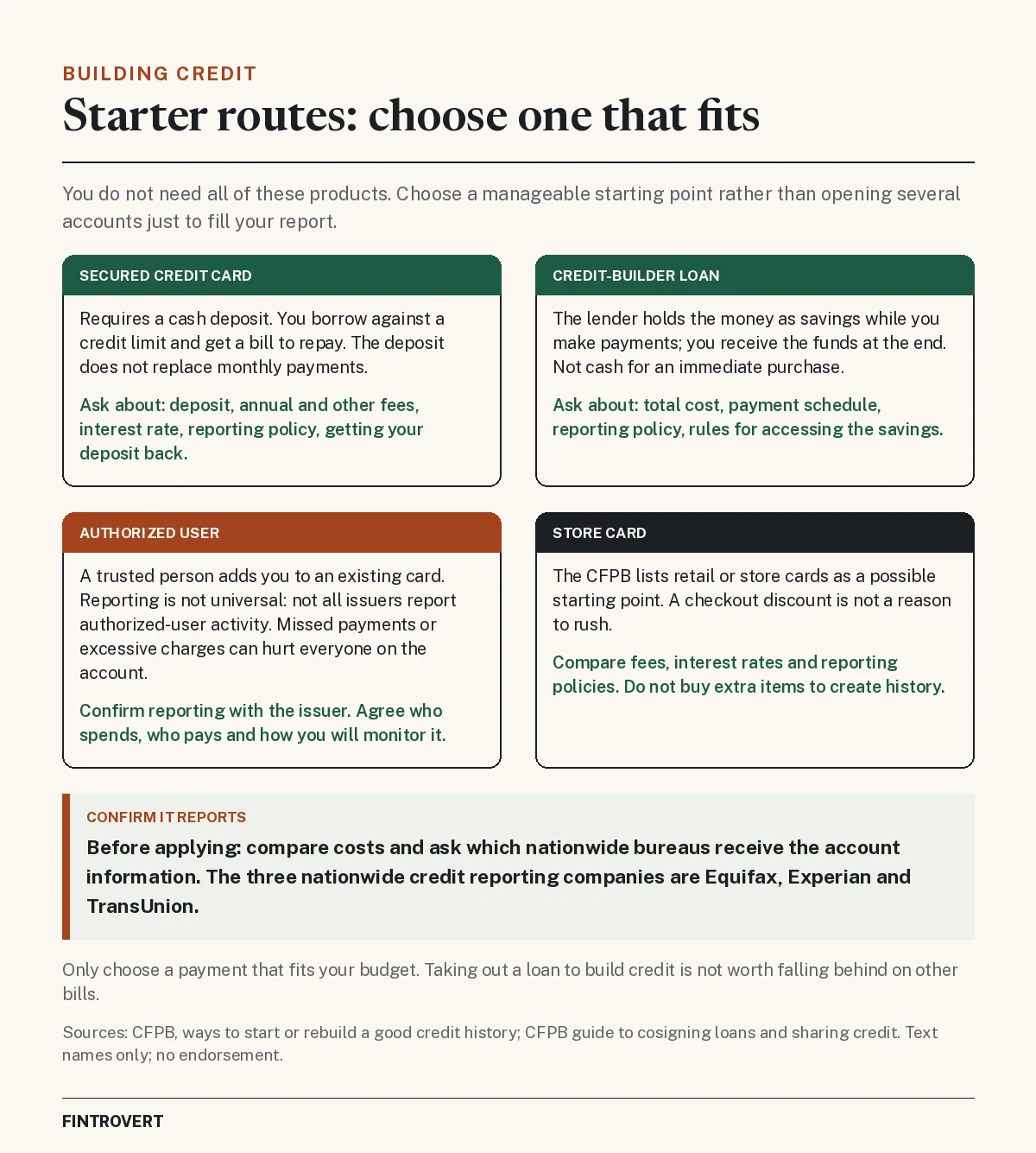
The CFPB lists several products that can establish credit history. Ask your bank or credit union what it offers. Before applying, compare costs and ask which nationwide bureaus receive the account information.
A secured credit card
A secured card requires a cash deposit. You borrow against a credit limit and receive a bill to repay. A prepaid card is different: it spends money loaded onto it rather than extending credit.
Ask about the deposit, annual and other fees, interest rate, reporting policy and conditions for getting your deposit back. Do not assume the deposit replaces monthly payments. Choose a deposit you can spare without leaving yourself short for rent, groceries or emergencies.
A credit-builder loan
With a credit-builder loan, the lender holds the money as savings while you make payments. You receive the funds at the end under the agreement. This is a way to establish payment history, not cash for an immediate purchase.
Ask for the total cost, payment schedule, reporting policy and rules for accessing the savings. Only choose it if the payment fits your budget. Taking out a loan to build credit is not worth falling behind on other bills.
Becoming an authorized user
A trusted person may be willing to add you to an existing credit card. But CFPB guidance on sharing credit warns that not all issuers report authorized-user activity. Missed payments or excessive charges can also hurt the people connected to the account.
Confirm reporting with the issuer. Discuss who may spend, who pays and how you will monitor the account. The primary cardholder is responsible for purchases. Treat this as a shared financial arrangement, not a guaranteed score boost.
What about a store card?
The CFPB also lists retail or store cards as a possible starting point. A checkout discount is not a reason to rush. Compare fees, interest rates and reporting policies with other options. Do not buy extra items to create payment history.
You do not need all of these products. Choose a manageable starting point rather than opening several accounts just to fill your report.
3. Set up payments you can keep making
The CFPB recommends paying on time, keeping balances low and applying only for credit you need. For a first card, consider one small recurring expense you already pay, with money set aside before it goes on the card.
- Set payment reminders. If you use autopay, check the amount, date and bank balance so the payment can go through.
- Pay at least the required minimum by the due date. Aim to pay the full statement balance rather than carry debt month to month.
- Review every statement, even with autopay. Check for unfamiliar charges, fees and changes to the bill.
- If a payment becomes unaffordable, contact the lender before the due date and ask about available options.
You do not need to carry a balance to get a good score. Paying interest is not a credit-building fee. If you already have balances you cannot clear, focus on repayment before adding accounts. Our credit card debt payoff guide covers that separate problem.
4. Leave room below your credit limit
Credit utilization is the share of available credit you are using. For illustration, a $100 balance on a card with a $500 limit uses 20% of that limit. This is arithmetic, not a spending target or a promise about your score.
Low balances matter, especially on a small starter limit. The CFPB notes that a high balance can affect a score even if you pay it off the next day, because scores are calculated at different times. Paying in full does not mean a high balance can never appear in a score calculation.
Keep spending comfortably below your limit. There is no need to engineer an exact percentage or make purchases you do not need.
5. Give the account time
A longer record of managing accounts gives scoring systems more information. Repeated applications are not a shortcut. The CFPB warns that applying for a lot of credit over a short period can signal financial strain.
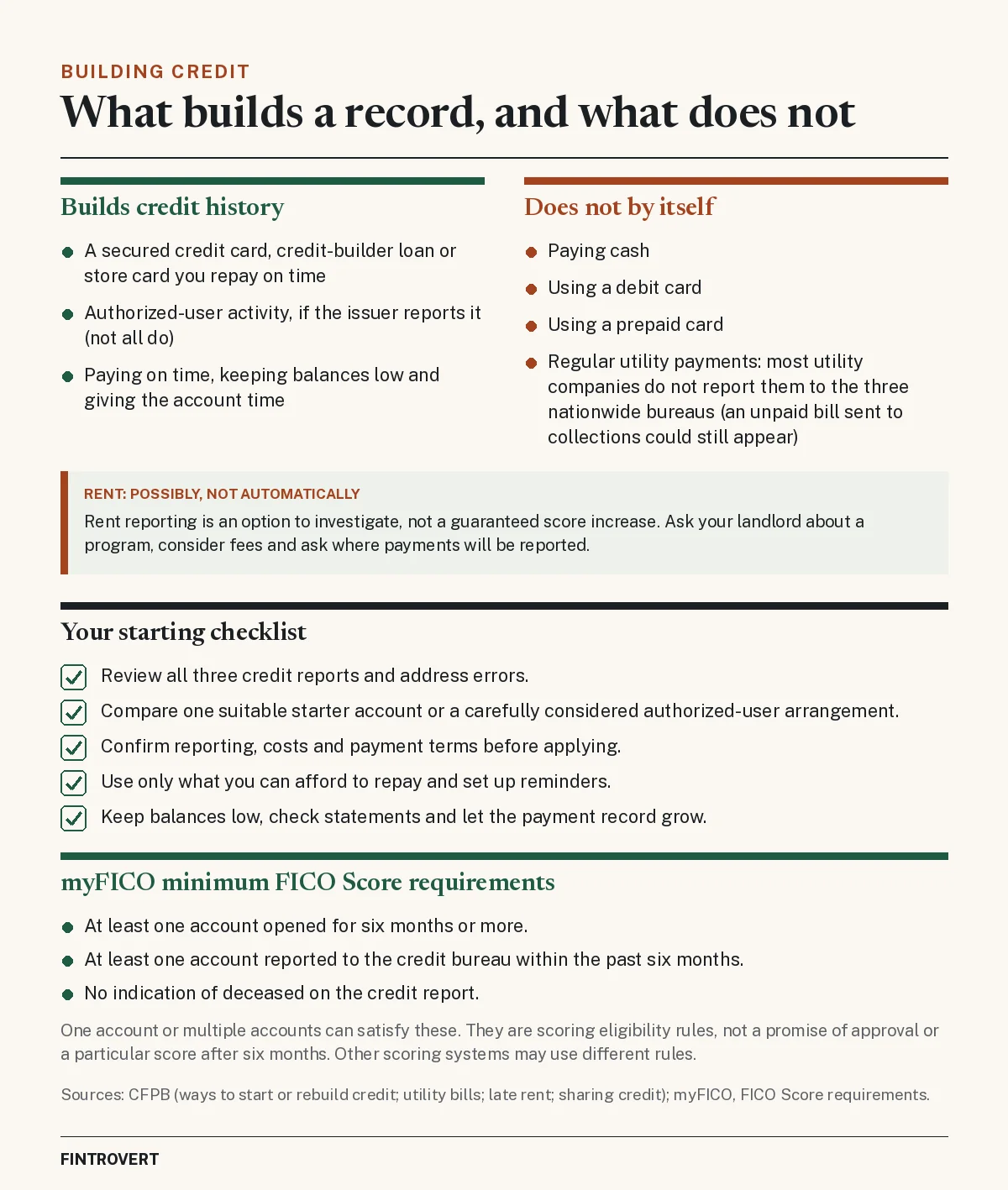
There is no universal deadline for getting a score. myFICO lists these minimum FICO Score requirements:
- At least one account opened for six months or more.
- At least one account reported to the credit bureau within the past six months.
- No indication of deceased on the credit report.
One account or multiple accounts can satisfy those requirements. myFICO notes that rare differences can occur across FICO versions. These are scoring eligibility rules, not a promise of approval or a particular score after six months. Do not assume another scoring system uses the same rules.
Once an account works well, do not close it automatically just because you qualify for something else. The CFPB explains that closing a card can increase utilization. Still, keeping a costly card or one that encourages unaffordable spending may not be worth it. Monitor any account you keep open.
Can rent and utility payments help?
Possibly, but do not assume every bill appears on your nationwide reports. The CFPB says positive rental payments can help build credit and suggests asking your landlord about a rent-reporting program. Consider fees before signing up, and ask where payments will be reported.
For utilities, the CFPB says most companies do not report regular payment history to the three nationwide bureaus. An unpaid bill sent to collections could still appear. Pay these bills because you owe them, but do not assume that doing so automatically creates a credit history. Rent reporting is an option to investigate, not a guaranteed score increase.
What does not build credit by itself?
According to the CFPB, paying cash, using a debit card and using a prepaid card do not establish credit history. Those can still be sensible ways to manage spending. They simply do not show a record of repaying borrowed money.
Spending more on a credit card is not the goal, either. A small bill you repay comfortably is a better starting point than purchases that strain your budget.
Protect the file you are building
If a report contains an error, follow the CFPB credit report dispute process: contact the bureau showing it and the company that supplied the information. Explain what is wrong, include copies of supporting documents and keep records. You can dispute errors yourself rather than pay someone to do it.
For suspected identity theft, the CFPB directs consumers to IdentityTheft.gov, the federal resource for reporting and recovering from identity theft.
A free credit freeze can help prevent someone from opening credit in your name by blocking prospective creditors from accessing your file. Contact each nationwide bureau separately. Freezes can be lifted for free when you need to apply. A freeze does not replace reviewing existing accounts for unauthorized activity.
Your starting checklist
- Review all three credit reports and address errors.
- Compare one suitable starter account or a carefully considered authorized-user arrangement.
- Confirm reporting, costs and payment terms before applying.
- Use only what you can afford to repay and set up reminders.
- Keep balances low, check statements and let the payment record grow.
Building credit is a routine, not a race. A modest account you can manage is a better starting point than several you struggle to pay. Find more everyday money help in our Saving & Credit hub.
This article is general education, not individual financial advice.
By Fintrovert Team