

Social Security spousal and survivor benefits can add a meaningful check when your own work record is thin, or when a spouse or ex-spouse earned more over a career. The two programs use different ages, percentages and remarriage rules. This guide separates living-spouse benefits from survivor benefits, using Social Security Administration (SSA) rules only.
You will see how much a living spouse can get, how aged widow(er) benefits differ from child-in-care survivor benefits, how your own benefit combines with a spouse or survivor payment, divorced-spouse rules, remarriage, and when you can switch from one type of benefit to another. For how the worker’s own benefit is built, see how Social Security benefits are calculated. For the age-62-to-70 tradeoff on your own record, see when to claim Social Security.
Spousal benefits vs. survivor benefits at a glance
Spousal (family) benefits apply while the worker is alive and collecting retirement or disability. Survivor benefits apply after the worker dies. The SSA publishes separate pages for each, and the numbers are not the same:
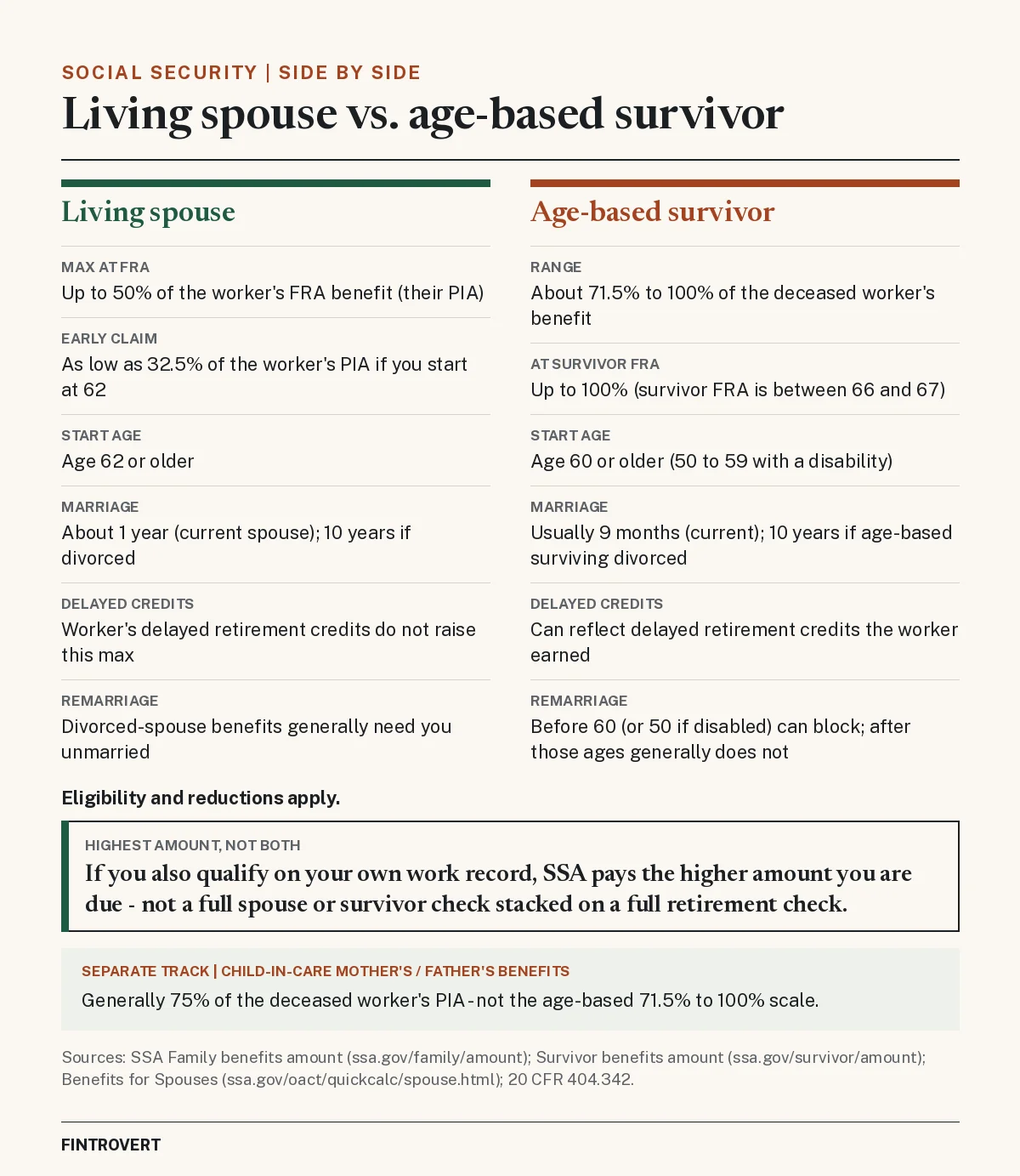
- Living spouse: up to 50% of the worker’s benefit at their full retirement age (FRA), per the SSA’s family benefits amount page and Benefits for Spouses page.
- Aged widow(er) or surviving divorced spouse (age-based): about 71.5% to 100% of the deceased worker’s benefit, depending on when you claim, per the SSA’s survivor benefits amount page.
- Surviving parent with a child in care (mother’s or father’s benefits): generally 75% of the deceased worker’s primary insurance amount (PIA), per 20 CFR 404.342. That is a separate benefit type from the age-based widow(er) scale above.
In both the living-spouse and survivor tracks, if you also qualify on your own work record, the SSA pays the higher amount you are due. It does not add a full spouse or survivor check on top of a full retirement check. That rule appears on the family amount page and the survivor amount page.
Who can get a spousal benefit
Per the SSA’s family benefits eligibility page and its spouse’s benefits overview, you may qualify as a current spouse if:
- You have been married at least one year, and
- You are age 62 or older, or you are any age and care for the worker’s child who is younger than 16 or who has a disability and is entitled to benefits on the worker’s record, and
- Your spouse is already receiving Social Security retirement or disability benefits. If your spouse has not filed yet, you generally have to wait.
Divorced spouses have a longer marriage requirement and some extra options. Those rules are covered below.
How much a living spouse can get
Your full spouse’s benefit is up to one-half of the amount your spouse is eligible to receive at their FRA. That FRA amount is the worker’s PIA. Two details trip people up:
- Delayed retirement credits do not raise the spousal maximum. If your spouse waits past FRA and earns delayed retirement credits, your maximum spouse’s benefit stays at 50% of their FRA benefit, not 50% of the higher delayed amount. A surviving spouse’s benefit can reflect the higher amount. The SSA spells this out in its spouse’s benefits overview.
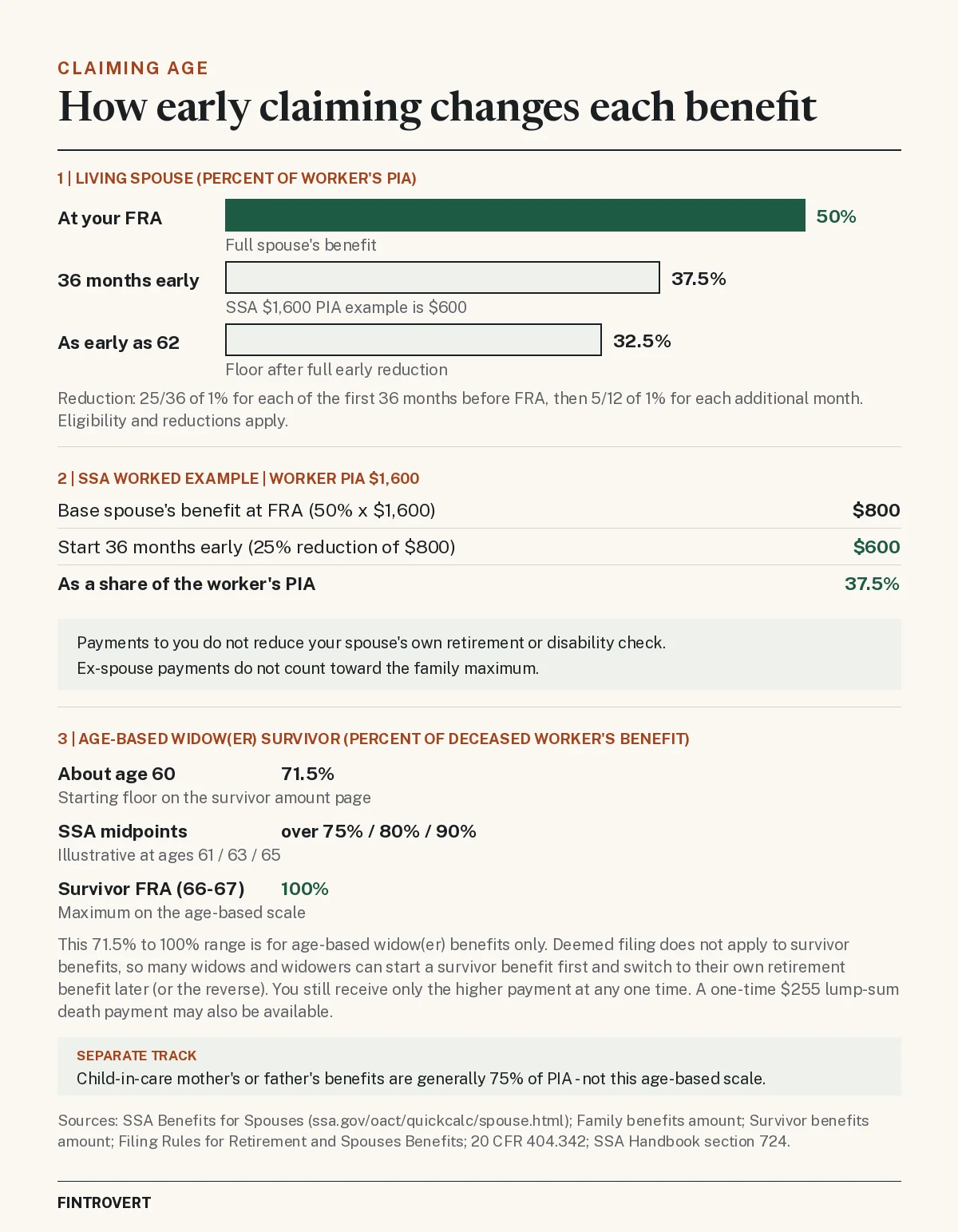
- Claiming before your own FRA permanently reduces the spouse’s benefit. You can start as early as 62, but the payment is cut for each month before FRA. The SSA’s Benefits for Spouses page notes that early claiming can leave a spouse with as little as 32.5% of the worker’s PIA. The reduction is 25/36 of 1% for each of the first 36 months before FRA, then 5/12 of 1% for each additional month.
If you are under FRA but care for a qualifying child (younger than 16, or a child with a disability who is entitled on the worker’s record), the SSA pays the unreduced 50% spouse’s benefit. Payments to you do not reduce your spouse’s own retirement or disability check.
Worked example from the SSA’s Benefits for Spouses page: if the worker’s PIA is $1,600, the base spouse’s benefit at FRA is $800. If the spouse starts 36 months early, a 25% reduction brings that to $600, which is 37.5% of the worker’s PIA.
Own benefit plus spousal benefit: not a double payment
If you qualify for retirement on your own record and for a spouse’s benefit, the SSA does not hand you both full amounts. Per the SSA’s FAQ on collecting both and its spouse’s benefits overview:
- You must apply for both (see deemed filing below).
- The SSA pays your own retirement benefit first.
- If the spouse’s benefit is higher, it adds enough from the spouse’s benefit to bring your total up to that higher spouse’s amount.
SSA example at full retirement age: Sandy is due $1,000 on her own record and $1,250 as a spouse if she waits until FRA. She receives her $1,000, then $250 more from the spouse’s benefit, for a total of $1,250. The SSA’s overview presents that example for someone who waits until FRA.
If you claim before FRA, both your own retirement benefit and the spouse’s benefit are generally reduced for age (unless a child-in-care exception applies to the spouse’s piece). The combined payment still equals the higher of those amounts, but that “higher” figure is the reduced spouse’s benefit, not automatically half of the worker’s PIA. Handbook section 320 states that the spouse’s insurance benefit starts at one-half of the worker’s PIA and may be less when you take a reduced spouse’s benefit before retirement age, or when your own benefit is smaller than the spouse’s rate and only the difference is paid as the spouse’s piece.
Deemed filing: when applying for one means applying for both
“Deemed filing” means that if you are eligible for both your own retirement benefit and a spouse’s (or divorced spouse’s) benefit, filing for one counts as filing for the other. You then receive a combined payment equal to the higher amount. Current rules are on the SSA’s Filing Rules for Retirement and Spouses Benefits page.
For anyone who turned 62 on or after January 2, 2016 (born January 2, 1954 or later), deemed filing applies whenever you are eligible for both benefits, including at FRA and beyond. You generally cannot take only a spouse’s benefit while letting your own retirement benefit grow with delayed retirement credits.
People born before January 2, 1954 had a narrower deemed-filing window and, at FRA, could sometimes take only a spouse’s benefit while delaying their own. That group is already past age 70 in 2026, so the old “restrict and delay” approach is not a planning option for new claimants today.
Deemed filing does not apply to survivor’s benefits. It also does not apply if you receive spouse’s benefits because you are entitled to disability, or because you are caring for the retired worker’s child. The survivor exception is what lets many widows and widowers start a survivor benefit first and switch to their own retirement benefit later.
Divorced spouses (while the ex is still living)
Per SSA Handbook section 311 and the SSA’s divorced spouses overview, you may get benefits on a living ex-spouse’s record if:
- The marriage lasted at least 10 years before the divorce became final,
- You are age 62 or older,
- You are unmarried (if you remarried, you generally cannot collect on that former spouse unless the later marriage ended), and
- You are not already entitled to a retirement or disability benefit that equals or exceeds one-half of the worker’s PIA.
Two practical points:
- Independent entitlement after two years. If you have been divorced for at least two continuous years, you can apply on your former spouse’s record even if they have not filed yet, as long as they are at least 62 and fully insured. You do not need their permission, and your claim does not reduce what they or their current family receive.
- No child-in-care shortcut before 62. Unlike a current spouse, a divorced spouse is not entitled before age 62 even with a child in care (Handbook section 311). That is different from survivor mother’s or father’s benefits after the ex dies, covered below.
The amount follows the same spouse’s benefit rules: up to 50% of the worker’s FRA benefit, reduced if you claim before your FRA. Ex-spouse payments do not count toward the family maximum that can shrink checks for a current spouse and children.
Who can get survivor benefits
The SSA’s survivor eligibility page and its Survivors Benefits publication (EN-05-10084) describe several paths. Age-based widow(er) benefits and child-in-care mother’s or father’s benefits are not the same path.
Age-based surviving spouse or surviving divorced spouse:
- Age 60 or older, or age 50 to 59 with a disability.
- Current spouse: married at least 9 months before the worker’s death (with limited exceptions in SSA instructions).
- Surviving divorced spouse on this age-based track: marriage of at least 10 years.
- Did not remarry before age 60 (age 50 if disabled). Remarriage after those ages does not block these benefits under the eligibility page rules.
Child-in-care survivor benefits (mother’s or father’s benefits): You may qualify at any age while caring for the deceased worker’s child who is younger than 16 or who has a disability and is entitled to child’s benefits. For a surviving divorced mother or father, the SSA’s Survivors Benefits publication states that the former spouse does not have to meet the age or length-of-marriage rule if they care for the worker’s child who is younger than 16 or has a disability and is entitled on the worker’s record. The child must be the natural or legally adopted child of both the worker and the former spouse. That same rule appears in 20 CFR 404.340, which lists parent-of-child and certain adoption tests rather than a 10-year marriage test.
Children, and in some cases dependent parents age 62 or older, can also qualify. This article focuses on spouses and ex-spouses; see the SSA survivor pages for child and parent details.
How much a surviving spouse can get
Age-based widow(er) benefits: On the survivor amount page, the SSA says payments for spouses and ex-spouses start at 71.5% of the worker’s benefit and rise the longer you wait, up to 100% at your full retirement age for survivor benefits (between 66 and 67, depending on your birth year). Illustrative midpoints the SSA lists include over 75% at 61, over 80% at 63, and over 90% at 65. That 71.5% to 100% range is for age-based widow(er) benefits, not for every survivor category.
Child-in-care mother’s or father’s benefits: These are generally 75% of the deceased worker’s PIA under 20 CFR 404.342. Handbook section 1829 also notes that a widow(er) or surviving divorced spouse with a qualifying child in care is not reduced below 75% of the deceased worker’s PIA for those months (family maximum or excess earnings can still apply).
Other limits and extras:
- If the deceased worker had already started a reduced retirement benefit, that can limit how much an aged widow(er) receives, even at the survivor’s FRA. SSA Handbook section 724 notes that widow(er)’s benefits may stay reduced when the deceased spouse received reduced benefits.
- Unlike a living spouse’s maximum, an aged survivor benefit can reflect delayed retirement credits the deceased worker earned.
- There is also a one-time $255 lump-sum death payment that a surviving spouse, or in some cases a child, may receive. The SSA recommends calling 1-800-772-1213 about that payment when a spouse dies.
Survivor switching: start one benefit, move to another later
Because deemed filing does not apply to survivor benefits, a surviving spouse who also has their own work record often has a sequencing option the SSA describes on its claiming-rules page and survivor materials:
- Start a survivor benefit (reduced if claimed before survivor FRA on the age-based track) while delaying your own retirement benefit so it can grow with delayed retirement credits, then switch to your own higher retirement benefit later (for example at 70), or
- Start a reduced retirement benefit on your own record and wait to claim a higher survivor benefit later.
You still receive only the higher payment at any one time. The survivor amount page notes that you can switch benefits later, for example starting with survivor benefits and then changing to retirement at 70 when that payment is highest.
If you were already getting spouse’s benefits when your spouse dies, the SSA converts you to surviving spouse benefits. You still need to contact the SSA about the $255 lump-sum death payment. You cannot apply for survivor benefits online; you schedule an appointment by phone.
Surviving divorced spouses
Age-based surviving divorced spouse: Per the SSA’s divorced spouses and survivor materials, you may qualify if you were married at least 10 years, you are at least 60 (or at least 50 with a disability), and you are unmarried or your remarriage occurred after age 60.
Surviving divorced mother or father (child in care): As noted above, the 10-year marriage rule and the age-60 rule do not apply when you care for the worker’s entitled child under 16 or with a disability, and the child is your natural or legally adopted child (EN-05-10084; 20 CFR 404.340). You must be unmarried for mother’s or father’s benefits.
Benefits paid as a surviving divorced spouse on the age-based track do not reduce what the ex-spouse’s current spouse or other survivors receive. You can qualify even if your former spouse had remarried. The Survivors Benefits publication notes that if you are a surviving divorced spouse with the worker’s child in your care, your benefit can affect the benefits of others on the same record.
Remarriage: different rules for spouse vs. survivor
- Divorced spouse benefits (ex still living): you generally must be unmarried. Remarriage usually ends eligibility on that former spouse’s record unless the later marriage ends.
- Age-based survivor benefits: remarrying before 60 (or before 50 if disabled) can block eligibility. Remarriage at 60 or later generally does not. The survivor eligibility page states the “didn’t remarry before age 60” test directly.
- Mother’s or father’s benefits: you must be unmarried while receiving them (20 CFR 404.339 and 404.340).
If your facts are unusual (multiple marriages to the same person, short marriage, disability onset dates), call the SSA. Some marriage-duration exceptions appear only in the agency’s detailed instructions.
Family maximum and working while you collect
If several family members draw on one worker’s record, the SSA applies a family maximum. Spouse and child payments can be reduced so the total stays under that cap. Payments to ex-spouses do not count toward the family maximum, which is why a divorced spouse’s claim does not squeeze a current spouse’s check.
If you work before FRA while receiving family or survivor benefits, earnings above the yearly limit can temporarily reduce your payment. The SSA flags that on both the family and survivor amount pages. The limits change each year; check the current figures on ssa.gov before you plan around them.
Quick checklist
- Confirm the track: living spouse (up to 50% of the worker’s FRA benefit), age-based survivor (about 71.5% to 100%), or child-in-care mother’s/father’s benefits (generally 75% of PIA).
- Check marriage rules that apply to your track: about 1 year for a current living spouse; 10 years for most age-based divorced-spouse and surviving-divorced cases; usually 9 months for an age-based surviving current spouse; no 10-year rule for surviving-divorced child-in-care mother’s/father’s benefits when the SSA’s child tests are met.
- Note claiming ages: 62+ for most living-spouse benefits; 60+ (or 50+ with a disability) for most age-based survivor benefits; any age for qualifying child-in-care survivor benefits.
- If you have your own record, expect the higher of the two amounts, not a double payment. Early claiming can reduce that combined total below a full half-PIA spouse rate.
- If you are divorced two years or more, you may be able to claim on a living ex even if they have not filed.
- Create a my Social Security account to review estimates. The SSA’s Spouse’s Benefit Estimates page explains how both spouses’ accounts can be used to estimate benefits on each other’s records.
FAQ
Do I get my own Social Security check plus a full spouse or survivor check? No. The SSA pays the higher amount you are due, which may be your own benefit plus a smaller top-up, not two full benefits stacked.
Is every survivor paid on the 71.5% to 100% scale? No. That range is for age-based widow(er) benefits. A surviving parent with a qualifying child in care generally receives mother’s or father’s benefits equal to 75% of the deceased worker’s PIA.
Does a surviving divorced parent with a child in care need a 10-year marriage? Not for mother’s or father’s benefits. The SSA’s Survivors Benefits publication and 20 CFR 404.340 use parent-of-child and related tests instead of the 10-year rule that applies to age-based surviving divorced spouse benefits.
For more retirement planning context, see our Retirement hub, how Social Security benefits are calculated, when to claim Social Security, and the retirement calculator.
This article is general information, not financial, tax or legal advice. Social Security rules can depend on your exact dates of birth, marriage and work history, so check your own record and current guidance at ssa.gov, or talk with a qualified professional, before you file.
By Fintrovert Team