
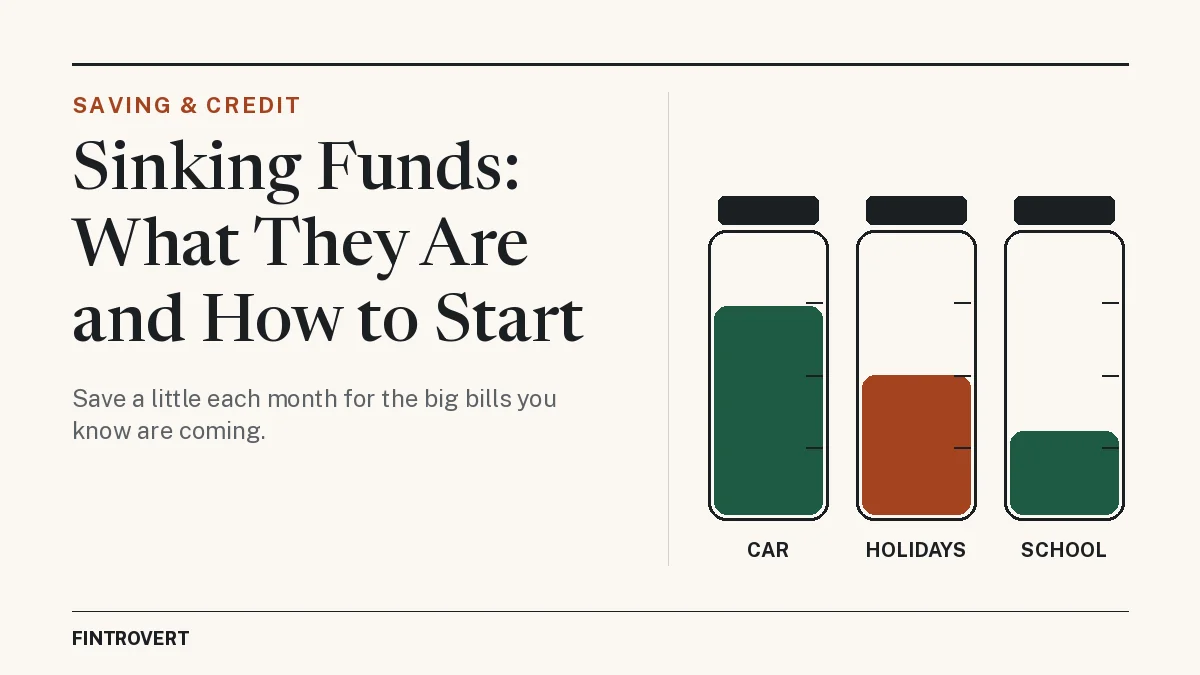

Some bills show up like clockwork every month. Others hit two or three times a year, or only once, and they’re often the ones that throw a budget off: the car insurance premium, holiday gifts, new tires, the back-to-school list. A sinking fund is a simple way to stop those bills from feeling like surprises. You figure out what’s coming, divide it by the months you have left, and set that amount aside a little at a time. This guide explains what sinking funds are, how they differ from an emergency fund, and how to start one this week with real dollar examples.
What is a sinking fund?
A sinking fund is money you save on purpose for a specific expense you know is coming. Instead of paying a large bill all at once, you spread the cost over the months before it’s due. When the bill arrives, the cash is already waiting.
The Consumer Financial Protection Bureau calls these periodic expenses. In its Your Money, Your Goals toolkit, the CFPB describes them as expenses that come only once or a few times a year, like renters insurance, income taxes, car insurance or children’s school supplies. As the toolkit puts it, they’re not unexpected, but they can be hard to pay for all at once if you haven’t been setting money aside.
Sinking funds vs. an emergency fund
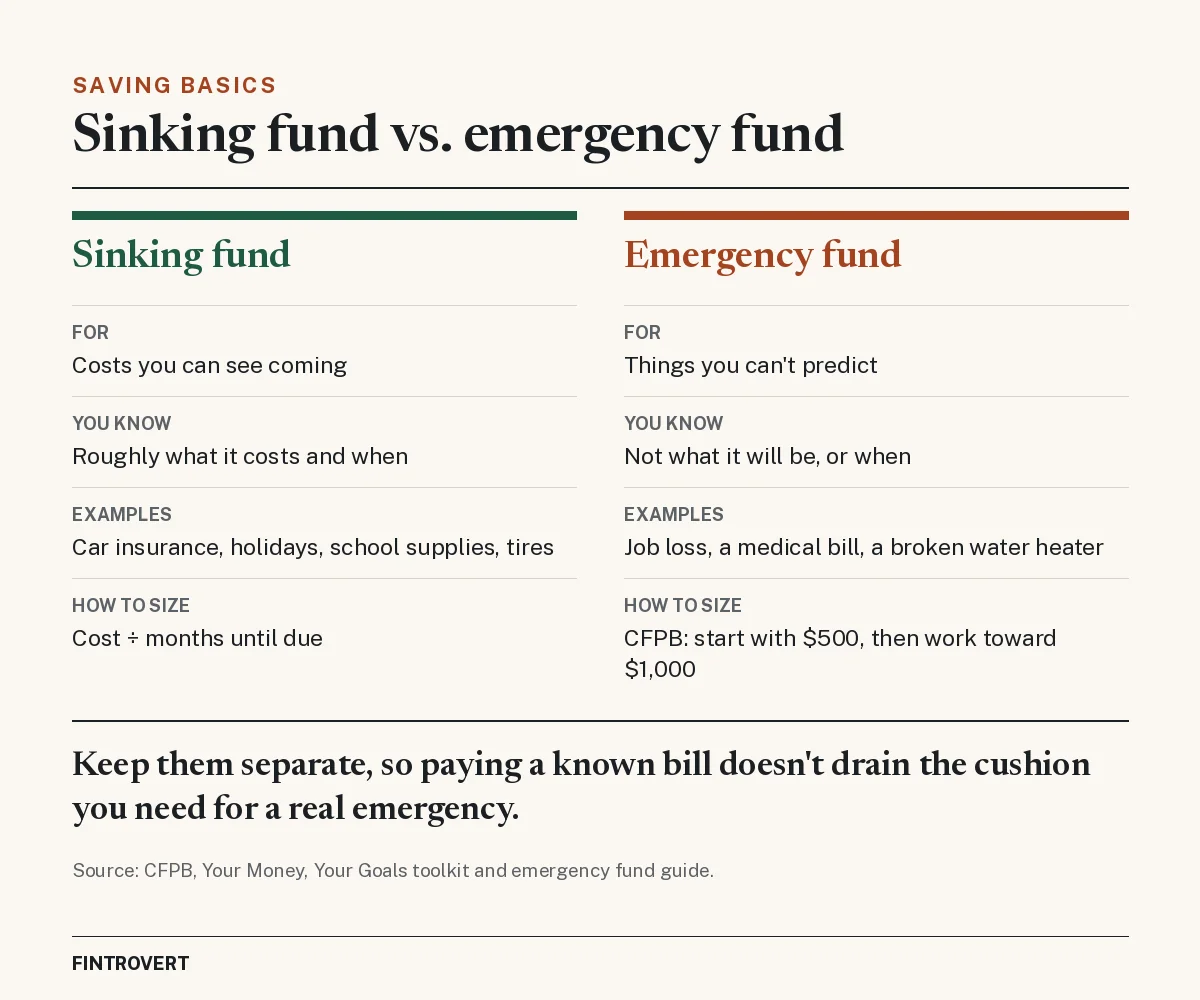
The two sound alike, but they do different jobs:
- Emergency fund: money for things you can’t predict, such as a job loss, a medical bill or a broken water heater. The CFPB’s guide to building an emergency fund describes it as a cash reserve set aside for unplanned expenses or financial emergencies.
- Sinking fund: money for things you can see coming, even if they don’t happen every month. You know roughly what they’ll cost and when.
Keep them apart. The CFPB toolkit suggests keeping money for goals separate from your emergency fund, so that covering a real emergency doesn’t wipe out what you saved for something else. The reverse matters too: if your car insurance comes out of your emergency fund every six months, you won’t have that cushion when something truly unexpected happens. If you don’t have any emergency savings yet, the CFPB toolkit suggests starting with a goal of $500 and then working toward $1,000. Our emergency fund calculator can help you size a bigger target.
Common things to build sinking funds for
The CFPB’s savings plan worksheet lists examples of expenses that come one to four times a year, including auto insurance, renters insurance, tools for your trade, back-to-school costs, birthdays and holidays. Other common ones include:
- Car maintenance, registration and new tires
- Annual subscriptions and memberships
- Home repairs and replacing worn-out appliances
- Medical and dental costs you expect, like a deductible or new glasses
- Travel and vacations
- Pet care, such as yearly vet visits
- Quarterly estimated taxes if you’re self-employed
- Bigger goals like a new laptop or a down payment on a car
A good way to build your list is to look back through the last 12 months of bank and card statements and note every cost that didn’t happen monthly.
How to calculate how much to save
The math is the same for every sinking fund:
Monthly amount = (expected cost minus what you’ve already saved) divided by the months until it’s due
This is the same approach the CFPB uses in its savings plan worksheet, where the example is saving $1,000 in 10 months by setting aside $100 a month.
Here’s what a set of sinking funds might look like for one household. These are example figures, so swap in your own.
| Expense | Cost | Months to save | Monthly amount |
|---|---|---|---|
| Car insurance (6-month premium) | $720 | 6 | $120 |
| Holiday gifts | $900 | 9 | $100 |
| Car maintenance and tires | $600 | 12 | $50 |
| Back-to-school costs | $400 | 8 | $50 |
| Annual subscriptions and memberships | $240 | 12 | $20 |
| Total | $2,860 | $340 |
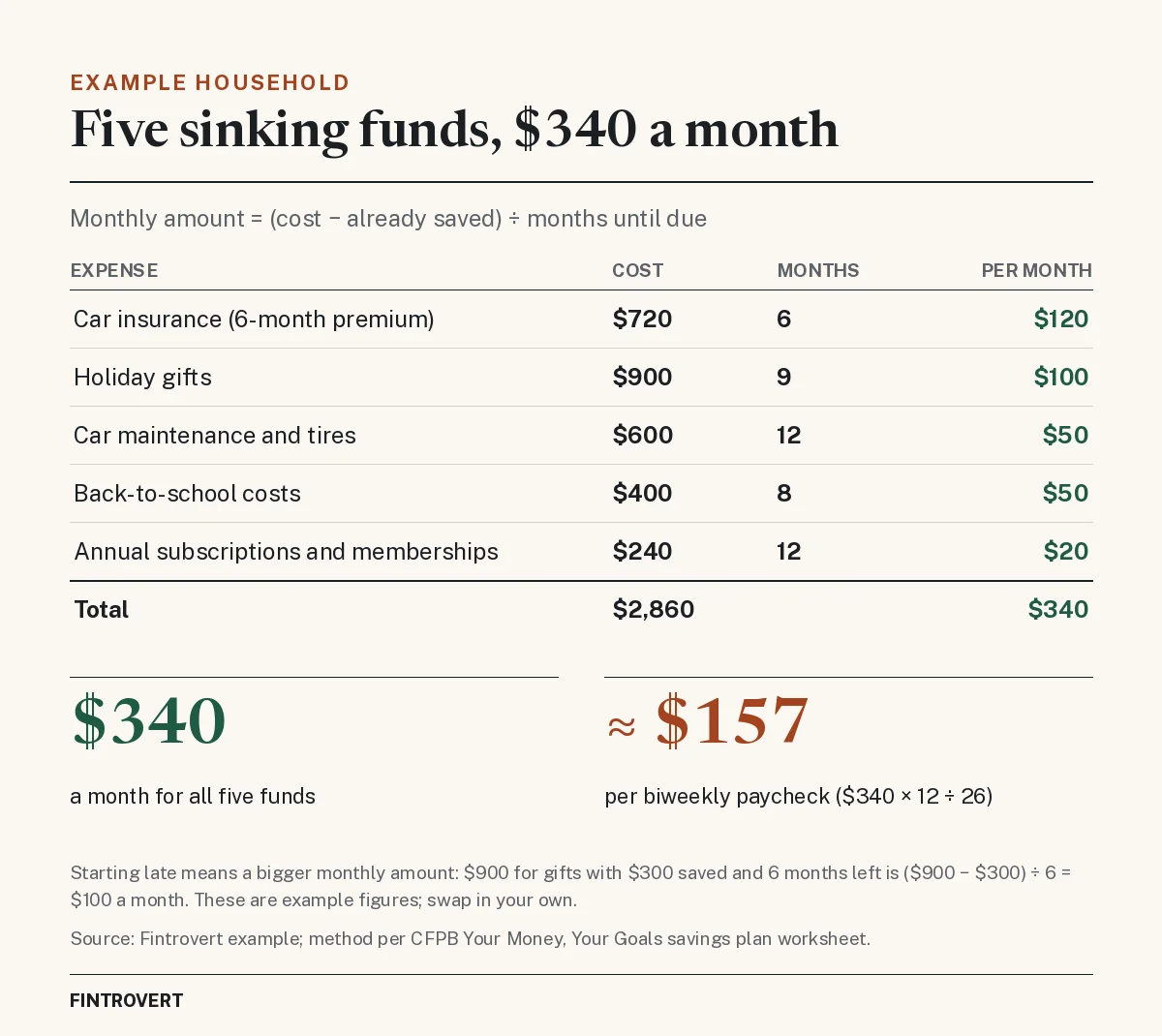
That’s $340 a month, or about $157 per paycheck if you’re paid every two weeks ($340 x 12 months divided by 26 paychecks). Compare that with getting hit by a $720 insurance bill and $900 in holiday spending in the same few months.
Starting late just means a bigger monthly amount. Say you want $900 for holiday gifts, you’ve saved $300 so far, and there are six months to go. You’d need ($900 minus $300) divided by 6, or $100 a month. Start in January next year and the same $900 over 12 months is only $75 a month.
How to start a sinking fund in 5 steps
1. List your non-monthly expenses
Go through your statements and your calendar. Write down each expense, what it cost last time and when it’s due next.
2. Pick your priorities
If you can’t fund everything right away, start with bills that are required and costly to miss, like insurance and car registration. Nice-to-haves like a vacation can come later.
3. Do the math for each one
Use the formula above, then add the monthly amounts together. Fit that total into your budget. Our 50/30/20 budget planner can show where the money might come from.
4. Choose where to keep the money
Keep sinking funds out of your everyday checking account, where it’s easy to spend them by accident. A savings account works well. Some people use one account and track each fund in a spreadsheet; others open several savings accounts or use “buckets” if their bank offers them. A high-yield savings account can help your money earn a little while it waits.
Since this is money you’ll need on a set date, keep it somewhere safe rather than in the stock market. Per the FDIC, deposits in checking, savings, money market deposit accounts and CDs are insured to at least $250,000 at each FDIC-insured bank. Credit union accounts get similar protection through the NCUA.
5. Automate it
Set up an automatic transfer from checking to savings for the day after payday. Once it’s automatic, you don’t have to remember it, and you’re less tempted to skip a month.
Using the money
When the bill comes, pay it from the fund, or pay it from checking and move the matching amount over from savings. Then reset. If the bill came in higher than you planned, raise next year’s monthly amount. If it came in lower, roll the leftover into next year’s fund or another goal.
Sinking funds also help you avoid putting predictable bills on a credit card. The CFPB notes that borrowing to cover an expense usually means paying fees and interest on top of the original cost. If you’re already carrying a balance, see our guide on how to pay off credit card debt.
Tips that make sinking funds easier
- Start small. Even one fund for your biggest yearly bill makes a difference.
- Name your accounts. Seeing “Car Insurance” or “Holidays” on a balance makes it easier to leave the money alone.
- Use windfalls. The CFPB suggests setting a goal for how much of a tax refund to save. A refund or bonus can jump-start a fund.
- Review once or twice a year. Prices change, so update your amounts when your premiums or plans do.
- If your income varies, the CFPB toolkit suggests setting aside more in higher-income weeks or months to cover the leaner ones.
The bottom line
Sinking funds turn big, irregular bills into small, steady ones. List what’s coming, divide each cost by the months you have, keep the money in a separate insured savings account and automate the transfers. Keep them separate from your emergency fund so each one can do its job. For more ways to save and manage credit, visit our Saving & Credit hub.
This article is for general educational purposes and isn’t personalized financial advice.
1 thought on “Sinking Funds: What They Are and How to Start”