

Credit card debt has a way of sticking around. You make a payment, interest gets added, and the balance barely moves. The good news is that there are proven ways to pay off credit card debt faster, and most of them cost nothing but a plan and some follow-through. This guide walks through the main options, shows the real dollar difference between two popular methods, and explains when outside help makes sense.
Why credit card debt is so hard to shake
It mostly comes down to the interest rate. According to the Federal Reserve’s G.19 consumer credit report, the average rate on credit card accounts that were charged interest was above 22% in its most recent reading. At that rate, a $5,000 balance builds up roughly $90 or more in interest every month. If your payment is close to the minimum, much of it goes to interest instead of the balance.
So every strategy below works by doing one or both of two things: putting more money toward the balance each month, or lowering the interest rate you pay while you do it.
Step one: know exactly what you owe
Before you pick a method, list every card with its balance, interest rate (APR) and minimum payment. Your monthly statement shows all three. It also shows a “minimum payment warning” that tells you how long payoff would take if you paid only the minimum, which is often a wake-up call. If you think you’re missing an account, you can check your credit reports for free, as the CFPB explains.
Next, figure out how much you can put toward debt each month in total. A simple budget helps here. Our 50/30/20 budget planner can show where some extra dollars might come from.
Avalanche vs. snowball: two ways to order your payments
Both methods start the same way. You pay the minimum on every card so you never miss a payment, then send every extra dollar to one target card. When that card is paid off, you roll its payment into the next one. The only difference is which card you target first.
The avalanche method
With the avalanche method, you target the card with the highest interest rate first. Because you’re cutting down the most expensive debt first, this approach costs the least in total interest.
The snowball method
With the snowball method, you target the smallest balance first, no matter the rate. You pay off your first card sooner, and that early win can keep you motivated. The trade-off is that you usually pay somewhat more interest.
A worked example
Say you have three cards and can put $500 a month toward them in total:
| Card | Balance | APR | Minimum payment |
|---|---|---|---|
| Card A | $1,200 | 18% | $35 |
| Card B | $4,500 | 24% | $110 |
| Card C | $3,300 | 28% | $90 |
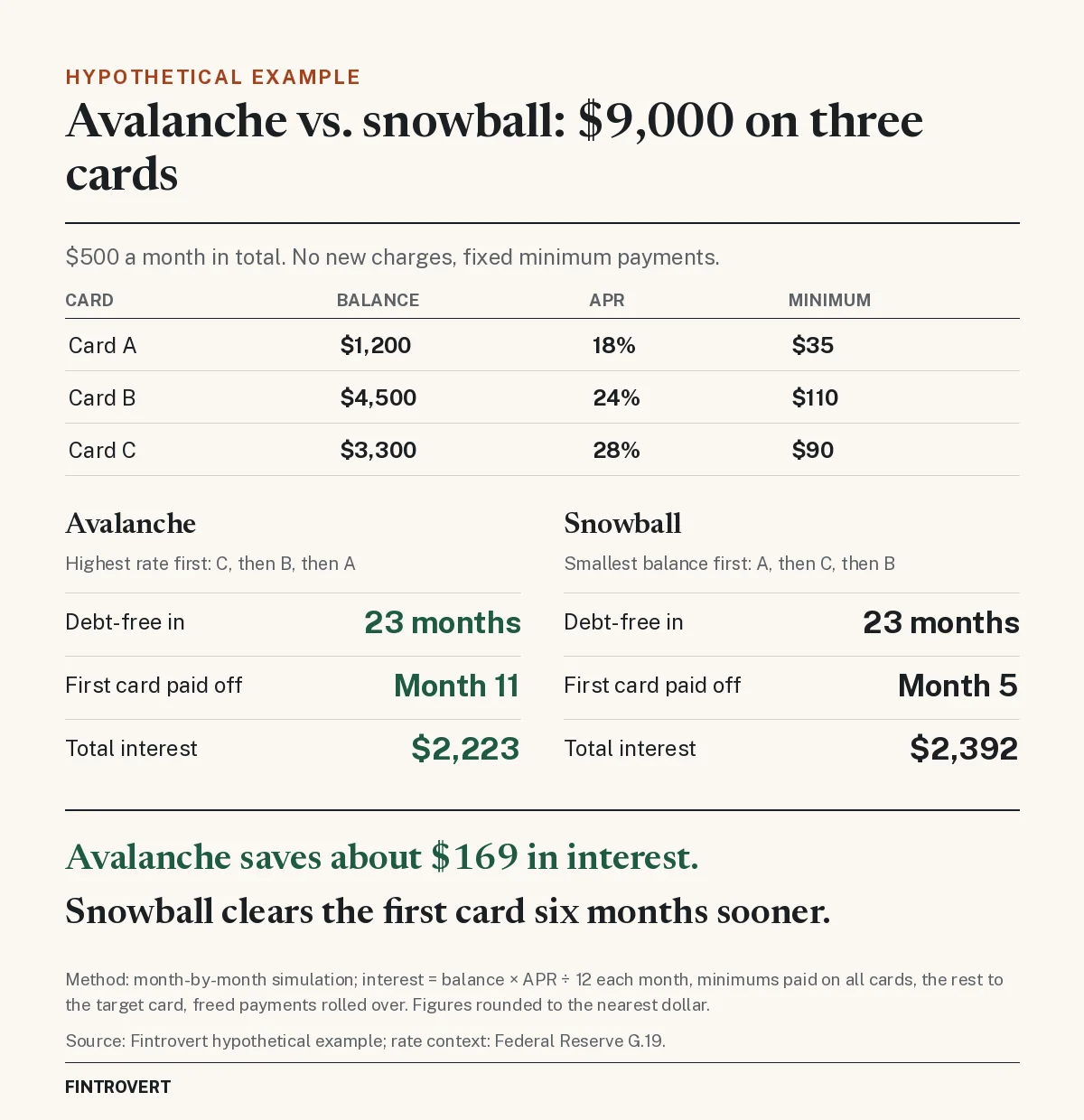
That’s $9,000 in total. Here’s how the two methods compare, with interest figured monthly:
- Avalanche (Card C, then B, then A): debt-free in 23 months, about $2,223 in total interest. Your first card is gone in month 11.
- Snowball (Card A, then C, then B): debt-free in 23 months, about $2,392 in total interest. Your first card is gone in month 5.
In this case, the avalanche saves about $169. The snowball gets you a paid-off card six months sooner. Neither choice is wrong. The best method is the one you’ll actually stick with. You can plug in your own cards with our Debt Payoff Calculator to see your numbers.
Balance transfer cards
A balance transfer moves debt from one or more cards to a new card, often one with a low or 0% introductory rate. The CFPB notes that these offers usually come with a balance transfer fee and that the promotional rate ends after a set period, after which the regular rate applies to what’s left.
Here’s how the math can look. If you move $9,000 to a card with a 0% rate for 18 months and a 3% fee, the fee is $270. To clear the full $9,270 before the promo ends, you’d need to pay about $515 a month. That’s close to the $500 budget in the example above, but with almost no interest.
A few cautions. You generally need good credit to qualify. Read the terms closely, since a late payment can end the promotional rate early. And a transfer only helps if you stop adding new charges to the old cards.
Debt consolidation loans
A debt consolidation loan is a new loan, often a personal loan, that you use to pay off several debts so you have just one monthly payment. The CFPB points out that consolidation only saves money if the new loan’s rate and fees are lower than what you pay now, and that a longer term can mean more total interest even with a lower payment.
The Federal Reserve’s G.19 data shows average 24-month personal loan rates at commercial banks running well below average credit card rates, though the rate you’re offered depends on your credit. A fixed loan also gives you a set end date, which a credit card doesn’t. Use our loan comparison calculator to compare offers side by side.
Nonprofit credit counseling and debt management plans
If you’re struggling to keep up, a reputable credit counselor can help. According to the CFPB, credit counseling organizations can advise you on managing your money and debts, help you build a budget, and offer free educational materials.
A counselor may suggest a debt management plan (DMP). Under a DMP, you make one monthly payment to the counseling agency, and it pays your creditors. The CFPB says these plans usually work to lower your monthly payment, and creditors may agree to reduce interest or waive fees. You’ll typically be asked to stop using the cards in the plan.
Be careful about who you work with. Look for a nonprofit agency, ask about all fees up front, and be wary of any company that charges big fees before doing anything or tells you to stop paying your debts. The FTC warns that debt settlement is a different and riskier service than credit counseling and can hurt your credit. The U.S. Department of Justice also keeps a list of approved credit counseling agencies for people considering bankruptcy, which is one place to start your search.
Call your card issuer
It’s worth a phone call. Ask your issuer whether it can lower your interest rate, especially if you have a history of on-time payments. If you’re facing a hardship, such as a job loss or medical bills, ask whether it offers a hardship program with a lower rate or smaller payments for a while. Not every issuer will say yes, but the call is free. Get any agreement in writing, and ask how it will be reported to the credit bureaus.
Avoid adding new debt while you pay it off
No payoff plan works if the balance keeps growing. A few habits help:
- Take the cards you’re paying down out of your wallet and off your saved payment settings.
- Build a small emergency fund so a surprise bill doesn’t go back on a card. Our emergency fund calculator can help you set a target, and a high-yield savings account is a good place to keep it.
- Set up autopay for at least the minimum on every card so you never pay a late fee.
- Keep paid-off cards open unless they charge an annual fee. Closing old accounts can affect your credit utilization.
How paying off cards can help your credit
How much of your available credit you use is a big factor in your credit scores. As your balances fall, your utilization drops, and your score often improves. On-time payments help too. See our guide to credit score ranges to understand where you stand.
Quick checklist
- List every card with its balance, APR and minimum payment.
- Set a monthly debt budget you can keep.
- Pick avalanche (lowest cost) or snowball (fastest early win).
- Look at a balance transfer or consolidation loan if you can get a lower rate, and add up all fees first.
- Call your issuers and ask for a lower rate or a hardship plan.
- If you’re falling behind, talk to a nonprofit credit counselor about a debt management plan.
- Stop adding new charges and build a small emergency fund.
For more ways to manage your money, visit our Saving & Credit hub.
This article is general information, not financial or legal advice. Rates and offers change, so check current terms with your lender or a qualified professional before you act.