
Use this retirement calculator to see how much your savings could grow by the time you stop working. Enter your age, when you plan to retire, what you have saved so far and what you add each month. You can also include an employer match. The calculator shows a projected balance, a year-by-year summary and a rough idea of the yearly income that balance might support.
Project your retirement savings
Year-by-year growth
How this retirement calculator works
The math is plain compound growth. Each month, your balance earns one twelfth of the annual return you entered, then your contribution and any employer match are added. This is the same idea behind the compound interest calculator on Investor.gov, the SEC's site for everyday investors, where you can also test a range of rates.
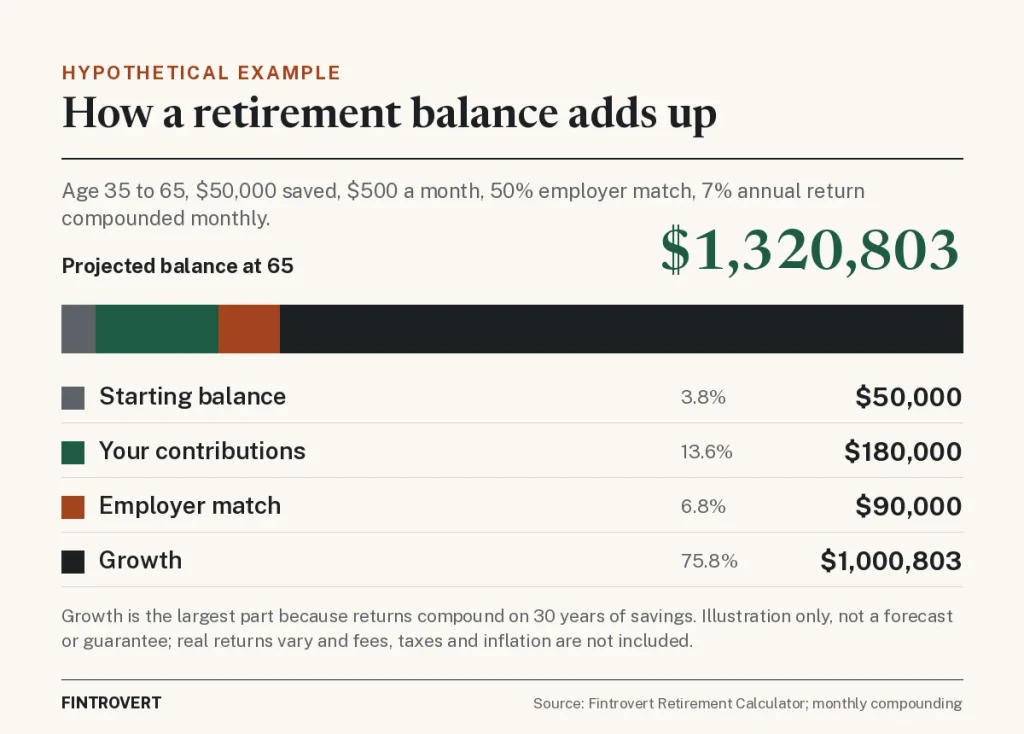
For example, a 35-year-old with $50,000 saved who adds $500 a month, gets a 50% employer match and earns 7% a year would have about $1,320,803 at 65. Of that, $50,000 is the starting balance, $180,000 comes from their own contributions, $90,000 from the match and about $1,000,803 from growth. At a 4% withdrawal rate, that balance could support roughly $52,832 a year. These numbers are illustrations, not promises.
About the withdrawal rate
The income figure is only as good as the withdrawal-rate assumption behind it. We start at 4% of your balance in the first year because it is a common planning shortcut, but it isn't an official rule and it can't guarantee your money will last. A lower rate is more cautious. Your real spending will depend on market returns, inflation, taxes, fees and how long you live.
2026 contribution limits to keep in mind
If you want to raise your monthly contribution, check the yearly caps first. According to the IRS, for 2026:
- You can put up to $24,500 into a 401(k), 403(b), governmental 457 plan or the Thrift Savings Plan.
- If you are 50 or older, you can usually add a catch-up contribution of $8,000, for a total of $32,500.
- If you are 60, 61, 62 or 63, a higher catch-up limit of $11,250 applies in these plans.
- The IRA contribution limit is $7,500, plus a $1,100 catch-up if you are 50 or older.
Don't forget Social Security
This calculator only covers your own savings. Most workers will also get Social Security. The Social Security Administration says you can start benefits as early as 62, but your monthly check is reduced if you start before your full retirement age, which is 67 for anyone born in 1960 or later. Waiting past full retirement age, up to 70, raises your benefit.
Want to dig into one piece of the plan? Our 401(k) calculator focuses on workplace plans, and the Roth vs Traditional IRA calculator helps you compare the two account types. You'll find more tools on our calculators page and more guides in Retirement.
Retirement calculator FAQ
Does this calculator account for inflation?
No. Results are in future dollars. To get a rough sense of today's dollars, you can enter a lower return, for example your expected return minus the inflation rate you expect.
Are taxes included?
No. Withdrawals from traditional 401(k) and IRA accounts are generally taxed as income, while qualified Roth withdrawals are not. The income estimate is before any tax.
How is the employer match handled?
The match is entered as a percent of your own contribution and added each month. Real plans often cap the match at a share of your pay, so check your plan documents and use the amount you actually expect to get.
Disclaimer: This calculator gives an educational estimate only. It isn't financial, tax or investment advice. Returns are illustrative and not guaranteed, and results don't include inflation, taxes, fees or Social Security.
By Fintrovert Team