

If you earn $100,000 a year, lenders will probably approve you for more house than you’d guess. Whether you should borrow that much is a separate question. This guide shows how to work out how much house you can afford using the debt-to-income ratios lenders use, then runs the numbers on a $100,000 salary so you can see how rates, other debts, and your down payment change the answer.
If you’d rather plug in your own numbers first, our home affordability calculator does the math for any income and debt-to-income ratio you choose.
The short answer
Under the common 28/36 guideline, with a 20% down payment, no other debt payments above $500 a month, and the current average 30-year rate, a $100,000 salary supports a home price of roughly $334,000. That’s an illustration built on assumptions spelled out below, not a quote. Your number could be well above or below it depending on your rate, your local property taxes, and what else you owe each month.
How lenders measure what you can afford
Lenders mostly look at one number: your debt-to-income ratio, or DTI. The CFPB defines DTI as all your monthly debt payments divided by your gross monthly income, meaning your pay before taxes and other deductions. In the CFPB’s own example, someone with $2,000 in monthly debt payments and $6,000 in gross monthly income has a DTI of 33%.
Mortgage lenders usually split this into two ratios:
- Front-end ratio: your housing payment alone, including principal, interest, property taxes, and homeowners insurance (often shortened to PITI).
- Back-end ratio: your housing payment plus your other monthly debts, such as car loans, student loans, and credit card minimums.
The 28/36 guideline
The best-known rule of thumb is 28/36. The FDIC explains that lenders usually want your housing costs at or below 25% to 28% of gross monthly income, and your housing costs plus long-term debt at or below 33% to 36%. The CFPB’s Your Home Loan Toolkit uses the same 28% rule of thumb for the total monthly home payment, and adds that lenders may approve you for more or less depending on your overall finances.
What lenders will actually allow
The 28/36 rule is a guideline, not a legal cap. Many loans go higher. Fannie Mae’s Selling Guide sets a maximum total DTI of 36% for manually underwritten loans, which can go up to 45% if the borrower meets credit score and reserve requirements. For loans run through its automated Desktop Underwriter system, the maximum is 50%. The CFPB’s debt-to-income worksheet suggests keeping total debt at 36% or less and notes that some lenders will go up to 43% or higher.
So there are really two answers to “how much house can I afford”: the amount a lender will approve, and the amount that leaves room in your budget for savings, repairs, and everything else. The rest of this guide uses 28/36 as the starting point because it’s the more conservative of the two.
Running the numbers on a $100,000 salary
A $100,000 salary works out to $8,333 a month before taxes. Applying the guideline:
- 28% for housing: $8,333 × 0.28 = about $2,333 a month for principal, interest, taxes, and insurance.
- 36% for all debt: $8,333 × 0.36 = $3,000 a month for housing plus everything else you owe.
Your housing budget is whichever limit is lower. If your other debts are $667 a month or less, the 28% limit is the one that binds. Above that, the 36% limit takes over and your housing budget shrinks dollar for dollar.
Assumptions for the examples
These figures are for illustration only. Your own taxes, insurance, and rate will differ.
- Interest rate: 7.32% on a 30-year fixed loan, the average Freddie Mac reported in its Primary Mortgage Market Survey for the week of October 22, 2026. That survey reflects borrowers with good to excellent credit putting 20% down, so your quote may be higher or lower.
- Down payment: 20%, so no private mortgage insurance.
- Property taxes: an assumed $350 a month.
- Homeowners insurance: an assumed $150 a month.
- No HOA dues.
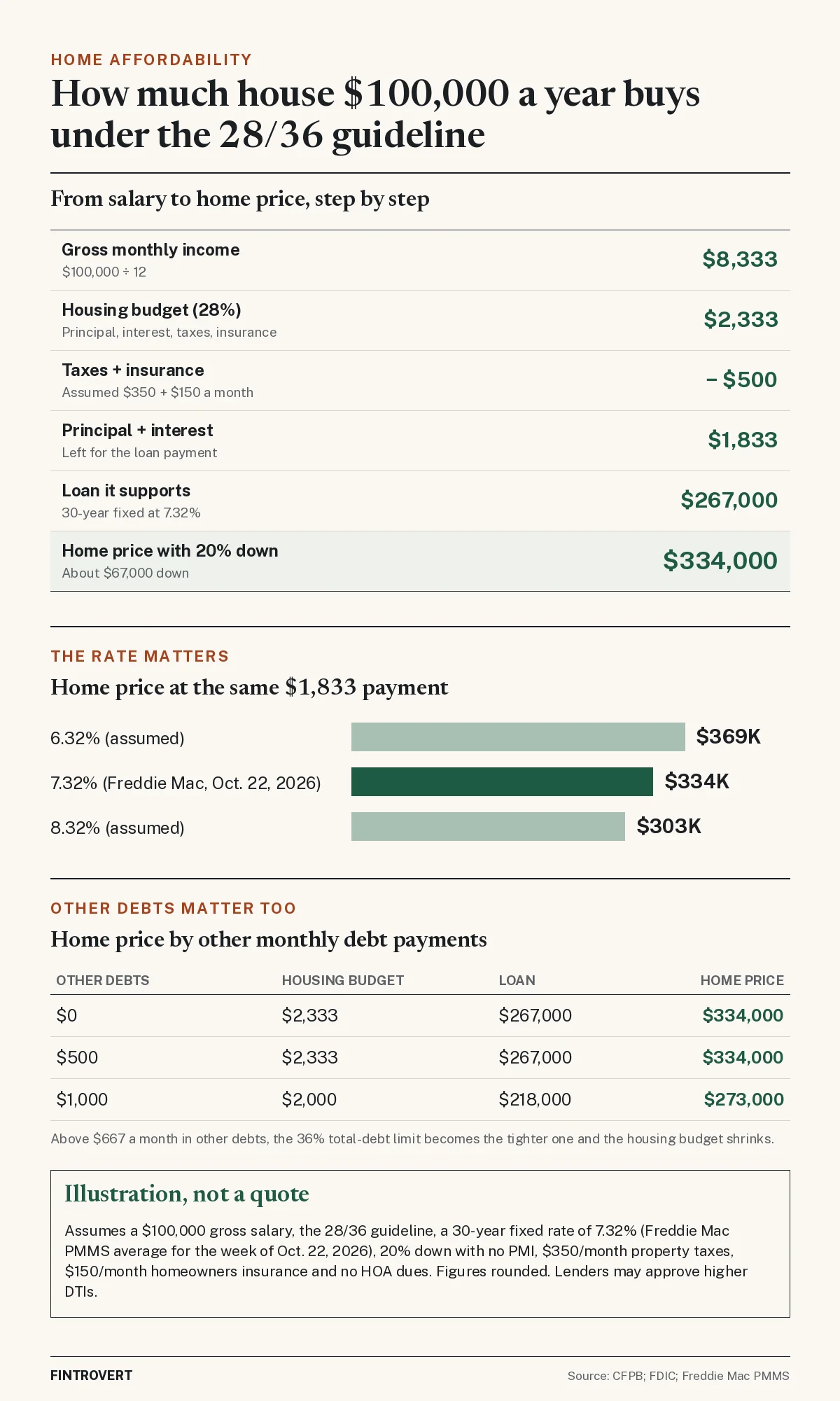
With $500 going to taxes and insurance, about $1,833 of the $2,333 housing budget is left for principal and interest. At 7.32% over 30 years, that payment supports a loan of about $267,000. Add a 20% down payment and the home price comes to roughly $334,000, with about $67,000 down.
How other debts change the answer
| Other monthly debts | Housing budget (PITI) | Loan amount | Home price (20% down) |
|---|---|---|---|
| $0 | $2,333 | About $267,000 | About $334,000 |
| $500 | $2,333 | About $267,000 | About $334,000 |
| $1,000 | $2,000 | About $218,000 | About $273,000 |
A $500 car payment doesn’t change anything here, because $2,333 plus $500 is still under the $3,000 back-end limit. A $1,000 total in car and student loan payments does. It cuts the housing budget to $2,000 and the price you can afford by about $61,000. Paying down a balance before you apply can make a real difference, and our debt payoff calculator can help you plan it.
How the interest rate changes the answer
Holding everything else the same, here’s what the same $1,833 principal-and-interest payment buys at the current average rate and one percentage point either side of it. The 6.32% and 8.32% rates are assumed for comparison, not quotes.
| 30-year fixed rate | Loan amount | Home price (20% down) |
|---|---|---|
| 6.32% (assumed) | About $296,000 | About $369,000 |
| 7.32% (Freddie Mac PMMS, Oct. 22, 2026) | About $267,000 | About $334,000 |
| 8.32% (assumed) | About $242,000 | About $303,000 |
One point on the rate moves the price you can afford by roughly $31,000 to $36,000 on this salary. That’s why it pays to compare offers from several lenders and to work on your credit before you apply. Our guide to credit score ranges covers what lenders look at.
What a higher DTI would allow
Say a lender approves you at a 43% total DTI instead of 36%, and you have $500 in other monthly debts. On $8,333 a month, 43% is about $3,583. Subtract the $500 in other debts and the $500 for taxes and insurance, and about $2,583 is left for principal and interest. At 7.32%, that supports a loan of about $376,000 and a home price near $470,000 with 20% down.
That’s about $136,000 more house than the 28/36 version, and the monthly housing payment rises from $2,333 to about $3,083. That’s 37% of your gross pay before you’ve bought groceries or saved anything. A bigger approval isn’t wrong, but it’s worth running your real monthly budget before you take it.
The down payment and mortgage insurance
Twenty percent down isn’t required for most loans, but it changes the math. The CFPB explains that if you put less than 20% down on a conventional loan, you’ll usually have to pay private mortgage insurance (PMI). PMI protects the lender, not you, and it’s added to your monthly payment. That extra cost comes out of the same housing budget, so a smaller down payment generally means a lower price you can afford on the same income.
PMI doesn’t last forever. Per the CFPB, you can ask your servicer to cancel it once your balance is scheduled to reach 80% of the home’s original value, and the servicer generally must end it automatically when the balance is scheduled to hit 78%, as long as you’re current on payments.
FHA loans are another option for smaller down payments. HUD notes that FHA’s minimum required investment is 3.5% in most cases, and the money can come from your own savings, gifts, or approved down payment assistance. FHA loans carry their own mortgage insurance with different rules, so compare the total monthly cost, not just the down payment.
To see how PMI, taxes, insurance, and HOA dues change a specific payment, try our mortgage payment calculator.
Costs the ratios leave out
DTI ratios only count fixed monthly debts. They don’t count the costs that come with owning a home, and they don’t know what your take-home pay looks like after taxes and retirement contributions. Before settling on a price, think about:
- Closing costs. These are separate from the down payment. Your Loan Estimate lists them, and the CFPB toolkit walks through each section.
- Maintenance and repairs. Renters call the landlord. Owners pay for the roof, the water heater, and the furnace.
- Utilities and commuting. A bigger house or a longer drive can add up every month.
- Savings after closing. Emptying your accounts for the down payment leaves no cushion. Our emergency fund calculator can help you set a target to keep in reserve.
Property taxes and insurance also vary a lot by location. The $500 a month in our examples may be low or high for where you’re shopping, so get real figures from listings, your county’s tax records, and insurance quotes.
Frequently asked questions
How much house can I afford on $100k a year?
Using the 28/36 guideline, a 7.32% rate, 20% down, $500 a month for taxes and insurance, and modest other debts, roughly $334,000. A lower rate, lower taxes, or a lender that allows a higher DTI would raise that figure. More debt or a smaller down payment would lower it.
Is the 28/36 rule a requirement?
No. It’s a rule of thumb. Fannie Mae allows total DTI up to 45% on some manually underwritten loans and up to 50% through its automated system, and individual lenders set their own limits.
Does DTI use my take-home pay?
No. The CFPB defines DTI using gross monthly income, which is your pay before taxes and deductions. Your actual budget runs on take-home pay, which is one reason to stay below the maximum a lender offers.
Do I need 20% down?
Not always. Conventional loans with less than 20% down usually require PMI, and FHA loans can require as little as 3.5% in most cases. A smaller down payment means a larger loan and usually a higher monthly cost.
The bottom line
To answer “how much house can I afford,” start with your gross monthly income, apply the 28/36 guideline, subtract realistic taxes and insurance, and see what loan the remaining payment supports at today’s rates. On a $100,000 salary, that lands around $334,000 under our assumptions, and it moves quickly with your rate, your debts, and your down payment. Lenders may approve more, so decide on your comfortable number before you start shopping. For more on borrowing and saving, visit our Saving & Credit hub.
Sources: CFPB, What is a debt-to-income ratio?; CFPB, Your Home Loan Toolkit; CFPB, Debt-to-income calculator tool; FDIC, How Much Mortgage Can I Afford?; Fannie Mae Selling Guide, B3-6-02 Debt-to-Income Ratios; Freddie Mac, Primary Mortgage Market Survey; CFPB, What is private mortgage insurance?; CFPB, When can I remove PMI?; HUD, FHA Myths vs. Facts. Rates and examples are illustrations as of October 2026. This article is for general education and isn’t individual financial advice. By Fintrovert Team.