
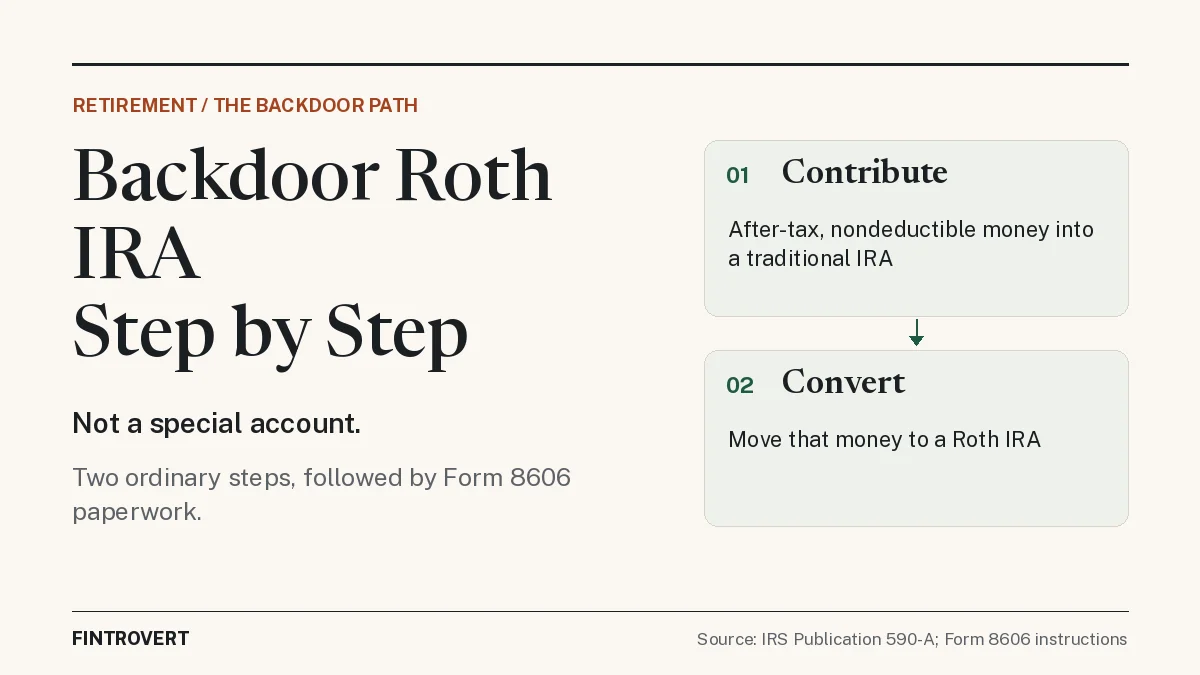

A backdoor Roth IRA is a way for people whose income is too high to contribute to a Roth IRA directly to still get money into one. It is not a special account. It is two ordinary steps done one after the other: you put after-tax (nondeductible) money into a traditional IRA, then you convert that money to a Roth IRA. This guide walks through who the backdoor Roth IRA is for, each step, the Form 8606 paperwork, and the pro-rata rule that trips up a lot of people.
If you want the details of how conversions are taxed in general, see our Roth conversion guide. Here we focus on the backdoor itself.
A note on years: as of November 2026, the IRS has not published 2027 IRA limits. The figures below are the official IRS numbers for tax year 2026.
Who a backdoor Roth is for
Direct Roth IRA contributions are limited by modified adjusted gross income (MAGI). For tax year 2026, the IRS says the Roth IRA contribution phase-out range is:
- Single, head of household, or married filing separately if you did not live with your spouse at any time during the year: $153,000 to $168,000
- Married filing jointly or qualifying surviving spouse: $242,000 to $252,000
- Married filing separately if you lived with your spouse at any time during the year: $0 to $10,000 (this range is not adjusted for inflation)
Above the top of your range, you can’t contribute to a Roth IRA directly that year. That’s the group the backdoor is usually discussed for.
Traditional IRAs work differently. Income doesn’t stop you from contributing; it can only limit whether the contribution is deductible. If you or your spouse is covered by a retirement plan at work, the deduction phases out at certain incomes. For 2026, the IRS lists these deduction phase-out ranges:
- Single or head of household, covered by a workplace plan: $81,000 to $91,000
- Married filing jointly or qualifying surviving spouse, contributing spouse covered: $129,000 to $149,000
- Not covered, but married to someone who is, and you live with your spouse or file a joint return: $242,000 to $252,000
- Married filing separately, covered, and you lived with your spouse: $0 to $10,000. If you file separately and did not live with your spouse at any time during the year, Publication 590-A says you use the single ranges.
When you can’t deduct some or all of a traditional IRA contribution, IRS Publication 590-A says you can still make the rest as a nondeductible contribution, up to the annual limit. That nondeductible money is the raw material for a backdoor Roth.
Step 1: Make a nondeductible traditional IRA contribution
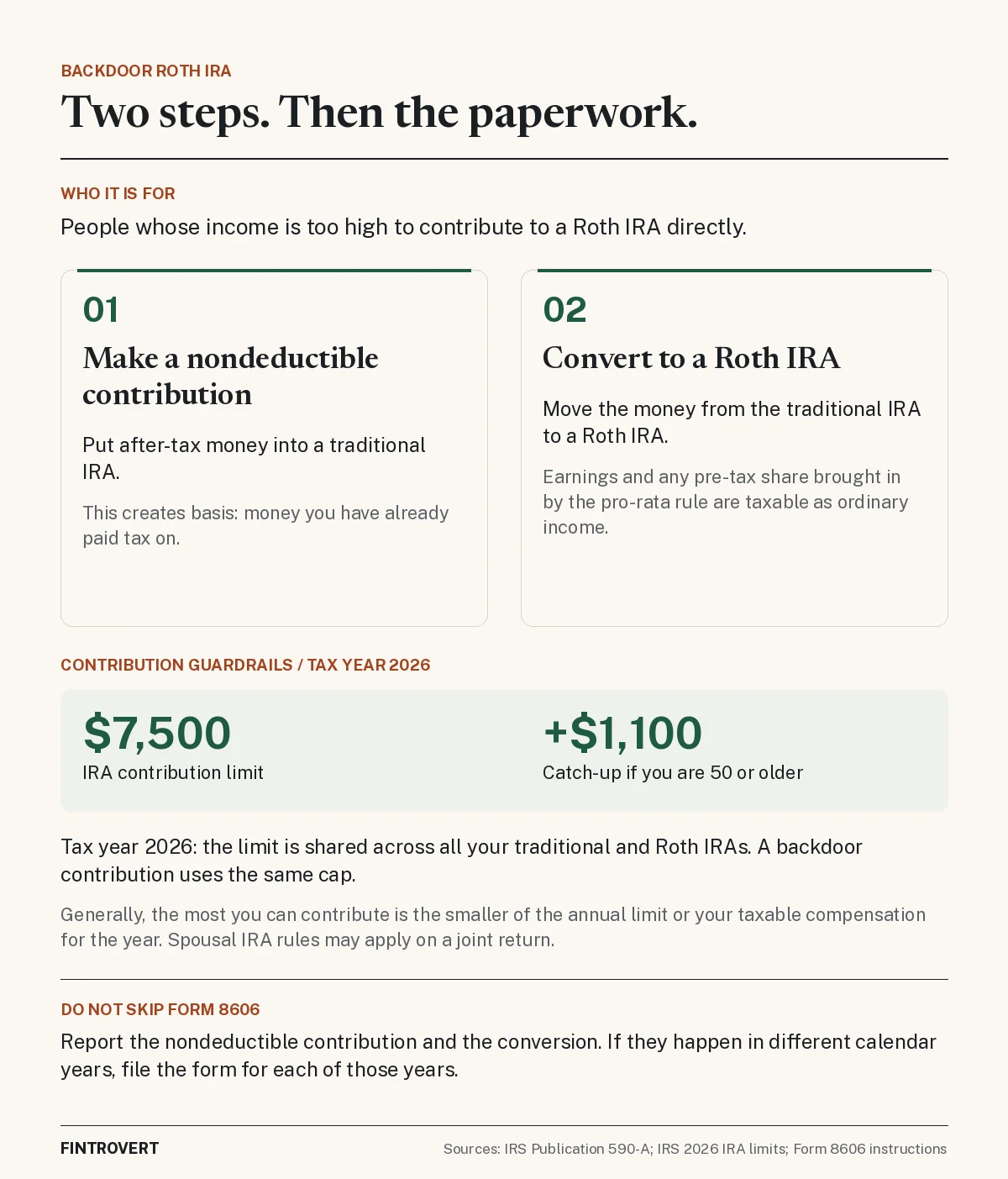
For tax year 2026, the IRS IRA contribution limit is $7,500, plus a $1,100 catch-up if you are 50 or older. That limit is shared across all your traditional and Roth IRAs for the year, so a backdoor contribution counts against the same cap.
A few rules from Publication 590-A to keep in mind:
- You need taxable compensation. The most you can contribute is generally the smaller of the annual limit or your taxable compensation for the year. On a joint return, a spouse with little or no compensation may be able to contribute based on the other spouse’s compensation (a spousal IRA).
- No age cap. For tax years after 2019, you can contribute to a traditional IRA at any age.
- Deadline. Contributions for a year can be made up to the due date of that year’s return, not including extensions. For most people, 2026 contributions are due by April 15, 2027.
Step 2: Convert to a Roth IRA
Next, you move the money from the traditional IRA to a Roth IRA. Publication 590-A describes three ways to convert: a 60-day rollover, a trustee-to-trustee transfer between providers, or a same-trustee transfer (often just a re-designation by your IRA provider). Many people use a direct transfer so they don’t have to manage a 60-day deadline.
One point that confuses people: the IRS’s one-rollover-per-year limit for IRAs does not apply here. Publication 590-A says trustee-to-trustee transfers and rollovers from traditional IRAs to Roth IRAs (conversions) aren’t limited by that rule.
The part of the conversion that comes from your nondeductible basis isn’t taxed again. Any earnings the money picked up before you converted it, and any pre-tax IRA money pulled in by the pro-rata rule below, are taxable as ordinary income. Our Roth conversion article covers how that taxable amount is handled in more depth.
Step 3: Report it on Form 8606
Form 8606, Nondeductible IRAs, is where the backdoor gets documented. You use it to:
- Report the nondeductible contribution (Part I). This creates your “basis,” the after-tax money you’ve already paid tax on.
- Report the conversion from a traditional IRA to a Roth IRA (Part II) and figure how much of it is taxable.
Publication 590-A notes there is a penalty for failing to file Form 8606 to report a nondeductible contribution. Without the form, you also have no record of your basis, which can lead to paying tax on the same money twice. Keep copies of every Form 8606 you file.
The pro-rata rule: the big catch
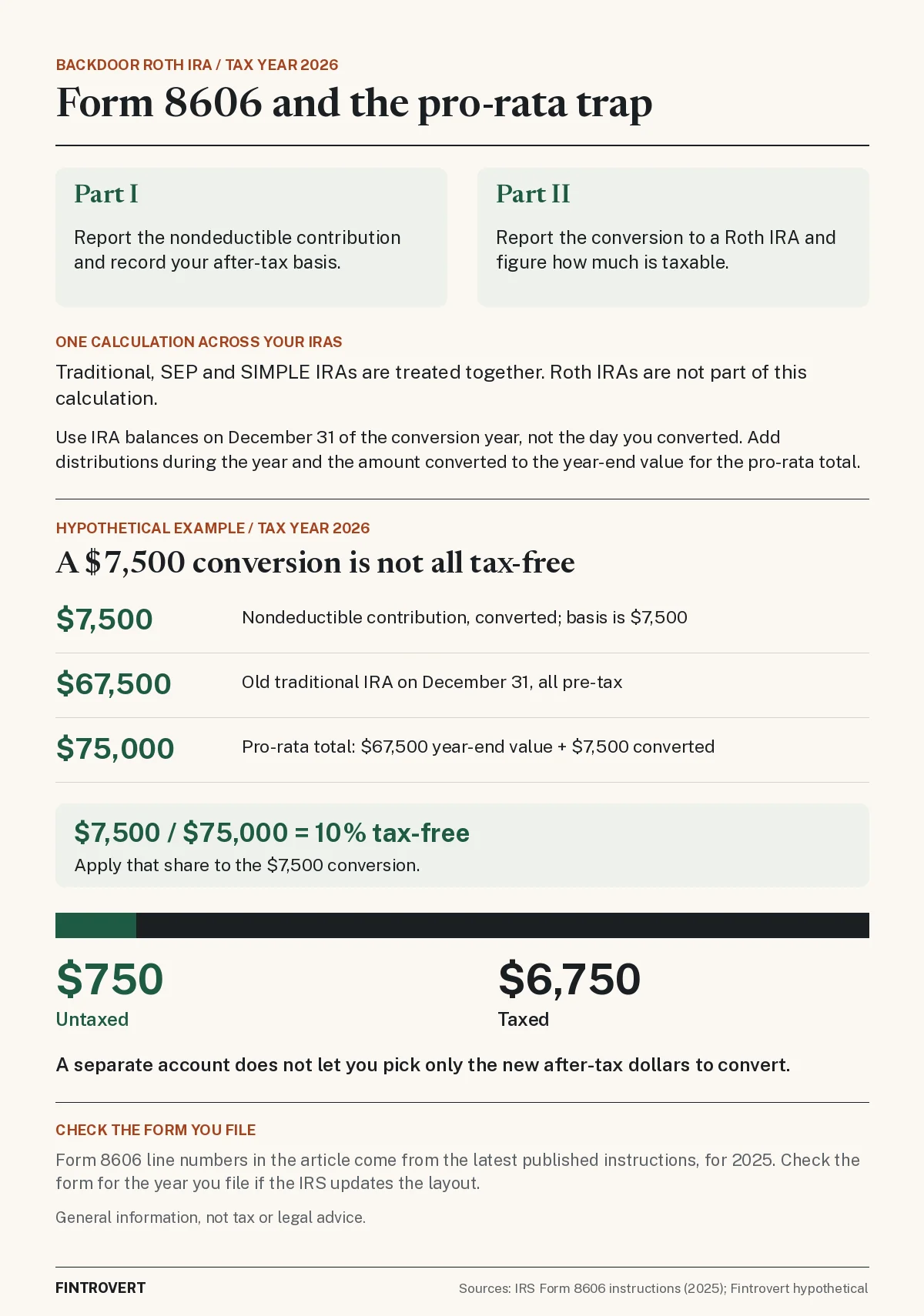
Here’s where many backdoor Roths go wrong. You don’t get to pick and choose which IRA dollars you convert. For Form 8606, the IRS treats your traditional IRAs together, and the instructions say the term “traditional IRA” includes traditional SEP IRAs and traditional SIMPLE IRAs. Roth IRAs are not part of this calculation.
So if you already have pre-tax money in any traditional, SEP, or SIMPLE IRA, your conversion is taxed in proportion to the mix of after-tax basis and pre-tax money across all of them. That’s true even if you convert only the new nondeductible contribution from a separate account.
The Form 8606 math works roughly like this:
- Add up your total basis (line 5).
- Add the value of all your traditional IRAs on December 31 of the year (line 6), plus distributions taken during the year (line 7) and the amount you converted (line 8). That total is line 9.
- Divide basis by that total (line 10). That’s the nontaxable share.
- Multiply the amount you converted by that share. The result is the nontaxable part of the conversion; the rest is taxable.
Those line numbers come from the latest published Form 8606 instructions, which are for 2025. Check the form for the year you file if the IRS updates the layout.
Illustration (hypothetical, 2026 figures): Sam makes a $7,500 nondeductible contribution and converts the $7,500 a few days later. Sam also has an old traditional IRA worth $67,500 on December 31, all pre-tax. Basis is $7,500. The total is $67,500 + $7,500 = $75,000, so the nontaxable share is 10%. Only $750 of the $7,500 conversion is tax-free, and $6,750 is taxable. If Sam had no other traditional, SEP, or SIMPLE IRA money at year-end, the whole $7,500 conversion would be nontaxable (apart from any earnings).
Notice the date: the calculation uses your IRA balances on December 31 of the conversion year, not the day you converted. Money sitting in a 401(k) or other workplace plan isn’t an IRA and isn’t entered on line 6.
A quick checklist
- Check whether your MAGI is actually over the Roth limit. If not, a direct Roth contribution is simpler.
- Total up every traditional, SEP, and SIMPLE IRA you have, so you know your pro-rata exposure before converting.
- Contribute within the annual limit and by the filing deadline (no extensions).
- Convert, and expect tax on any earnings and any pre-tax share.
- File Form 8606 to report the nondeductible contribution and the conversion. If those happen in different calendar years, file the form for each of those years.
FAQ
Is a backdoor Roth IRA a separate kind of account?
No. It’s a regular traditional IRA contribution followed by a regular Roth conversion. Both steps are described in IRS Publication 590-A.
Do I have to file Form 8606?
Yes, if you make a nondeductible contribution or convert traditional IRA money to a Roth IRA.
What are the 2027 limits?
The IRS hasn’t announced them yet. We’ll update this guide when it does.
Official sources
- IRS: 2026 IRA limits and phase-out ranges
- IRS Publication 590-A, Contributions to IRAs
- IRS Publication 590-B, Distributions from IRAs
- Instructions for Form 8606, Nondeductible IRAs
More retirement guides are on our Retirement hub.
This article is general information, not tax or legal advice. IRA rules depend on your situation; consider talking with a tax professional before converting.
By Fintrovert Team