

The earned income tax credit, or EITC, is one of the biggest tax breaks available to working people with low to moderate incomes. It can cut the tax you owe, and because it’s refundable, it can also put money in your pocket even if you owe no tax at all. Still, plenty of people who qualify never claim it. This guide covers who qualifies, how much the credit is worth, how to claim it, when the refund arrives and where to get free help filing. The 2026 figures here are for tax year 2026, meaning the return you file in early 2027. If you are filing in 2026 for tax year 2025, see the 2025 amounts further down.
What is the earned income tax credit?
The EITC is a federal tax credit for people who work and earn a modest income. The amount depends on three things: how much you earn, your filing status and how many qualifying children you claim. It rises as your earnings go up, levels off at a maximum, and then shrinks to zero as your income climbs past a set point.
A credit is different from a deduction. A deduction lowers the income you’re taxed on, while a credit comes straight off your tax bill. And since the EITC is refundable, any amount left over after your tax hits zero comes back to you as part of your refund.
EITC amounts for tax year 2026
The IRS adjusts the EITC for inflation each year. The figures below come from IRS Revenue Procedure 2025-32 and apply to tax year 2026. That means work you do in 2026, reported on the return you file in early 2027.
| Qualifying children | Maximum credit | Earned income needed for the maximum | Credit ends at (single, head of household and other filers) | Credit ends at (married filing jointly) |
|---|---|---|---|---|
| None | $664 | $8,680 | $19,540 | $26,820 |
| One | $4,427 | $13,020 | $51,593 | $58,863 |
| Two | $7,316 | $18,290 | $58,629 | $65,899 |
| Three or more | $8,231 | $18,290 | $62,974 | $70,244 |
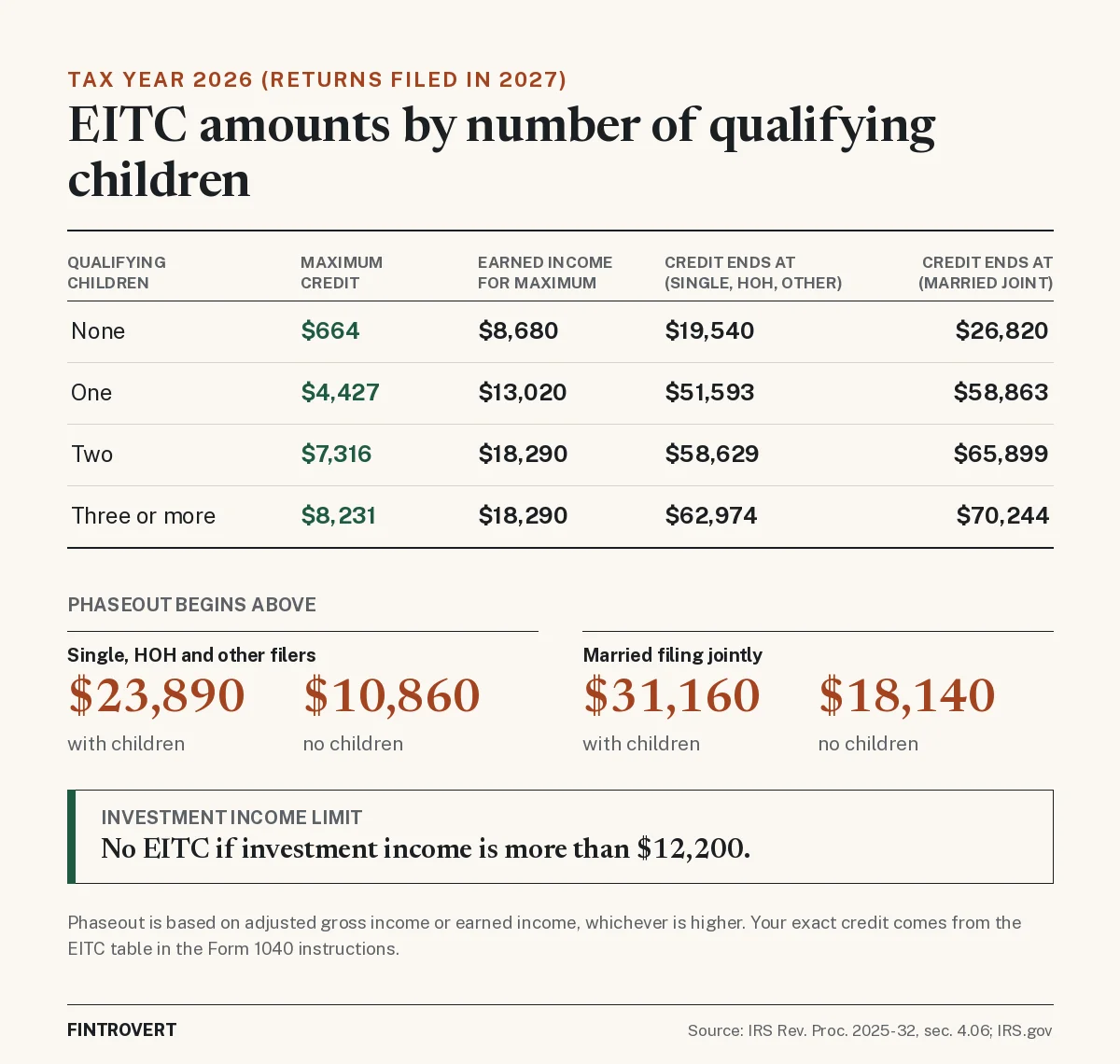
The credit starts to phase out once your adjusted gross income (or your earned income, if that’s higher) passes a threshold. For tax year 2026, that threshold is $23,890 for single, head of household and other filers with children, or $10,860 with no children. For married couples filing jointly, it’s $31,160 with children, or $18,140 with no children. Above the threshold, the credit gets smaller with each extra dollar until it reaches zero at the amounts in the table.
There’s also a cap on investment income, such as interest, dividends and capital gains. For tax year 2026, you can’t claim the EITC if that income is more than $12,200.
Filing a 2025 return now? Use these numbers
If you’re working on the return you’ll file in 2026, you need the tax year 2025 figures instead. According to the IRS EITC tables page, the 2025 maximum credit is $649 with no children, $4,328 with one child, $7,152 with two and $8,046 with three or more. The 2025 investment income limit is $11,950.
A quick example
Maria is a single parent with two kids. In 2026 she earns $20,000 from her job and has no other income. That’s more than the $18,290 needed for the full credit and less than the $23,890 point where the phaseout begins for her filing status. If she and her children meet all the other rules, she could claim the maximum $7,316 on the return she files in 2027.
If Maria earned $40,000 instead, she’d be in the phaseout range, so her credit would be smaller. She’d still get some EITC, since $40,000 is below the $58,629 cutoff. The exact amount comes from the EITC table in the Form 1040 instructions, or your tax software will work it out for you.
Who qualifies for the EITC
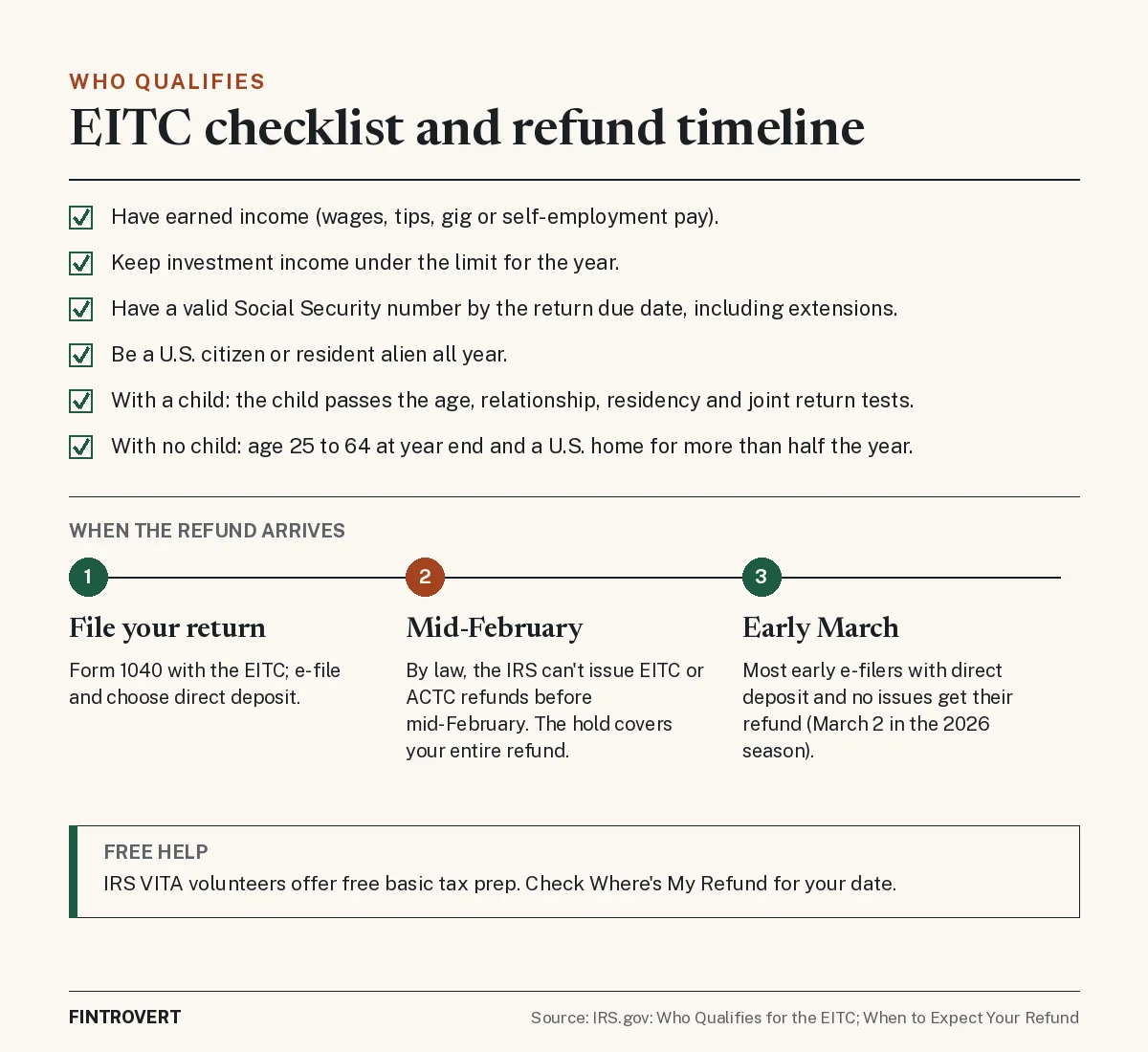
The IRS lists these basic rules. To claim the credit, you must:
- Have earned income.
- Keep your investment income under the limit for the year.
- Have a valid Social Security number by the due date of your return, including extensions.
- Be a U.S. citizen or resident alien all year.
- Not file Form 2555, which is used to exclude foreign earned income.
- Meet certain rules if you’re separated from your spouse and not filing a joint return.
What counts as earned income
Earned income is money you get from working. That includes wages, salaries and tips, pay from gig work like driving or delivery, and net earnings from your own business or farm. It does not include interest and dividends, pensions or annuities, Social Security benefits, unemployment benefits, alimony or child support.
The Social Security number rule
You, your spouse if you file jointly, and any child you claim must each have a valid SSN issued on or before your return’s due date, including extensions. An SSN issued only so someone could get a federally funded benefit, such as Medicaid, and that doesn’t authorize work doesn’t count for the EITC.
Qualifying child rules
Under the IRS qualifying child rules, a child must pass four tests:
- Age. Under 19 at the end of the year and younger than you (or your spouse, if filing jointly), or under 24 and a full-time student for at least five months of the year and younger than you. A child of any age who is permanently and totally disabled also counts.
- Relationship. Your son, daughter, stepchild, adopted child or eligible foster child, or your brother, sister, half-sibling or step-sibling, or your grandchild, niece or nephew.
- Residency. The child lived with you in the United States for more than half the year. The 50 states, Washington, D.C. and U.S. military bases count. U.S. territories such as Puerto Rico and Guam don’t.
- Joint return. The child can’t have filed a joint return for the year, for example with a spouse, unless it was only to get back tax withheld or estimated tax paid.
The child also needs a valid SSN, and only one person can claim the same child for the EITC.
Workers without children: the age rule
You can claim a smaller EITC with no qualifying child. On top of the basic rules, you must have lived in the United States for more than half the year, you can’t be someone else’s qualifying child or dependent, and you must be at least 25 but under 65 at the end of the year. If you’re married and filing jointly, only one spouse needs to meet the age rule.
How to claim the EITC
You have to file a federal tax return to get the credit, even if your income is low enough that you wouldn’t otherwise need to file. Here’s how it works, per the IRS page on how to claim the EITC:
- Check that you qualify. The IRS EITC Assistant on irs.gov walks you through the rules.
- File Form 1040 or 1040-SR. Report all your earned income.
- Add Schedule EIC if you have a qualifying child. It lists each child’s information. You don’t need it if you’re claiming the credit without a child.
- Complete Schedule 3-A for tax year 2026. The IRS says that starting with tax year 2026, anyone claiming the EITC must also complete Schedule 3-A, Federal Public Benefit.
- Choose direct deposit. Filing online with direct deposit is the fastest way to get your refund.
Missed the credit in an earlier year? You generally have three years from a return’s due date to claim a refund, so you may still be able to file or amend a past return to claim it.
When your refund will arrive
Under the Protecting Americans from Tax Hikes (PATH) Act, the IRS can’t issue refunds on returns that claim the EITC or the Additional Child Tax Credit before mid-February. The hold applies to your entire refund, not just the part from the credit. So if you file in late January, don’t plan on spending that money in early February.
For the 2026 filing season, the IRS said most early EITC filers who filed online, chose direct deposit and had no problems with their return could expect their refund by March 2. Expect a similar timeline each year, and check the IRS refund timing page or Where’s My Refund for your own date.
Free help filing: VITA
You don’t have to pay someone to claim the EITC. The IRS Volunteer Income Tax Assistance (VITA) program offers free basic tax prep from IRS-certified volunteers. It generally serves people who make about $70,244 or less, people with disabilities and taxpayers who speak limited English. The IRS doesn’t set one income limit for every site, so check with the site near you. VITA sites are often at community centers, libraries and schools, and the IRS site has a locator to find one.
Before you go, gather your W-2s and 1099s, photo ID, Social Security cards or ITIN letters for everyone on the return, and your bank routing and account numbers for direct deposit.
Common mistakes to avoid
- Claiming a child who doesn’t meet all four tests, especially the residency test.
- Two people, such as separated parents, claiming the same child.
- Leaving out side income, or reporting too much or too little self-employment income.
- Typos in names or Social Security numbers.
- Using the wrong year’s figures. Tax year 2026 numbers are for the return you file in 2027.
Mistakes can delay your refund, and an incorrect claim can lead to the IRS denying the credit. If you’re unsure, the EITC Assistant or a VITA volunteer can help.
The bottom line
If you work and earn a modest income, the earned income tax credit is worth checking every year. For tax year 2026, it’s worth up to $8,231 with three or more children and up to $664 with none. File a return even if you don’t have to, attach Schedule EIC if you have kids, and expect your refund after mid-February. To estimate your overall tax picture, try our federal income tax calculator or paycheck calculator, and find more guides like tax-loss harvesting and FSA vs HSA in our Taxes hub.
Written by the Fintrovert Team. This article is for general educational purposes and isn’t personalized tax advice. Figures are from the IRS and can change, so check irs.gov for the year you’re filing.