

Your Social Security check isn’t a random number, and it isn’t based on your last paycheck either. It comes out of a formula the Social Security Administration (SSA) applies to your whole work history. Once you see the steps, the math is pretty manageable. This guide walks through each piece of the Social Security benefits calculation: earning credits, averaging your best 35 years, the benefit formula with its “bend points,” and the adjustments that come after. We also run a full example with real dollar figures.
Step 1: Earn 40 credits to qualify
Before any math happens, you need to qualify. According to the SSA’s page on Social Security credits, you need 40 credits to be eligible for retirement benefits. You can earn up to four credits a year, so 40 credits usually means about 10 years of work.
In 2026, you earn one credit for every $1,890 in covered earnings, so $7,560 gets you the full four credits for the year. For 2027, the SSA has set the amount at $1,970 per credit (see the SSA quarter of coverage table). One thing people often get wrong: extra credits beyond 40 don’t raise your benefit. Credits only decide whether you qualify. Your earnings decide how much you get.
Step 2: Your highest 35 years, indexed for wage growth
The SSA looks at your earnings history and adjusts, or “indexes,” older earnings so they reflect how much average wages have grown since you earned them. A $30,000 salary from the 1990s counts for a lot more in today’s terms than it looks on paper. The SSA explains this on its Social Security Benefit Amounts page.
Here’s how the indexing works. Earnings are indexed to the national average wage index for the year you turn 60. Earnings from age 60 on count at face value, with no indexing. For example, for someone who turns 62 in 2027, the SSA uses the 2025 average wage index of 72,800.33 as the yardstick.
Then the SSA picks your 35 highest years of indexed earnings, adds them up, and divides by 420 (the number of months in 35 years). The result, rounded down to the next lower dollar, is your average indexed monthly earnings, or AIME. If you worked fewer than 35 years, the missing years count as zeros, which pulls your average down. That’s why a few extra working years can make a real difference for people with short or uneven careers.
Only earnings up to the yearly taxable maximum count. For details on the current cap, see our post on the Social Security wage base for 2027.
Step 3: The PIA formula and bend points
Your AIME goes into a formula that produces your primary insurance amount, or PIA. That’s the monthly benefit you’d get if you started exactly at your full retirement age. The formula gives you back a large share of your first dollars of average earnings and a smaller share of higher earnings, so lower earners replace a bigger portion of their pay.
The dollar amounts where the percentages change are called bend points. They depend on the year you first become eligible, which for retirement is the year you turn 62. Per the SSA bend points table, for someone first eligible in 2026 (born in 1964), the PIA is:
- 90% of the first $1,286 of AIME, plus
- 32% of AIME over $1,286 and through $7,749, plus
- 15% of AIME over $7,749.
The SSA has already published the 2027 bend points too: $1,340 and $8,077, which apply to people who turn 62 in 2027 (born in 1965). The percentages (90%, 32% and 15%) stay the same; only the dollar amounts move with wages. The SSA then rounds the result down to the next lower dime if it isn’t already a multiple of 10 cents, as described on its PIA formula page.
Worked example: turning earnings into a benefit
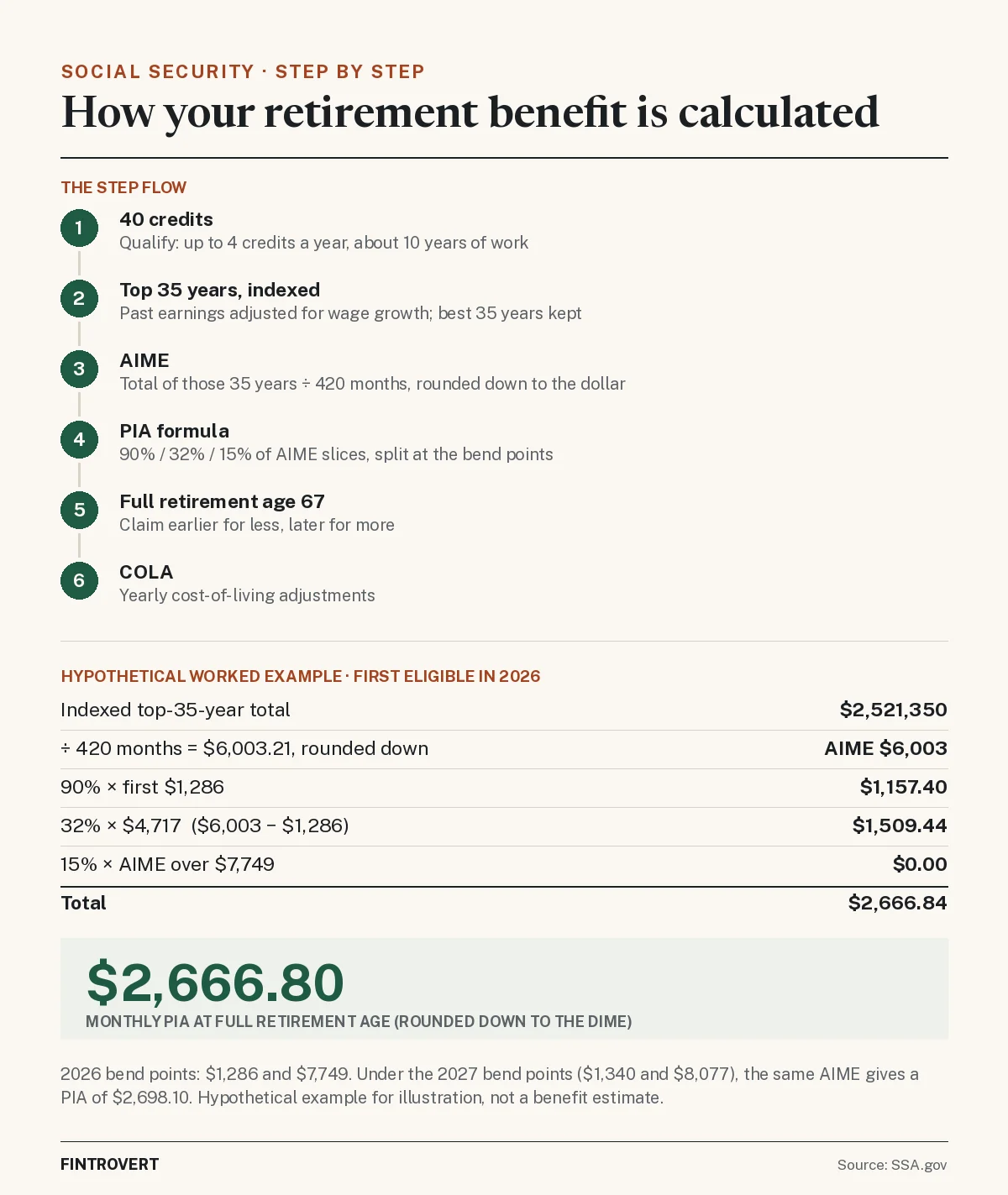
Say Maria turns 62 in 2026. After indexing, her 35 best years add up to $2,521,350.
- AIME: $2,521,350 divided by 420 months = $6,003.21, rounded down to $6,003.
- First tier: 90% of $1,286 = $1,157.40.
- Second tier: her AIME over $1,286 is $6,003 minus $1,286 = $4,717. 32% of $4,717 = $1,509.44.
- Third tier: her AIME is below $7,749, so nothing falls in the 15% tier.
- Total: $1,157.40 + $1,509.44 = $2,666.84, rounded down to the dime = $2,666.80 PIA.
That $2,666.80 is what Maria would get each month if she claims at her full retirement age, before any cost-of-living adjustments she picks up along the way. The actual monthly payment is then rounded down to the whole dollar. If she had turned 62 in 2027 instead, the same AIME run through the 2027 bend points would give a PIA of $2,698.10.
Step 4: Full retirement age
Your PIA is tied to your full retirement age. For anyone born in 1960 or later, that age is 67, according to the SSA’s retirement age chart. If you were born on January 1, the SSA treats you as if you were born the year before.
Step 5: Claiming early or late changes the check
You can start as early as 62, but your benefit is cut for each month before full retirement age. With a full retirement age of 67, claiming at 62 means about a 30% reduction, so a $1,000 benefit becomes $700 (SSA). Going the other way, for anyone born in 1943 or later, waiting past full retirement age earns delayed retirement credits of 8% a year (2/3 of 1% a month), up to age 70 (SSA).
Picking the right age depends on your health, savings, job and marriage. We cover that in our companion guide on when to claim Social Security.
Step 6: COLAs keep benefits up with inflation
Once you’re eligible, your benefit gets cost-of-living adjustments (COLAs) tied to the Consumer Price Index for Urban Wage Earners and Clerical Workers (CPI-W). COLAs start applying beginning with the year you turn 62, even if you haven’t claimed yet. The latest COLA is 3.6%, starting with December 2026 benefits that are paid in January 2027. Our post on the Social Security COLA for 2027 has more on what that means for your check.
How to see your own estimate
You don’t need to do all this by hand. A free my Social Security account lets you see your Social Security Statement, check your earnings record, and get estimates for claiming at different ages. Check your earnings history while you’re there. A missing year shows up as a zero in your 35-year average, and fixing it now is much easier than fixing it later.
Quick recap
- You need 40 credits to qualify. Extra credits don’t increase your benefit.
- Your 35 highest years of wage-indexed earnings become your AIME.
- The PIA formula pays 90%, 32% and 15% of different slices of your AIME. The 2026 bend points are $1,286 and $7,749, and the 2027 bend points are $1,340 and $8,077.
- Full retirement age is 67 if you were born in 1960 or later.
- Claiming early lowers your check, and waiting until 70 raises it.
- COLAs adjust your benefit every year. The latest is 3.6% for 2027.
For more retirement guides and tools, visit our Retirement hub. You can also see how your savings could stack up next to Social Security with our retirement calculator.
This article is general information, not financial, tax or legal advice. Social Security rules and yearly figures change, and your actual benefit depends on your own earnings record. Check your my Social Security account or contact the SSA for your personal figures.