

You spend decades putting money into tax-deferred retirement accounts. At some point, the IRS wants its share, and that’s where the required minimum distribution comes in. This guide covers when RMDs start, how to figure yours with the IRS table, the deadlines that trip people up, what happens if you miss one, and a few rules that can make the whole thing easier.
What is a required minimum distribution?
A required minimum distribution, or RMD, is the smallest amount you must withdraw from certain retirement accounts each year once you reach a set age. According to the IRS, the rules apply to traditional IRAs, SEP IRAs, SIMPLE IRAs, 401(k) plans, 403(b) plans, 457(b) plans, profit-sharing plans and other defined contribution plans. You can always take out more than the minimum. Withdrawals are taxed as ordinary income, except for any part that was already taxed (your basis).
When do RMDs start?
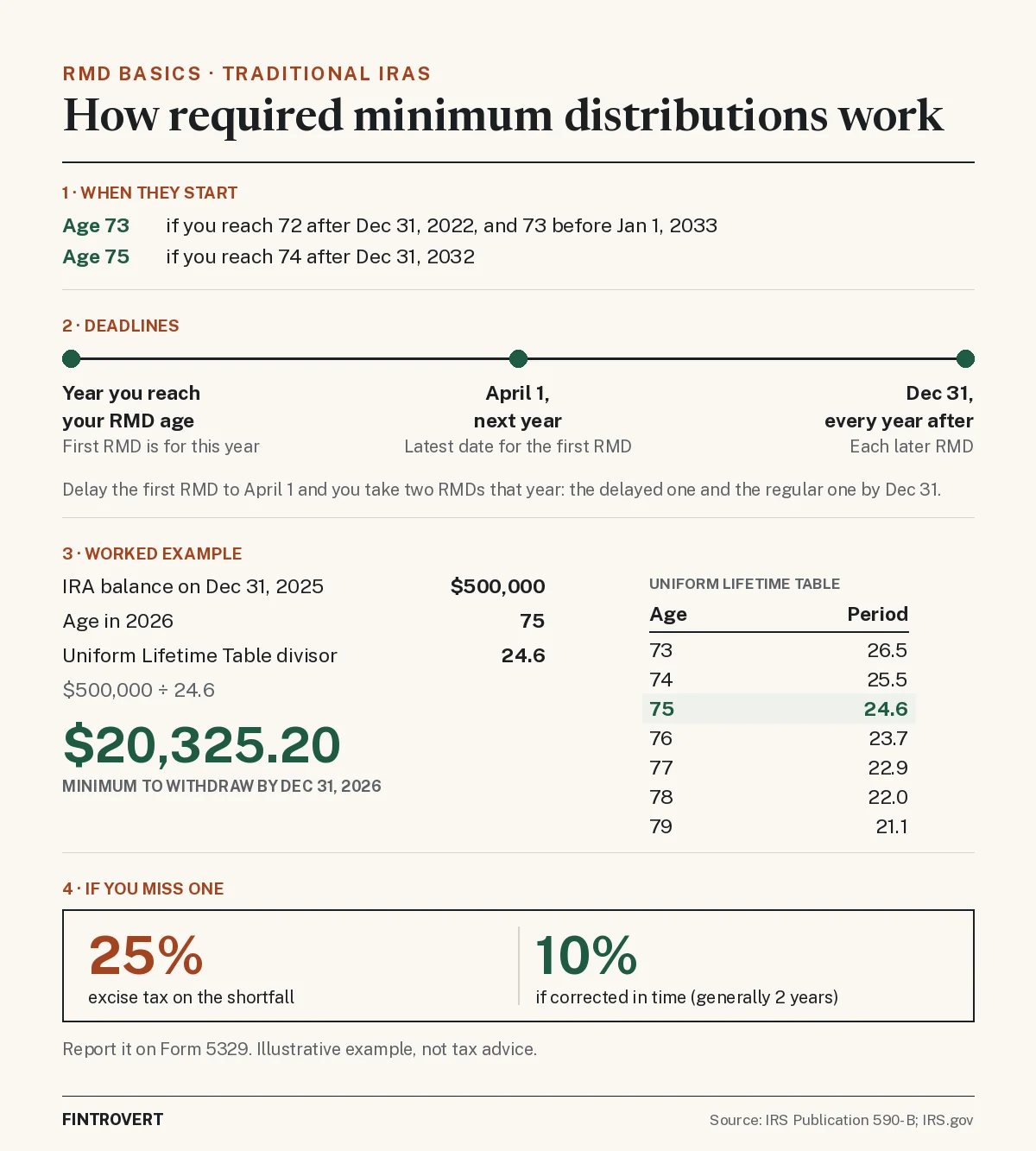
Under the SECURE 2.0 Act, the starting age is now 73. The IRS explains in its final RMD regulations (Internal Revenue Bulletin 2024-33) that the applicable age is 73 for people who reach age 72 after December 31, 2022, and age 73 before January 1, 2033. For people who reach age 74 after December 31, 2032, the applicable age rises to 75.
There’s one useful exception for workplace plans. If you’re still working, your 401(k) or similar plan may let you wait until the year you retire to start RMDs from that plan, as long as you don’t own 5% or more of the business. This exception doesn’t cover IRAs. IRA owners must start at the applicable age even if they’re still working, per the IRS RMD FAQs.
Which accounts don’t have RMDs?
Roth IRAs have never required withdrawals while the original owner is alive. Starting in 2024, the same is true for designated Roth accounts inside a 401(k) or 403(b). SECURE 2.0 removed the lifetime RMD requirement for those accounts for tax years beginning after December 31, 2023, as described in IRB 2024-33. Beneficiaries who inherit a Roth IRA or a Roth 401(k) are still subject to the RMD rules, though.
If you’re weighing Roth money against traditional money partly because of RMDs, our guide to Roth conversions and our Roth vs. traditional IRA calculator can help you think it through.
How to calculate your RMD
The formula is simple. Take the account balance as of December 31 of the prior year and divide it by the distribution period (the IRS calls it the applicable denominator) for your age that year. Most owners use Table III, the Uniform Lifetime Table, in IRS Publication 590-B. You use a different table, Table II, only if your spouse is your sole beneficiary and is more than 10 years younger than you.
Here are a few distribution periods from the Uniform Lifetime Table:
| Age that year | Distribution period |
|---|---|
| 73 | 26.5 |
| 74 | 25.5 |
| 75 | 24.6 |
| 76 | 23.7 |
| 77 | 22.9 |
| 78 | 22.0 |
| 79 | 21.1 |
A worked example
Say you turn 75 in 2026, and your traditional IRA held $500,000 on December 31, 2025. Your spouse isn’t more than 10 years younger than you, so you use the Uniform Lifetime Table. The distribution period for age 75 is 24.6.
$500,000 divided by 24.6 = $20,325.20. That’s the least you must withdraw from this IRA by December 31, 2026. Next year you’d repeat the math with your December 31, 2026 balance and the age 76 figure of 23.7.
If you have more than one traditional IRA, you figure the RMD for each one separately, but you can take the total from any one or more of them. That flexibility doesn’t extend to 401(k) or 457(b) plans. Each of those must pay out its own RMD, according to the IRS FAQs. Your custodian may calculate the number for you, but the IRS holds you responsible for getting it right.
RMD deadlines, including the first-year April 1 rule
Your first RMD is for the year you reach the applicable age, but you can wait until April 1 of the next year to take it. Every RMD after that is due by December 31.
Waiting has a catch. If you delay your first RMD to April 1, you’ll take two RMDs in that second year: the delayed one by April 1 and the regular one by December 31. The IRS gives this example: if you reach 73 in 2024, your first RMD is due by April 1, 2025, based on your December 31, 2023 balance, and your second is due by December 31, 2025, based on your December 31, 2024 balance. Two withdrawals in one year can push you into a higher tax bracket, so many people take the first one in the year they turn 73 instead. Our federal income tax calculator can show how an extra withdrawal changes your bill.
You also can’t get ahead. Withdrawing more than your RMD in one year doesn’t reduce what you owe in a later year, per Publication 590-B. And RMD amounts can’t be rolled over into another tax-deferred account.
What happens if you miss an RMD?
If you don’t withdraw enough, the shortfall may be hit with a 25% excise tax. That drops to 10% if you correct it in time, generally within two years, according to the IRS. So a missed $10,000 RMD could cost $2,500, or $1,000 if you fix it promptly. You report the tax on Form 5329.
The IRS can also waive the tax if the shortfall came from a reasonable error and you’re taking steps to fix it. To ask for relief, you file Form 5329 and attach a letter of explanation.
Inherited IRAs and the 10-year rule
Different rules apply when you inherit an account. For owners who died after December 31, 2019, most beneficiaries must empty the inherited account by December 31 of the year containing the 10th anniversary of the owner’s death. If the owner died in 2025, for example, the account must be fully paid out by December 31, 2035, per Publication 590-B.
Some beneficiaries are “eligible designated beneficiaries” and can generally stretch withdrawals over their own life expectancy instead. These are the surviving spouse, the owner’s minor child, a disabled or chronically ill person, and anyone not more than 10 years younger than the owner. Whether you must also take yearly RMDs during the 10 years depends on whether the owner had already reached their required beginning date. Inherited account rules get complicated quickly, so check the IRS page on beneficiaries or talk with a tax professional.
Qualified charitable distributions (QCDs)
If you give to charity, a QCD can take some of the sting out of RMDs. A QCD is a distribution your IRA trustee sends straight to an eligible charity. You must be at least 70½ when it’s made, and it can’t come from an ongoing SEP or SIMPLE IRA. The money isn’t included in your taxable income, and it counts toward your RMD for the year, per Publication 590-B.
The annual QCD limit is indexed for inflation. It was $108,000 for 2025, and IRS Notice 2025-67 raised it to $111,000 for 2026. If you’re married filing jointly, your spouse can make their own QCD up to the same limit. You can’t also deduct a QCD as a charitable contribution, and the check has to go directly from the IRA to the charity. If you take the cash first and donate it later, it doesn’t count.
A simple RMD checklist
- Note the year you reach your applicable age (73, or 75 for people who reach 74 after 2032).
- Find each account’s December 31 balance from the prior year.
- Divide by your distribution period from the Uniform Lifetime Table in Pub 590-B.
- Decide whether to take the first RMD in the year you reach that age or by April 1 of the next year.
- Take every later RMD by December 31.
- Consider a QCD if you give to charity anyway.
- If you miss one, withdraw it quickly and file Form 5329.
RMDs are one piece of a bigger retirement plan. You can find more guides and tools on our Retirement page, and our 401(k) calculator shows how much your savings could grow before RMDs begin. To see your whole picture, including the income your savings could support, try our retirement calculator.
This article is general information, not tax or legal advice. Rules can change, so check IRS.gov or a qualified tax professional for your situation.