

If your employer offers both a flexible spending account and a health savings account, or you’re picking a health plan during open enrollment, you’ve probably wondered which one is the better deal. The short answer on FSA vs HSA: both let you pay for medical costs with pre-tax money, but they work very differently once you look at who can open one, how much you can put in, and what happens to money you don’t spend. This guide lays out the rules side by side, with the current IRS limits, so you can pick the account that fits your situation.
The quick answer
An HSA is usually the stronger account if you qualify for one, because the money is yours to keep, it rolls over every year, and it can be invested for the long run. The catch is that you can only contribute to an HSA if you’re covered by a high deductible health plan (HDHP). A health FSA is open to more people through their employer, but it’s mostly a “spend it this year” account. Many people don’t actually get to choose: your health plan decides which one you can use.
What is a health FSA?
A health flexible spending arrangement is an account set up through your employer’s cafeteria plan. You choose how much to set aside for the year, and that amount comes out of your paychecks before taxes. You then use it for qualified medical expenses like copays, prescriptions, dental work and glasses. According to IRS Publication 969, a few rules shape how an FSA works:
- Your full election is available early. You can be reimbursed up to the full amount you elected at any time during the coverage period, even if you haven’t contributed that much yet.
- It’s generally use-it-or-lose-it. Money left at the end of the plan year is usually forfeited, unless your plan offers a grace period of up to 2 1/2 months or a limited carryover. A plan can offer one or the other, not both.
- It stays with the employer. Your employer isn’t allowed to refund unused money to you, and the account is tied to that job.
What is an HSA?
A health savings account is a tax-exempt account you own. You, your employer, or even a family member can put money in, but only while you’re an eligible individual. Per IRS Publication 969, that generally means you’re covered by an HDHP, you have no other disqualifying health coverage, you aren’t enrolled in Medicare, and no one can claim you as a dependent. HealthCare.gov has a plain explainer on what counts as a high deductible health plan.
The HSA is often described as having a triple tax advantage. Contributions are tax-deductible (or pre-tax through payroll), the account grows tax free, and withdrawals for qualified medical expenses aren’t taxed. The IRS also points out that an HSA is portable: it stays with you if you change jobs or leave the workforce, and the balance carries over from year to year.
FSA vs HSA contribution limits
The IRS adjusts both limits for inflation each year. As of early November 2026, the IRS has published the 2027 HSA limits but has not yet released the 2027 health FSA limit, so the FSA figures below are the official 2026 numbers.
- Health FSA, 2026: up to $3,400 in salary reduction contributions. If your plan allows a carryover, the most you can carry into the next plan year is $680. Source: IRS Rev. Proc. 2025-32.
- HSA, 2026: $4,400 for self-only coverage and $8,750 for family coverage. Source: IRS Rev. Proc. 2025-19.
- HSA, 2027: $4,500 for self-only coverage and $9,000 for family coverage. Source: IRS Rev. Proc. 2026-24.
- HSA catch-up: if you’re 55 or older, you can add an extra $1,000 a year, per IRS Publication 969.
For a closer look at next year’s numbers, see our guide to 2027 HSA contribution limits.
What counts as a high deductible health plan
To open or fund an HSA, your plan has to meet the IRS minimum deductible and stay under the out-of-pocket maximum:
- 2026: deductible of at least $1,700 (self-only) or $3,400 (family), with out-of-pocket costs capped at $8,500 (self-only) or $17,000 (family).
- 2027: deductible of at least $1,750 (self-only) or $3,500 (family), with out-of-pocket costs capped at $8,700 (self-only) or $17,400 (family).
Sources: Rev. Proc. 2025-19 and Rev. Proc. 2026-24.
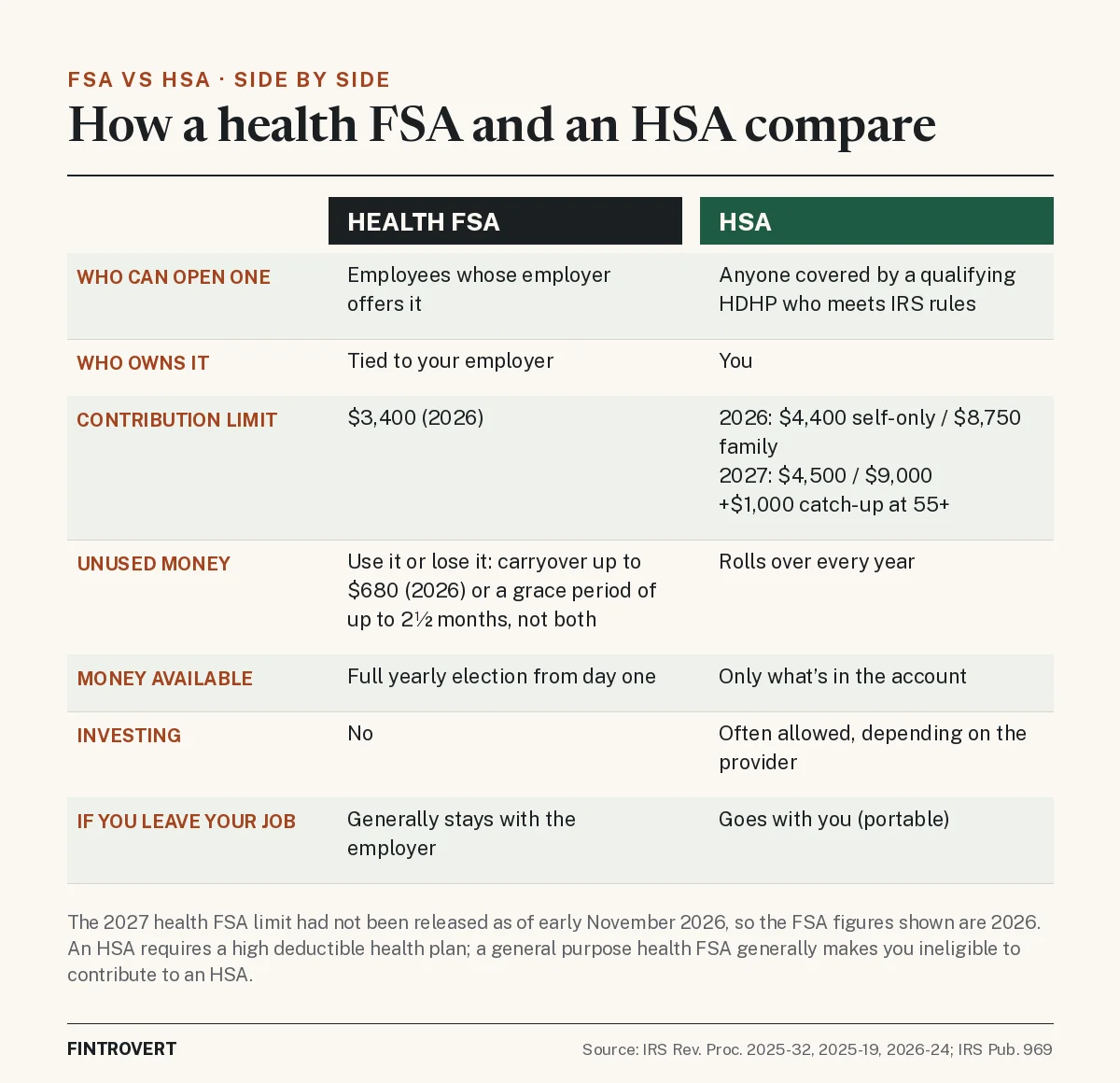
Side-by-side comparison
| Feature | Health FSA | HSA |
|---|---|---|
| Who can open one | Employees whose employer offers it | Anyone covered by a qualifying HDHP who meets IRS rules |
| Who owns it | Tied to your employer | You |
| Contribution limit | $3,400 (2026) | $4,400 self-only / $8,750 family (2026); $4,500 / $9,000 (2027) |
| Unused money | Usually forfeited, unless a grace period or carryover ($680 max for 2026) applies | Rolls over every year |
| Money available | Full yearly election from the start of the plan year | Only what’s in the account |
| Investing | No | Often allowed, depending on the provider |
| If you leave your job | Generally stays with the employer | Goes with you |
| Non-medical withdrawals | Not allowed | Taxed, plus a 20% additional tax before age 65 |
When an HSA is the better choice
If you’re healthy, rarely see a doctor, and can handle a higher deductible, an HDHP paired with an HSA can work out well. You keep every dollar you don’t spend, and over time the account can grow into a real cushion for future medical costs, including in retirement. If you want to see how an HSA fits with the rest of your savings, try our retirement calculator. Once you reach 65, the IRS says the 20% additional tax no longer applies to non-medical withdrawals, though you’ll still owe regular income tax on them. That’s why some people treat an HSA as a second retirement account.
When an FSA makes more sense
An FSA is a good fit if your plan isn’t an HDHP, or if you know you’ll have steady, predictable expenses this year, such as regular prescriptions, braces or a planned procedure. Because your full election is available on day one, it can help with a big bill early in the year. The key is to estimate carefully. Add up what you spent last year and plan for known costs, so you don’t end up putting in more than you’ll use. For bigger costs you see coming, a sinking fund can cover what the FSA doesn’t.
Can you have both?
Usually not a regular one. A general purpose health FSA counts as other health coverage, which makes you ineligible to contribute to an HSA. The exception is a limited-purpose health FSA. IRS Publication 969 says you can still contribute to an HSA while covered by an HDHP and a limited-purpose FSA, which can pay for items like dental and vision care, plus preventive care. If your employer offers one, it lets you use both accounts in the same year. Watch out for grace periods too: IRS Publication 969 notes that grace-period coverage from a general purpose FSA is only allowed for HSA purposes if your FSA balance at the end of the prior plan year is zero. If your spouse has a general purpose FSA that can pay your expenses, that can also affect your eligibility, so check with your benefits team.
How to decide
- Check which health plans your employer offers. If you aren’t in an HDHP, the FSA is likely your only option of the two.
- If you are in an HDHP, an HSA usually wins because the money rolls over and stays yours.
- Estimate your medical costs for the year before choosing an FSA amount.
- Ask whether your FSA has a grace period or a carryover, and how much.
- If you open an HSA, see whether your provider lets you invest the balance and what the fees are.
Both accounts can save you real money on taxes. The best one is the one your health plan allows and that matches how you actually spend on care. For more ways to cut your tax bill, see our guide to tax-loss harvesting, and browse the rest of our saving and credit guides. If you’re unsure, your HR or benefits department can tell you exactly what your plan offers.
By Fintrovert Team. This article is for general education and isn’t tax or legal advice. Figures come from IRS publications current as of November 2026.
1 thought on “FSA vs HSA: Which Is Better?”