

By Fintrovert · Last updated: October 24, 2026
The Social Security wage base for 2027 is $192,300, up from $184,500 in 2026 (SSA, Contribution and Benefit Base). Once you earn more than that in a year, you stop paying the 6.2% Social Security tax for the rest of the year. Here’s what that means for your paycheck.
1. What the wage base is
The wage base, also called the taxable maximum, is the most earnings that can be taxed for Social Security in a year. It’s also the cap on earnings that count toward your future benefit. SSA adjusts it every year based on the national average wage index.
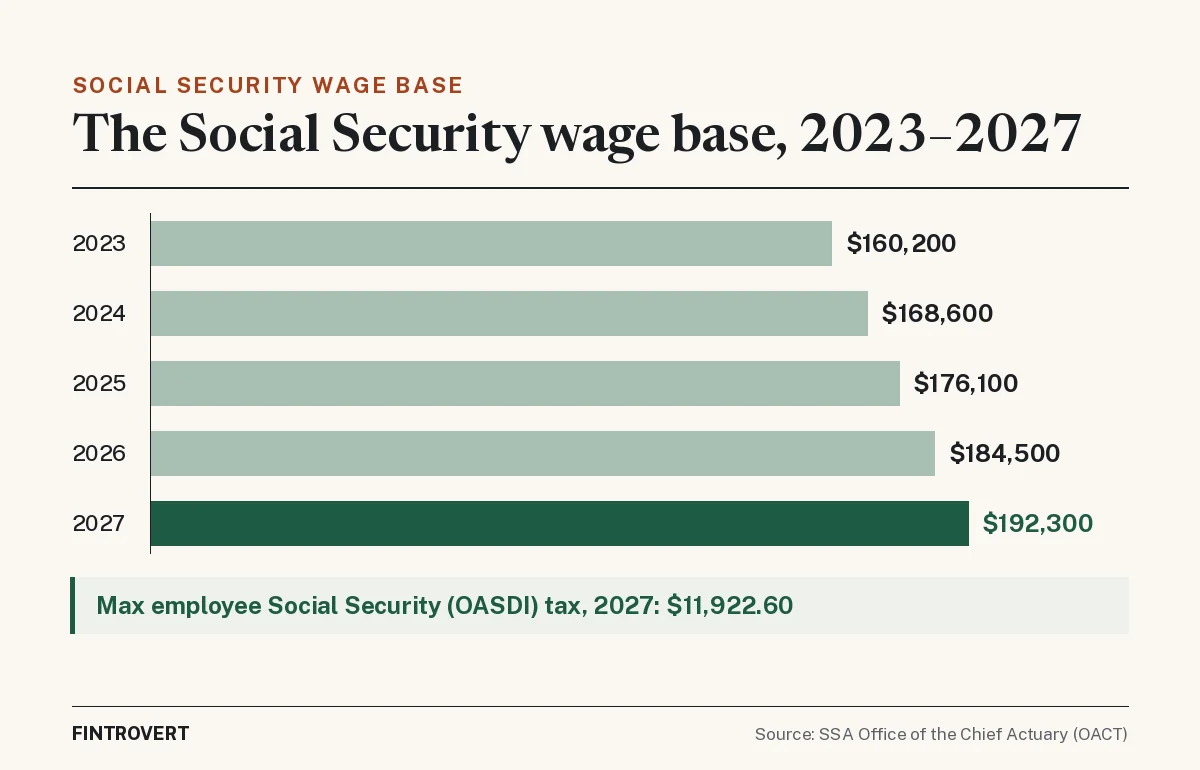
| Year | Wage base |
|---|---|
| 2023 | $160,200 |
| 2024 | $168,600 |
| 2025 | $176,100 |
| 2026 | $184,500 |
| 2027 | $192,300 |
2. The maximum Social Security tax in 2027
At 6.2%, the most an employee can pay in 2027 is $11,922.60. Your employer pays the same amount, for a combined total of $23,845.20.
3. Medicare has no cap, plus the 0.9% additional tax
Medicare tax is 1.45% for you and 1.45% for your employer, and it applies to every dollar you earn. There’s no wage base for it (IRS Topic 751). Your employer also has to withhold an extra 0.9% Additional Medicare Tax on your wages above $200,000 in a calendar year, no matter your filing status. There’s no employer match on that. When you file, the threshold is $250,000 for married couples filing jointly (SSA fact sheet), and you settle the difference on Form 8959.
4. Self-employed rates
If you’re self-employed, you pay both halves yourself: 12.4% for Social Security on earnings up to $192,300, plus 2.9% for Medicare on all of it, for a total of 15.3%. The 0.9% additional tax applies above the same thresholds. You can deduct half of your self-employment tax on your federal return.
5. Two jobs? You may get a refund
Each employer withholds Social Security tax on its own, up to the full wage base, so with two jobs you can end up paying too much. If your combined wages go over $192,300, you claim the excess as a credit on your 2027 federal tax return. That only works if the extra came from more than one employer. If a single employer withheld too much, you have to ask that employer for the refund.
5.1 Example
Job A pays $130,000 and Job B pays $90,000, for $220,000 in total. Each employer withholds 6.2%: $8,060 + $5,580 = $13,640. The most you owe is $11,922.60, so you’d claim back $1,717.40.
6. Example paychecks
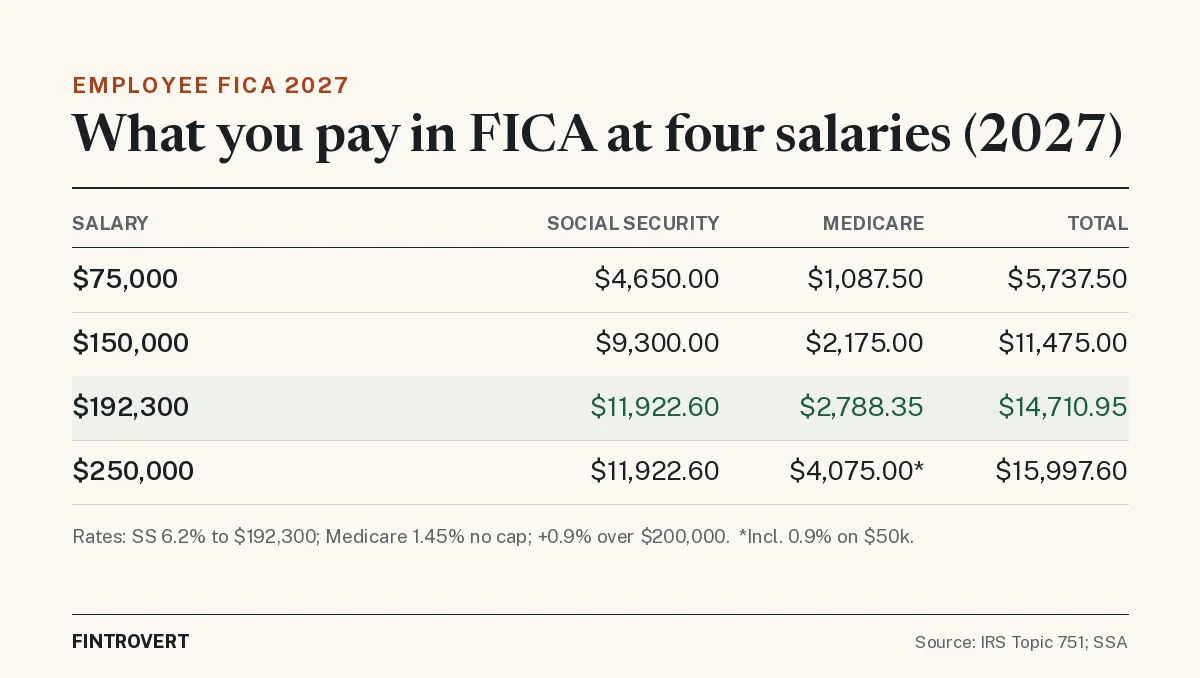
| Annual salary | Social Security (6.2%) | Medicare (1.45% + 0.9% over $200k) | Total employee FICA |
|---|---|---|---|
| $75,000 | $4,650.00 | $1,087.50 | $5,737.50 |
| $150,000 | $9,300.00 | $2,175.00 | $11,475.00 |
| $192,300 | $11,922.60 | $2,788.35 | $14,710.95 |
| $250,000 | $11,922.60 | $4,075.00 | $15,997.60 |
If you earn $250,000 and get paid every two weeks, Social Security tax stops after about the 20th paycheck. That’s when your year-to-date pay passes $192,300. Your take-home pay goes up by roughly $596 per paycheck for the rest of the year.
To see how this plays out on your own pay, try our paycheck calculator.
7. What to do with the extra take-home pay
If you hit the cap, think about sending that late-year bump straight into savings or investments. Our guide to the basics of stock market investing in the USA is a good place to start, and we also compare the pros and cons of real estate investment.
8. FAQs
What is the Social Security wage base for 2027?
$192,300.
What is the most Social Security tax I can pay in 2027?
$11,922.60 as an employee, or $23,845.20 in Social Security tax if you’re self-employed.
Is there a cap on Medicare tax?
No. And wages above $200,000 get an extra 0.9% withheld.
I overpaid because I had two jobs. How do I get it back?
Claim the excess as a credit when you file your federal tax return.
For general information only, not tax advice. Figures from SSA and IRS sources linked above.